Panda Tetra
Nematobrycon palmorei
Overview
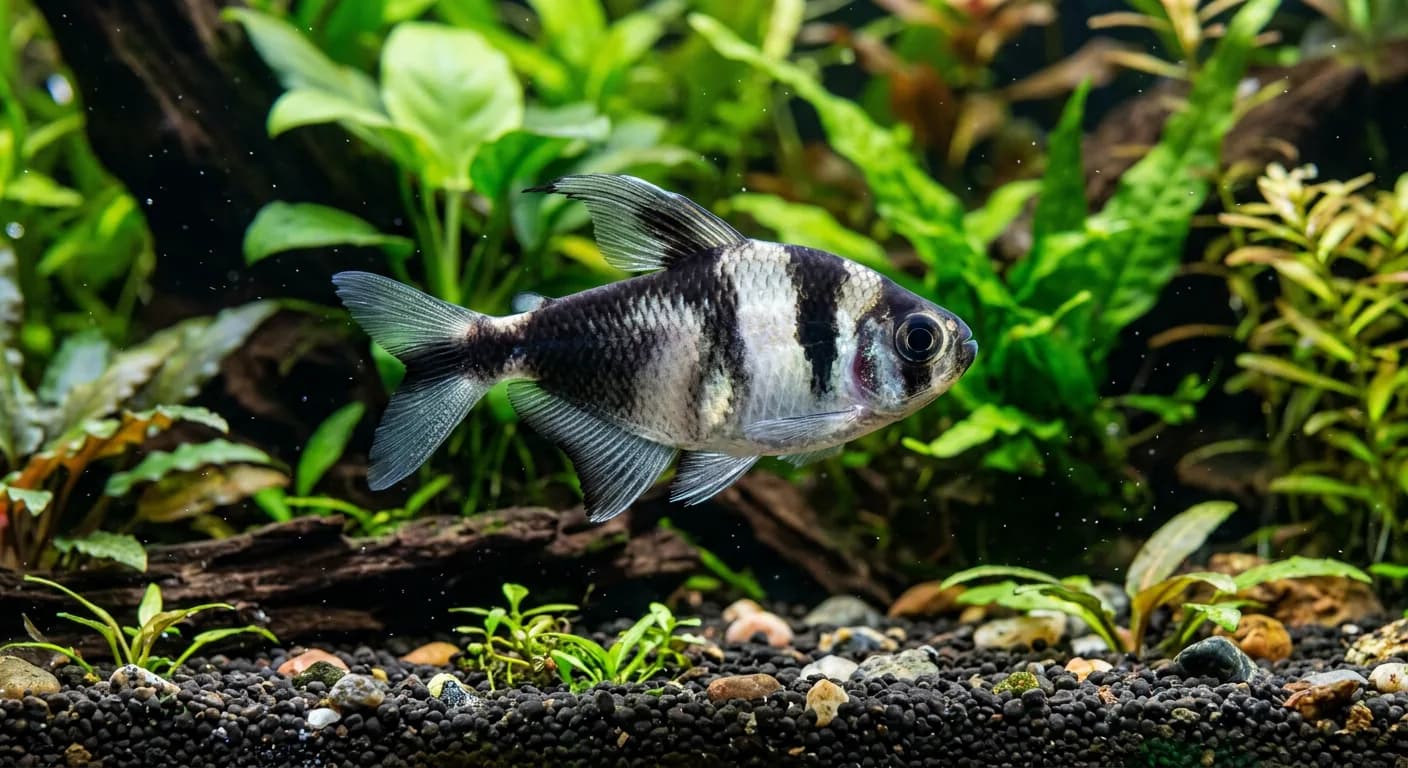
The panda tetra is one of those underappreciated gems that deserves way more attention in the aquarium hobby. Despite its name, it is not actually a tetra but a characin in the family Characidae. What makes this fish special is its subtle but striking coloration: a translucent body with a bold black stripe running from the eye to the tail, accented by a splash of yellow in the dorsal fin and a red or orange spot at the base of the tail. They have a graceful, almost elegant swimming style that adds movement and life to any community tank. Panda tetras are peaceful schooling fish that do best in groups of six or more. In a group, they display more confidence and natural behaviors, including the occasional territorial sparring between males. They are active without being chaotic, making them a versatile choice for both planted tanks and community setups. The name comes from their dark eye stripe which gives them a panda-like facial marking, though the comparison is more subtle than the name suggests.
Tank Setup
A 20-gallon tank is the absolute minimum for a small group of panda tetras, but a 30-gallon is ideal and allows for a larger school and better tankmate options. These fish come from the rivers of Colombia in South America, where the water is warm, slightly acidic, and stained with tannins from decaying vegetation. They appreciate a planted tank with floating plants to diffuse overhead lighting, which brings out their best coloration. Java fern, anubias, amazon sword, and moss all work well. Use dark substrate like flourite black sand to make their colors pop. Filtration should be moderate, turning over the tank 4-6 times per hour. A hang-on-back filter or sponge filter works well for a 20-30 gallon setup. They do not need strong current. Keep the water slightly acidic to neutral (pH 6.0-7.5) with soft to moderately hard water (2-10 dGH). Weekly water changes of 20-25 percent maintain water quality. A lid is recommended as they may jump when startled, though it is less common than with other characins.
Water Parameters
Panda tetras are adaptable fish that have been tank-bred for generations, making them more forgiving than wild-caught species. They do best in water temperatures between 73 and 82 degrees, with 77 being ideal. pH should range from 6.0 to 7.5, leaning toward the lower end to mimic their natural habitat. They tolerate soft to moderately hard water, though extremely hard water can cause health issues over time. Ammonia and nitrite must always be zero. Nitrates should stay below 20 ppm with regular water changes. These fish are somewhat sensitive to sudden parameter changes, so when adding them to a new tank or during water changes, match the temperature and drip slowly. Their colors are a good indicator of health: well-kept panda tetras display bright fin edges and clear body transparency. Dull colors often signal poor water quality or stress.
Diet & Feeding
Panda tetras are not picky eaters and will accept most foods offered. A quality flake or micro pellet forms the staple diet. They are mid-water feeders that will take food from the surface and as it drifts down. Supplement with frozen bloodworms, brine shrimp, or daphnia 2-3 times per week to maintain optimal health and encourage breeding behavior. Live foods like baby brine shrimp or mosquito larvae trigger the best color and activity. Feed twice daily, offering only what they consume in 2-3 minutes. These fish are peaceful feeders and may be outcompeted by more aggressive eaters, so watch that everyone gets their share in a community tank. A varied diet with some vegetable matter (spirulina flakes or blanched vegetables) supports overall health. Avoid overfeeding, as panda tetras are prone to bloating if given too much protein-rich food at once.
Behavior & Temperament
Panda tetras are peaceful, schooling fish that spend most of their time in the middle of the water column. They are active but not frantic, adding graceful movement to the tank without causing stress to more timid tankmates. In a group of six or more, they display natural schooling behavior and will often swim together in a coordinated group. Males occasionally spar with each other, spreading their fins and displaying, but these confrontations rarely result in injury. They are compatible with most peaceful community fish and do well in planted tanks. Their transparency makes them look delicate, but they are actually quite hardy once established. They may be shy initially in a new tank but will become more confident as they settle in. A well-planted tank with dimmer lighting helps them feel secure and encourages natural behavior. They are not aggressive and will not nip fins, making them safe for tanks with long-finned tankmates.
Compatible Tankmates
Panda tetras are excellent community fish that pair well with a wide variety of peaceful species. They do well with other small to medium-sized community fish including corydoras (bronze, sterbai, panda, pygmy), rasboras (harlequin, chili, exclamation), and other tetras (cardinal, neon, ember, rummy-nose). Bottom-dwellers like kuhli loaches and corydoras make good tankmates. Peaceful plecos like bristlenose or rubber lip work well. Snails (mystery, nerite) are always safe additions. Smaller gouramis like honey, pearl, or dwarf gourami are compatible. Avoid large, aggressive fish like cichlids, bettas (especially long-finned varieties), or fish large enough to eat them. Fast swimmers and fin nippers like tiger barbs will stress or harass panda tetras. Goldfish are not compatible due to temperature requirements.
Common Health Issues
Panda tetras are generally hardy fish when kept in appropriate conditions. The most common health issue is ich, which appears as white spots on the body and fins. It is usually triggered by stress or temperature fluctuations. Treat by raising the water temperature to 86 degrees over 48 hours and adding aquarium salt. Fin rot can occur in poor water quality and is identified by frayed or discolored fins. Address with improved water quality and, if needed, antibacterial medication. They can be susceptible to fungal infections, which show as white cottony growths. These typically respond to good water quality and antifungal treatments like malachite green. Internal parasites may cause weight loss despite normal eating. Medicated food with praziquantel handles most intestinal parasites. The best prevention is consistent water quality, appropriate temperature, and a varied, nutritious diet. Quarantine new fish for at least two weeks before adding them to the main tank.
Breeding
Breeding panda tetras is moderately challenging and rewarding for intermediate aquarists. They are egg scatterers that do not provide parental care. To trigger spawning, condition a group with high-protein foods like live or frozen bloodworms and baby brine shrimp for 1-2 weeks. Set up a separate breeding tank (10-20 gallons) with slightly lower pH (6.0-6.5), soft water, and plenty of fine-leaved plants or spawning mops. The temperature should be around 78-80 degrees. Males will display to females, chasing them among the plants. Spawning typically occurs in the early morning. A single female can lay 100-200 eggs, scattering them among plants. Remove adults after spawning, as they will eat the eggs. Eggs hatch in 24-48 hours depending on temperature. The fry are tiny and need infusoria or liquid fry food for the first week, then can be transitioned to baby brine shrimp. Fry grow slowly and reach sexual maturity at around 6-8 months. Raising the fry is the most challenging part of breeding panda tetras.
Tankmates to Avoid
These species don't mix well with Panda Tetra. Tap a name for the full breakdown.
Frequently Asked Questions
Quick Stats
What You Need for Panda Tetra
Gear that works well for this species, based on what experienced keepers actually use.
Rated for tanks up to 30 gallons with excellent biological filtration. The multi-stage filtration handles the bioload of a panda tetra school while maintaining stable water parameters. Adjustable flow rate lets you dial down the current for these peaceful swimmers.
Adjustable heater suitable for 20-40 gallon tanks. Provides consistent heat within the 73-82F range panda tetras need. Compact design fits easily in smaller tanks without taking up swimming space. Includes suction cups for secure placement.
Complete test kit measures pH, ammonia, nitrite, and nitrate. Essential for monitoring water quality in a panda tetra tank, where these fish are sensitive to parameter swings. Accurate liquid tests are more reliable than strip tests.
Insect-based formula with black soldier fly larvae as the first ingredient. High protein content supports health and color in panda tetras. The small flake size is perfect for these mid-water feeders. Tropical formula works well as a daily staple.