Platy
Xiphophorus maculatus
Overview
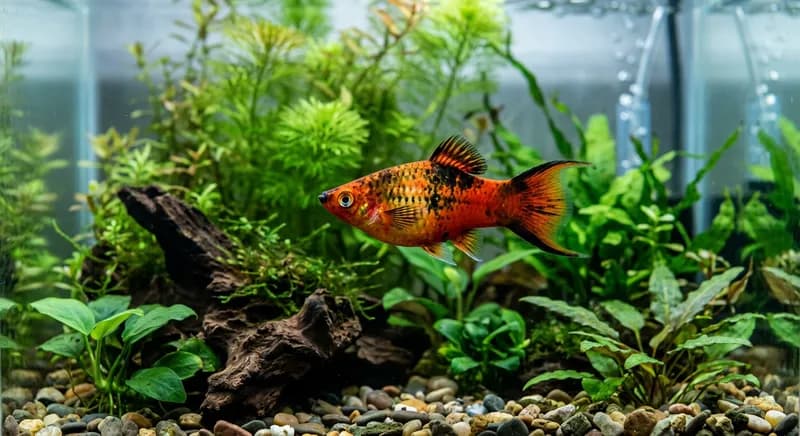
Platies are the goldilocks of community fish. They are colorful, hardy, easy to feed, and get along with almost everything. They come in dozens of color morphs from solid red to sunset orange to blue with black tails. The catch? Buy a male and a female, and you will have 30 platies within two months. They are livebearers, which means live babies instead of eggs, and they breed whether you want them to or not.
Tank Setup
A 10-gallon tank works for a small group of 3-4 platies, but a 20-gallon gives them more room and handles the inevitable fry explosion better. Platies are active mid-level swimmers, so horizontal swimming space matters more than height. Use any standard filter rated for your tank size. A hang-on-back filter or sponge filter both work fine. Substrate is dealer's choice since platies don't interact with it much. Gravel or sand, whatever looks good to you. Add a mix of live plants and open swimming areas. Platies appreciate some floating plants for cover, and their fry will hide in dense plant growth like java moss or hornwort. A heater keeps things stable, though platies tolerate a wider temperature range than most tropicals. A lid is a good idea since platies can jump when startled.
Water Parameters
Platies prefer slightly alkaline, harder water in the 7.0-8.2 pH range. This makes them a great choice if your tap water runs hard and alkaline, which is common in much of the US. Temperature between 70-80 degrees Fahrenheit, with 76 being the sweet spot. They are less sensitive to water chemistry than many tropicals, but they still need a cycled tank and consistent maintenance. Do 25% water changes weekly. Always use water conditioner. Test your water with a liquid test kit (not strips) if anything looks off. Ammonia and nitrite should always read zero in a cycled tank.
Diet & Feeding
Platies eat basically anything. A quality tropical flake food is the staple. Supplement with blanched zucchini, shelled peas, frozen bloodworms, or frozen brine shrimp a couple times per week. Feed a small pinch twice daily, only what they can finish in about 2 minutes. Platies graze on algae throughout the day, so a bit of algae growth in your tank is actually beneficial. Overfeeding is the most common mistake with platies because they always look hungry. They are begging, not starving. Trust the schedule, not the fish.
Behavior & Temperament
Platies are peaceful, active, and social. They don't form tight schools but loosely shoal together and explore the tank. Males will chase females for mating, which is constant and can stress females out if the ratio is wrong. Keep at least 2 females per male to spread the attention around. If you only want males, an all-male group works fine and eliminates breeding entirely. Platies are not aggressive but can be mildly pushy during feeding. They occupy the middle and top of the water column most of the time.
Compatible Tankmates
Platies get along with almost every peaceful community fish. Mollies, swordtails, corydoras, tetras, rasboras, and peaceful barbs are all solid choices. Avoid anything large enough to eat them or aggressive enough to harass them. Bettas are a poor match since the platy's active swimming and bright colors can trigger aggression from a territorial betta. Cherry shrimp adults will coexist but platies will eat shrimplets, so don't expect a breeding shrimp colony in a platy tank. Snails like nerites and mysteries are totally safe.
Common Health Issues
Platies are hardy but not bulletproof. Ich is the most common disease, showing up as white salt-like spots on the body and fins. Raise temperature to 82 degrees and treat with ich medication. Fin rot can occur from poor water quality. Clean water usually resolves early cases. Internal parasites can cause wasting (fish eating but getting thinner). Treat with medicated food containing praziquantel. Female platies can develop pregnancy complications if stressed. A sunken belly after appearing pregnant may indicate she absorbed or lost the fry internally. Not much you can do except keep water clean and reduce stress.
Breeding
You don't breed platies. Platies breed themselves. If you have males and females in the same tank, you will get fry. A female can store sperm for months and produce a new batch of 20-40 fry every 4-6 weeks. Fry are born fully formed and swimming. In a planted tank, some will survive by hiding in dense plant cover. In a bare tank, adults will eat most of them. If you want to raise fry deliberately, use a separate 5-10 gallon grow-out tank with a sponge filter. Move the pregnant female when her belly is very large and her gravid spot (dark area near the anal fin) is prominent. Remove her after she drops fry so she doesn't eat them. Feed fry crushed flake food or baby brine shrimp 3-4 times daily.
Tankmates to Avoid
These species don't mix well with Platy. Tap a name for the full breakdown.
Frequently Asked Questions
Quick Stats
Related Guides
Compare
What You Need for Platy
Gear that works well for this species, based on what experienced keepers actually use.
Quiet, reliable hang-on-back filter with adjustable flow. Handles the bioload from a platy community tank without creating too much current.
Solid all-around tropical flake that platies go crazy for. Good protein content and doesn't cloud the water as fast as cheaper brands.
Adjustable temperature dial with auto shutoff. Keeps a 10-20 gallon tank stable without overheating.
Liquid test kit that covers ammonia, nitrite, nitrate, and pH. Way more accurate than test strips and lasts hundreds of tests.