Celestial Pearl Danio
Danio margaritatus
Overview
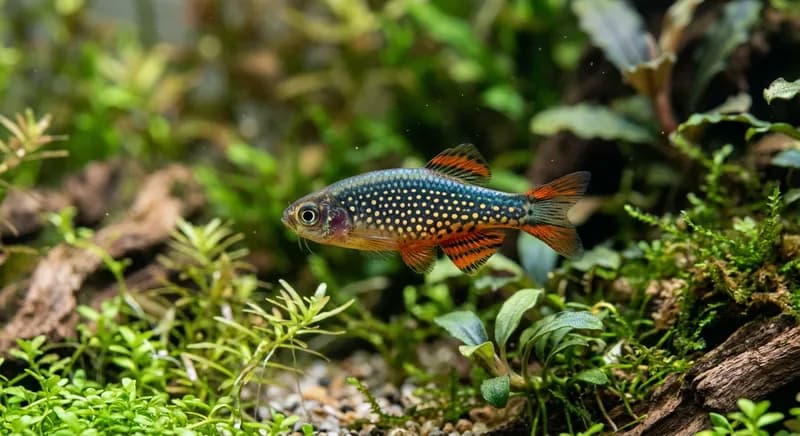
Celestial pearl danios were discovered in Myanmar in 2006 and instantly became one of the most sought-after nano fish. When photos first circulated online, a lot of people thought they were fake. The coloring is that striking: a deep blue-black body covered in tiny pearl-white spots, with fins banded in red and black. Males are brighter, with deeper blue bodies and more vivid red fins. Females are slightly duller with rounder bellies. The initial collection rush actually threatened wild populations, but captive breeding programs caught up quickly and most fish sold today are tank-bred. You might still see them labeled as "galaxy rasboras" in pet stores, which was their common name before they were formally described as a danio species. They are shy, small (barely an inch), and need a planted tank to feel secure. When they are comfortable, they reward you with one of the best color displays in the freshwater hobby.
Tank Setup
A 10-gallon tank is the minimum for a group of 6-8. A 15-gallon gives better results and lets you keep a larger group, which brings out more natural behavior. Heavy planting is not optional with this species. They are naturally found in shallow, densely vegetated pools, and they will hide constantly if the tank feels open. Use plants like java moss, dwarf hairgrass, rotala, and floating plants to create a layered environment. Leave some open patches in the front for viewing. Dark substrate helps their colors stand out. Filtration should be gentle since they come from still or slow-moving water. A small sponge filter is the standard choice. Keep water movement minimal.
Water Parameters
Temperature between 73-79 degrees Fahrenheit, with 75 as the ideal. This is cooler than many tropical fish, which limits tankmate options somewhat. They come from high-altitude habitats in Myanmar where water is relatively cool. pH of 6.5 to 7.5 is fine, and most tap water works after dechlorination. Soft to moderately hard water is preferred. Weekly 20-25% water changes are sufficient. These fish are small and produce very little waste, so a mature planted tank stays stable with minimal intervention. Avoid sudden parameter swings, which stress them more than slightly imperfect numbers.
Diet & Feeding
Celestial pearl danios need small food. Their mouths are tiny even by nano fish standards. Crush flakes into fine pieces, or use a micro pellet designed for small fish. Frozen baby brine shrimp, frozen cyclops, and vinegar eels are excellent supplements. Feed once or twice daily, a small amount that the group finishes in 60 seconds. They feed mostly in the mid-water column but will pick food off plant surfaces and the substrate. In a well-established tank with algae and biofilm, they graze throughout the day. Variety in diet helps with coloration, so rotate between 3-4 food types through the week.
Behavior & Temperament
CPDs are shy fish that spend most of their time hovering among plants. Males spar with each other regularly, flaring fins and chasing briefly, but injuries are extremely rare. The sparring actually makes the tank more interesting because males display their best colors while competing. In a group of 10+, the males cycle through displays constantly. Females are calmer and tend to shoal loosely. These fish are not bold and will retreat to cover if they feel exposed or if tankmates are too active. In a quiet tank with dense planting and calm companions, they gradually become bolder. First thing in the morning and during feeding are when you will see the most activity. Do not expect them to swim in the open like danios or tetras. They are skulkers by nature.
Compatible Tankmates
Other small, peaceful species are the way to go. Ember tetras, pygmy corydoras, and otocinclus are the classic nano community alongside CPDs. Cherry shrimp and amano shrimp are safe and add to the ecosystem. Honey gouramis work as a centerpiece in a 20+ gallon tank. Kuhli loaches are peaceful bottom dwellers that occupy different space. Avoid anything fast or aggressive: tiger barbs, bettas (too territorial), and anything large enough to eat a 1-inch fish. Angelfish will eat them. The ideal CPD tank is a dedicated nano community with species that share their calm temperament.
Common Health Issues
Celestial pearl danios are generally hardy once established. The biggest risk is stress from shipping and acclimation. Give new fish 2-3 weeks to settle before judging their health. Ich can appear during stressful transitions, treatable with temperature increase to 80 degrees and medication at reduced dosage (small fish are more medication-sensitive). Internal parasites occasionally show up in wild-caught or poorly sourced fish, presenting as thinness despite eating. Medicated food with praziquantel can help. Fin damage from male sparring heals on its own in clean water. Bacterial infections are uncommon with proper water quality.
Breeding
CPDs are egg scatterers that breed readily in planted tanks. Males display to females near dense plant clumps, particularly java moss. The female deposits a few eggs at a time in the vegetation, and the male fertilizes them. They will eat eggs and fry if they find them, so heavy planting gives some fry a chance to survive even in the community tank. For intentional breeding, move a conditioned pair to a small tank (5 gallons) with plenty of java moss and dim lighting. Remove the adults after a day or two of spawning. Eggs hatch in 3-4 days. Fry are minuscule and need infusoria or paramecium for the first week, then can graduate to baby brine shrimp. They grow slowly, reaching sellable size in about 3 months.
Tankmates to Avoid
These species don't mix well with Celestial Pearl Danio. Tap a name for the full breakdown.
Frequently Asked Questions
Quick Stats
Related Guides
What You Need for Celestial Pearl Danio
Gear that works well for this species, based on what experienced keepers actually use.
Gentle flow that matches the still water CPDs come from. No intake to trap tiny fish or fry.
Small enough for 1-inch fish. Semi-floating formula lets them feed at their preferred mid-water level.
Dark substrate that makes the pearl spots and red fins pop. Supports the dense plant growth CPDs need for cover.
The single most useful plant for CPD tanks. Provides cover, breeding sites, and surfaces for biofilm grazing.