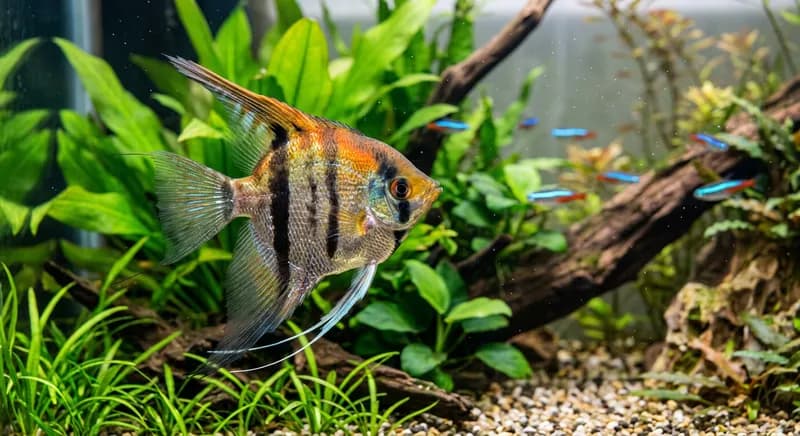
Angelfish
Pterophyllum scalare
Overview
Angelfish are the fish that got a lot of us into the hobby. That tall, elegant body drifting through a planted tank is hard to beat. But do not let the graceful appearance fool you. These are cichlids, and they act like it. Adult angels will eat neon tetras, cherry shrimp, and anything else small enough to fit in their mouths. They can also get territorial, especially when pairing off. A full-grown angelfish needs a tank at least 18 inches tall, and they live 8-10 years, so this is a real commitment.
Tank Setup
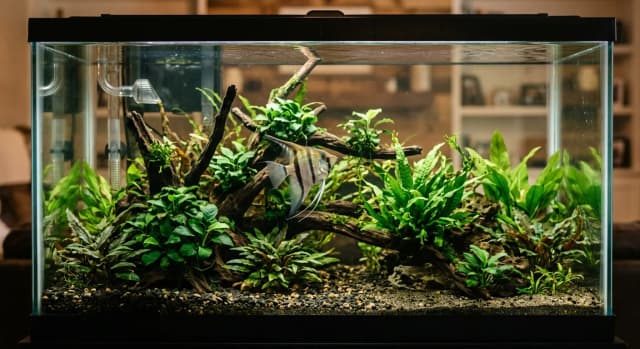
A well-setup aquarium suited to Angelfish
Height is the priority. Angelfish have tall, compressed bodies and need at least 18 inches of vertical swimming space. A standard 30-gallon tall (24x12x18) is the bare minimum for a pair, but a 55-gallon or larger is where they really look their best. Some hobbyists argue a 29-gallon tall works, others say nothing less than 40 gallons. The honest answer is that bigger is always better with angels because they grow larger than most people expect. Use moderate to heavy planting with tall stem plants like vallisneria and amazon swords, plus driftwood for a natural look. Substrate can be sand or fine gravel. Filtration should turn the tank volume 4-6 times per hour, but diffuse the output so there is not a strong current in one spot. Angels prefer calmer water.
Water Parameters
Temperature should be 76-84 degrees Fahrenheit, with 80 being a comfortable middle ground. pH between 6.0 and 7.5 covers the range. Most tank-bred angels are adaptable to a range of water conditions, unlike wild-caught specimens that strongly prefer soft acidic water. Do 25-30% water changes weekly. Angels are moderately sensitive to nitrates, so keep them below 20 ppm. They can handle harder water than many South American cichlids but thrive in softer conditions. Consistency matters more than hitting a perfect number. Avoid swinging pH by chasing a target. Stable 7.2 is better than bouncing between 6.5 and 7.0.
Diet & Feeding

Quality nutrition supports Angelfish health and color
Angelfish are omnivores with a strong carnivorous preference. A quality cichlid pellet or flake forms the base diet. Supplement with frozen bloodworms, brine shrimp, and mysis shrimp 3-4 times per week. Angels are enthusiastic eaters and will beg for food constantly. Do not fall for it. Feed twice daily, only what they consume in 2-3 minutes. Overfeeding leads to poor water quality and bloating. Vegetable matter like blanched zucchini or spirulina-based foods should be offered occasionally. Variety is key to keeping colors bright and immune systems strong.
Behavior & Temperament
Angelfish are semi-aggressive cichlids. A group of juveniles usually gets along fine, but as they mature and pair off, things change. A breeding pair will claim a section of the tank and aggressively defend it from everyone else. In a tank too small for this, the non-paired fish get bullied relentlessly. This is why a larger tank matters. Singles or pairs are easier to manage in community setups. Angels establish a pecking order and some chasing is normal, but watch for fish that are constantly hiding or have torn fins. Removing the aggressor or adding more hiding spots can help. Despite their cichlid nature, angels are still more mellow than most New World cichlids.
Compatible Tankmates
This is where people make the biggest mistake with angelfish. Those cute little neon tetras you see swimming with angels at the store? The angels will eat them once they grow up. Any fish under 1.5 inches is potential food for an adult angel. Safe tankmates include bristlenose plecos, bronze corydoras (in groups of 6+), kuhli loaches, larger tetras like black skirt or lemon tetras, and peaceful medium-sized fish. Mystery snails and nerite snails are fine. Avoid guppies (angels eat them), bettas (territorial clashes), and any small shrimp. Cherry shrimp will become expensive snacks. Pygmy corydoras are too small and will be hunted.
Common Health Issues
Ich is common, especially in newly purchased fish. Raise temperature to 86 degrees and treat with ich medication. Angelfish are also prone to a condition called angel plague or angelfish virus, which causes rapid death with symptoms like white stringy feces, lethargy, and clamped fins. There is no reliable cure, which is why quarantining new additions is critical. Hexamita (hole-in-the-head) shows up as small pits around the head and lateral line, usually linked to poor water quality and vitamin deficiency. Treat with metronidazole and improve diet variety. Fin rot from bacterial infections responds well to clean water and, in severe cases, antibiotics like Kanaplex.
Breeding
Angelfish are one of the easier cichlids to breed in captivity. A bonded pair will clean a vertical surface, usually a broad leaf, a piece of slate, or even the tank glass, and the female lays rows of eggs while the male follows behind to fertilize them. A single spawn can produce 100-400+ eggs. Both parents fan and guard the eggs, which hatch in about 60 hours at 80 degrees. The fry become free-swimming 5-7 days after hatching. First-time parents frequently eat the eggs. This is frustrating but normal. If you want to save the eggs, you can move the spawning surface to a separate hatching tank with an airstone providing gentle water flow over the eggs. Fry eat baby brine shrimp once free-swimming.
Tankmates to Avoid
These species don't mix well with Angelfish. Tap a name for the full breakdown.
Frequently Asked Questions
Quick Stats
Related Guides
Compare
What You Need for Angelfish
Gear that works well for this species, based on what experienced keepers actually use.
Provides the flow rate angels need in a 40-75 gallon tank without creating excessive current. Multi-stage filtration keeps water pristine for these nitrate-sensitive fish.
Color-enhancing formula with the protein content angelfish need. Mini pellet size fits juvenile and adult mouths without excess waste.
Reliable temperature control for the 40-55 gallon tanks angels need. Precise dial and shatterproof glass construction. Holds steady at 80F without fluctuation.
The classic angelfish plant. Broad leaves provide spawning surfaces and natural cover. Grows tall enough to complement the angel's vertical profile.