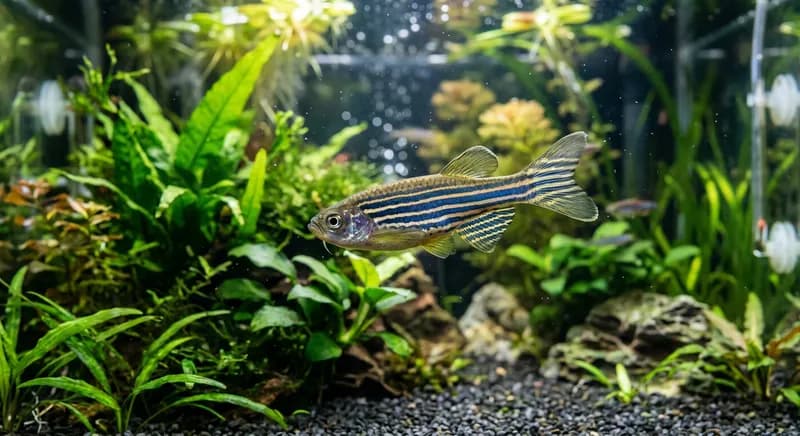
Zebra Danio
Danio rerio
Overview
People often call zebra danios the cockroaches of the aquarium world. In this context, that is a huge compliment. They survive conditions that would kill most tropical fish. They were the first vertebrate to be cloned, they have had their entire genome sequenced, and they are used in labs worldwide for genetic research. In your tank, they are hyperactive silver fish with horizontal blue-black stripes that zoom around the upper water level with frantic energy. They aren't the most beautiful fish, but they are among the toughest.
Tank Setup
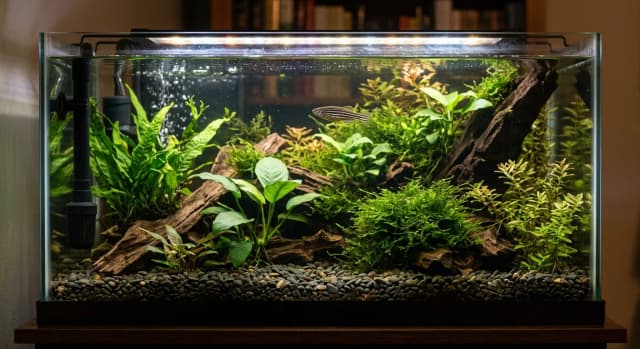
A well-setup aquarium suited to Zebra Danio
A 10-gallon tank works for a school of 6, but a 20-gallon long is better because danios are fast, relentless swimmers that use every inch of horizontal space. A tall, narrow tank is a poor match. They want room to race. Filtration can be moderate to strong since danios actually enjoy some current to swim against. A hang-on-back filter is fine. Danios spend most of their time at the surface and upper water column, so mid-ground and background plants create a nice contrast without limiting their swimming space. They don't care about substrate type. Gravel, sand, bare bottom, whatever works for you. A lid is a good idea because danios are jumpers, especially during feeding frenzies or when spooked. Danios tolerate cooler water than most tropicals, so an unheated tank in a room that stays above 64 degrees works. A heater is still recommended for consistency.
Water Parameters
Zebra danios have the widest acceptable parameter range of any common community fish. pH 6.5-7.5, temperature 64-78 degrees, and they handle both soft and moderately hard water. They are sometimes kept in unheated tanks at room temperature, which is fine as long as the room doesn't swing more than a few degrees day to night. If you're keeping them with other tropicals, target 74-76 degrees as a compromise. Danios tolerate minor ammonia and nitrite spikes better than most fish, which is why they were traditionally used for cycling new tanks. However, using fish for cycling is now considered outdated and unnecessary. Most hobbyists prefer fishless cycling. Weekly 25% water changes, standard conditioning, and test your water if behavior changes.
Diet & Feeding

Quality nutrition supports Zebra Danio health and color
Danios eat anything. Flakes, pellets, frozen foods, live foods, algae wafers that sink past them. They are not picky. A standard tropical flake is the base diet. Supplement with frozen bloodworms, brine shrimp, or daphnia 2-3 times a week. They feed at the surface and mid-water, aggressively. Danios are the first to the food and the last to stop looking for more. Feed a small pinch twice daily. In a community tank, make sure slower-feeding species (corydoras, shy tetras) are getting food too, because danios will outcompete them at the surface. Sinking pellets for bottom dwellers help solve this.
Behavior & Temperament
Danios are incredibly active. They zip around the top of the tank all day, chasing each other in a constant game of tag. This behavior is normal social interaction, not aggression. They establish a pecking order through chasing, but they rarely nip fins or cause injury. Keep at least 6 together to spread out the chasing behavior. A group of 3 often results in one fish being constantly harassed. Danios are not aggressive toward other species but their frantic swimming can stress out calm, slow-moving fish. Bettas, for example, do not appreciate sharing a tank with a pack of hyperactive danios buzzing past them all day. Danios are most active during daylight hours and settle down at night near the surface or among plants.
Compatible Tankmates
Danios pair well with other active, hardy community fish. Platies, swordtails, cherry barbs, corydoras, and rasboras are all solid matches. Avoid pairing with slow-moving, long-finned fish. Bettas and fancy guppies will be stressed by the constant motion, and some danios will nip flowing fins. Angelfish are too large and slow, and adult angels may eat danios. Zebra danios are a good dither fish for mildly shy species since their constant activity signals to other fish that the environment is safe. They are popular in rainbow fish communities for this reason. Bottom dwellers like bronze corydoras and panda corydoras are excellent companions since they occupy completely different water levels.
Common Health Issues
Danios are remarkably disease-resistant. Ich can occur, particularly after shipping stress, but they tolerate standard temperature and medication treatment well. Mycobacteriosis (fish tuberculosis) has been documented in danio populations, especially in laboratory settings. Symptoms include wasting, curved spine, and lethargy. There is no effective treatment, and affected fish should be removed. This is uncommon in healthy home aquariums. Danios can develop swim bladder issues from overfeeding, causing them to float oddly or swim at an angle. Fasting for 2 days usually resolves it. Their hardiness means that when a danio gets sick, it's often a sign that something is seriously wrong with the tank environment, not just the fish.
Breeding
Zebra danios are one of the easiest egg-laying fish to breed. They are egg scatterers that spawn at dawn. Set up a separate 10-gallon breeding tank with marbles or a mesh grate on the bottom to prevent the parents from eating the eggs. Alternatively, dense java moss works. Condition a group (2-3 males, 2-3 females) with frozen foods for a week. Females will look noticeably round when full of eggs. Place the group in the breeding tank in the evening, and spawning usually happens the next morning as light hits the tank. Remove all adults immediately after spawning. Eggs hatch in 24-48 hours. Fry become free-swimming in another 2 days and can eat baby brine shrimp or microworms immediately. A single spawn can produce 100-300 eggs. Danio genetics are well understood thanks to their role in research, so selective breeding for color variants (GloFish are genetically modified danios) is an established practice.
Tankmates to Avoid
These species don't mix well with Zebra Danio. Tap a name for the full breakdown.
Frequently Asked Questions
Quick Stats
Related Guides
What You Need for Zebra Danio
Gear that works well for this species, based on what experienced keepers actually use.
Moderate flow that danios enjoy swimming in. Bio-wheel adds extra biological filtration. Simple to maintain and reliable for a 10-20 gallon setup.
Standard floating flake that danios devour. Good nutritional profile and doesn't cloud the water. A staple that works for mixed community tanks.
Affordable starter tank that comes with a filter and LED lid. A 10-gallon is the entry point for a danio school, and this kit has everything to get started.
Concentrated dechlorinator that also detoxifies ammonia and nitrite temporarily. Essential for any tank but especially useful during water changes in a high-bioload danio community.