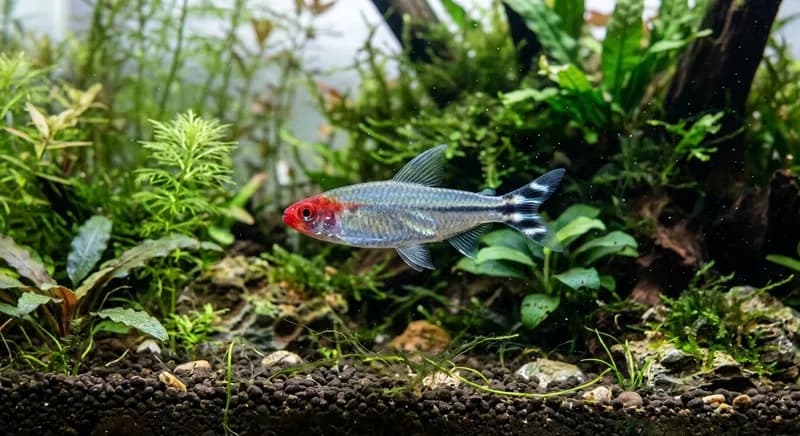
Rummy Nose Tetra
Hemigrammus rhodostomus
Overview
If you want the tightest schooling behavior of any freshwater fish, rummy nose tetras are the answer. They move together like a single organism, turning in unison, accelerating together, holding formation constantly. The bright red nose is their signature, and it doubles as a health indicator. Healthy rummy noses have a deep crimson blush extending to the gill plate. Stressed or sick fish lose the red almost immediately. This built-in health meter makes them both rewarding and demanding to keep.
Tank Setup
Rummy nose tetras need space to school. A 20-gallon is the minimum, but a 30-gallon long is where their schooling behavior becomes truly spectacular. A tight, synchronized school of 15 rummy noses sweeping through a planted tank is worth the extra tank size. Like other South American tetras, they prefer a setup that mimics a shaded forest stream: dark substrate, driftwood, live plants, and subdued lighting. Floating plants help dim the light naturally. Use a gentle to moderate filter flow. They are capable swimmers but don't appreciate being buffeted by strong current. Sponge filters or hang-on-back filters with adjustable flow work well. A canister filter on a larger setup gives great water quality with smooth, distributed flow.
Water Parameters
Rummy noses are the most water-parameter-sensitive of the common community tetras. They need soft, acidic water with a pH between 5.5 and 7.0, ideally around 6.0-6.5. General hardness should be low, under 8 dGH. Temperature on the warmer side, 75-84 degrees, with 80 being ideal. They come from the Rio Negro and similar blackwater tributaries where the water is extremely soft and tea-stained with tannins. If your tap water is hard and alkaline, keeping rummy noses healthy long-term requires RO water or heavy use of botanicals and aquasoil to bring parameters down. This is not a fish for beginners with difficult tap water. Weekly 25% water changes are mandatory, and consistency is everything. A sudden pH swing of 0.5 can cause the red nose to fade within hours.
Diet & Feeding
Rummy nose tetras are not picky eaters. A high-quality micro pellet or fine crushed flake is the daily staple. Supplement with frozen baby brine shrimp, frozen daphnia, and frozen bloodworms 3 times per week. The frozen foods noticeably enhance the intensity of the red nose coloration. Feed a small pinch twice daily. They feed in the mid-water column and will chase food particles as they sink. Make sure food is small enough for their mouths. Whole large flakes are awkward for them. Crush flakes between your fingers before adding to the tank.
Behavior & Temperament
Rummy nose tetras are obligate schoolers. They must be kept in groups of at least 8, and 12+ is strongly recommended. In small groups, they get stressed, hide, lose their red coloration, and become susceptible to disease. In a proper school, their behavior is mesmerizing. The group moves as one, changing direction simultaneously, maintaining tight formation even while feeding. They are completely peaceful and will never bother tankmates. They occupy the mid-water column and are active during the day, settling to the bottom to rest at night. Their schooling behavior is often used as a benchmark in aquascaping since a tight school of rummy noses indicates the tank environment is healthy and stable.
Compatible Tankmates
Rummy nose tetras pair beautifully with other peaceful South American species. Cardinal tetras, neon tetras, harlequin rasboras, and corydoras are all excellent companions. Cherry shrimp are safe since rummy noses don't hunt shrimp. Cherry barbs add a different color profile without any compatibility issues. Avoid aggressive or nippy fish like tiger barbs, which will chase and stress the school. Angelfish are a risk since adult angels can eat rummy noses. Bettas require different water parameters and the activity level of the school may stress them. The ideal rummy nose community is a group of other soft-water, peaceful species in a well-planted tank.
Common Health Issues
The red nose is your early warning system. If the red fades to pink or disappears, something is wrong. Check water parameters immediately. The most common causes of fading are ammonia spikes, pH shifts, temperature drops, or stress from recent changes. Healthy, stable water brings the red back within a day. Ich can affect rummy noses, and they are sensitive to many medications. Raise temperature to 84 degrees (they tolerate this well) and use half-dose ich treatment. Neon tetra disease can affect rummy noses, causing color loss, erratic swimming, and body cysts. There is no treatment, and affected fish should be removed. Rummy noses are also prone to bacterial infections during shipping stress, so quarantine new arrivals for 2 weeks before adding them to your display tank.
Breeding
Breeding rummy nose tetras in captivity is difficult and rarely accomplished accidentally. They require extremely soft water (under 2 dGH), a pH of 5.0-5.5, and warm temperatures around 82-84 degrees to trigger spawning. The breeding tank should be dimly lit with fine-leaved plants or spawning mops. Condition a pair with live or frozen foods for 2 weeks before attempting. Spawning typically happens in the early morning. The pair scatters eggs among the plants, and eggs are light-sensitive. Remove parents immediately after spawning. Eggs hatch in 24-36 hours, and the fry are extremely small. Start feeding infusoria, then move to vinegar eels, and finally baby brine shrimp after about a week. Most rummy noses in the trade are wild-caught, which reflects how challenging captive breeding remains.
Tankmates to Avoid
These species don't mix well with Rummy Nose Tetra. Tap a name for the full breakdown.
Frequently Asked Questions
Quick Stats
Compare
What You Need for Rummy Nose Tetra
Gear that works well for this species, based on what experienced keepers actually use.
Buffers water to acidic pH and provides low hardness. Ideal for recreating the soft, acidic conditions rummy noses need. Also dark colored, which brings out their best coloration.
Nutrient-dense small pellets with whole krill and algae. Enhances the red nose coloration noticeably after a few weeks of consistent feeding.
Reliable canister filter that provides excellent biological filtration with smooth, distributed flow. The spray bar prevents strong currents that stress the school.
Essential for keeping rummy noses since they are sensitive to parameter shifts. Liquid tests are far more accurate than strips, and you will be testing frequently with this species.