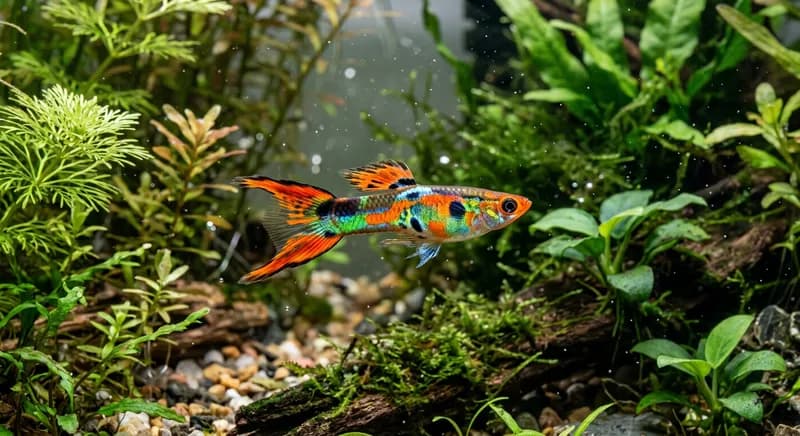
Endler's Livebearer
Poecilia wingei
Overview
Endler's livebearers are tiny, neon-bright fish that look like someone shrunk a guppy and turned the saturation up. Males are barely an inch long with electric green, orange, and black patterns. Females are plain silver-gray and slightly larger. They are closely related to guppies and will hybridize with them, so serious breeders keep them separate. Endlers breed fast, tolerate a range of conditions, and add incredible color to a nano tank.
Tank Setup
A 10-gallon tank is plenty for a colony of endlers. Their tiny size means you can keep a good-sized group in a smaller footprint. A 15-gallon gives even more room and makes maintenance easier. Use a sponge filter or a small hang-on-back with a pre-filter sponge over the intake. Endler fry are minuscule and will get sucked into unprotected filter intakes. Dense planting is ideal. Java moss, guppy grass, hornwort, and water sprite all provide cover for fry and make the tank feel like a natural habitat. Endlers spend most of their time in the mid to upper water column. A dark substrate like black sand makes their neon colors pop. Keep a lid on the tank because, like their guppy cousins, endlers will jump through surprisingly small gaps.
Water Parameters
Endlers are adaptable. pH anywhere from 6.8-8.0 works, with slightly alkaline water being their preference. Temperature 72-82 degrees, target 78. They handle a wider range than many tropical fish but don't do well with big temperature swings. A heater keeps things stable. Hardness isn't critical but moderate hardness (8-15 dGH) is ideal. Do 20-25% weekly water changes. In a heavily planted tank with a small bioload, you can get away with every 10 days, but weekly is safer. Ammonia and nitrite must be zero. Endlers are small, and even a minor ammonia spike can kill them quickly.
Diet & Feeding
Endlers eat anything that fits in their tiny mouths. A high-quality micro pellet or crushed tropical flake is the staple. Supplement with frozen baby brine shrimp, frozen cyclops, or frozen daphnia 2-3 times per week. Blanched zucchini or a small piece of blanched spinach once a week adds variety. Feed a tiny pinch twice daily. Overfeeding is easy with fish this small since a few extra flakes can foul the water fast. If you're keeping them in a planted tank, they will graze on biofilm and microorganisms between meals.
Behavior & Temperament
Male endlers are constantly displaying. They flash their colors, dart around each other, and chase females nonstop. It looks hectic but it's normal behavior. Females are calmer and tend to hang in loose groups. Like guppies, the male-to-female ratio matters. Keep at least 2 females per male, or go all-male if you want color without the population explosion. An all-male tank is a popular choice since you get the best coloration without the endless fry. Endlers are completely peaceful toward other species. They are too small and too busy showing off to bother anyone.
Compatible Tankmates
Endlers are best with other small, peaceful species. Cherry shrimp are a classic pairing since adult shrimp are safe and the environment both species prefer overlaps perfectly. Panda corydoras, smaller tetras like neon tetras and cardinal tetras, and harlequin rasboras all work. Avoid anything that can fit an endler in its mouth. Swordtails, mollies, and angelfish will eat them. Bettas may attack the colorful males. The biggest compatibility issue is actually guppies. Endlers and guppies will crossbreed freely, producing fertile hybrids. If you care about keeping pure endler genetics, do not house them with guppies.
Common Health Issues
Endlers are hardy for their size but not immune to problems. Ich is the most common disease, especially after being added to a new tank. Treat by raising temperature to 82 degrees and using half-dose ich medication (full dose can be harsh on nano fish). Fin rot can hit males whose long, colorful tails are susceptible to nipping and bacterial infection. Clean water is the best prevention and treatment. Internal parasites occasionally show up as white stringy feces or wasting. Medicated food with praziquantel handles most internal parasites. Because of their small size, endlers decline fast when sick. Catching problems early is critical.
Breeding
Endlers breed like they're trying to take over the tank, because they are. A single female can produce 5-25 fry every 3-4 weeks. Fry are born free-swimming and surprisingly large relative to the adults. In a densely planted tank, most fry survive since adult endlers rarely eat their own young (unlike guppies, who will). This means your population can snowball fast. Within 6 months, a trio can become 50+ fish. If you want to control numbers, keep only males. If you're breeding for color, separate males by pattern and pair them with unrelated females. Endler genetics are fascinating since selective breeding has produced dozens of named strains with specific color patterns.
Tankmates to Avoid
These species don't mix well with Endler's Livebearer. Tap a name for the full breakdown.
Frequently Asked Questions
Quick Stats
Related Guides
What You Need for Endler's Livebearer
Gear that works well for this species, based on what experienced keepers actually use.
Sponge filters are the safest choice for endler tanks. No intake to suck up fry, gentle flow, and the sponge surface supports beneficial bacteria.
Sized perfectly for endler mouths. Semi-floating pellets with good color-enhancing ingredients. Doesn't cloud the water.
Flat design, accurate thermostat, and shatterproof. The 25W model is perfect for a 10-15 gallon endler tank.
Black sand substrate that makes endler colors glow. Fine grain is gentle on any bottom dwellers you add, and it doesn't alter water chemistry.