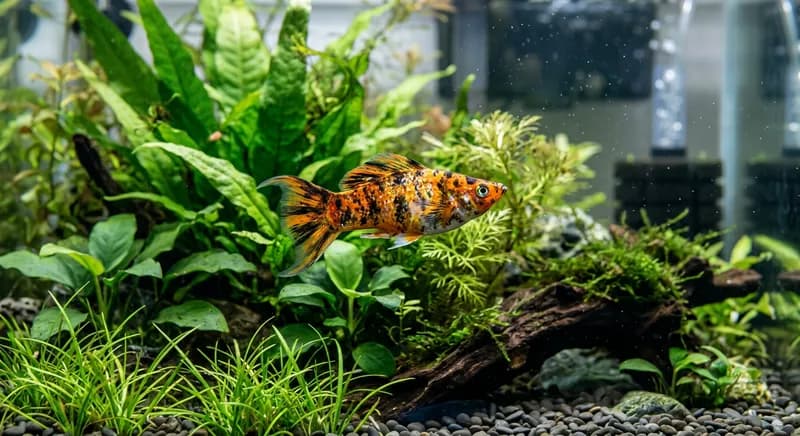
Molly
Poecilia sphenops
Overview
Mollies look like platies that hit the gym. They get bigger, come in wild varieties from dalmatian spots to solid black to sailfin, and have a reputation for being bulletproof. That reputation is partially earned and partially misleading. Mollies do best in harder, more alkaline water, and some experienced keepers add a tablespoon of aquarium salt per 5 gallons. They are livebearers that breed as prolifically as platies, so population control is something you will deal with.
Tank Setup
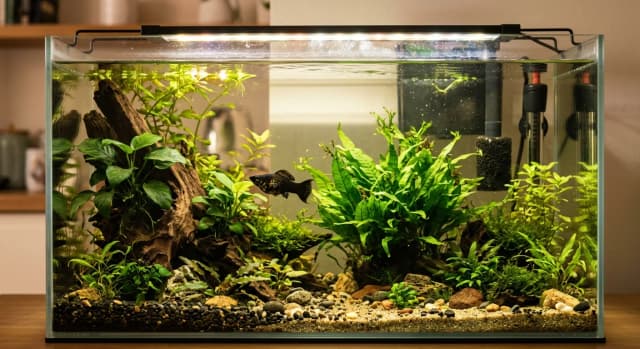
A well-setup aquarium suited to Molly
Mollies need more space than people expect. A full-grown sailfin molly can hit 5 inches, and even common mollies reach 3-4 inches. Start with a 20-gallon minimum, ideally 30 gallons for a group. A standard 29-gallon is a good footprint for a molly community. Use a filter rated for slightly above your tank volume since mollies produce a fair amount of waste. Hang-on-back or canister filters both work well. Mollies appreciate some plant cover but also need open swimming space. They are active fish that use the full tank. Hardy plants like java fern, anubias, and vallisneria handle the harder water that mollies prefer. Substrate doesn't matter much. Sand looks cleaner but gravel works fine.
Water Parameters
This is where mollies differ from other livebearers. They strongly prefer hard, alkaline water with a pH of 7.5-8.5. Soft, acidic water stresses them and makes them more prone to disease. The salt debate is real. In the wild, mollies are often found in brackish environments. Many long-time molly keepers add 1 tablespoon of aquarium salt per 5 gallons and report fewer health issues. Others keep them in straight freshwater without problems. If your mollies are constantly battling illness, salt is worth trying. Temperature between 72-82 degrees, target 78. Weekly 25% water changes, and always match the new water's temperature and hardness to the tank.
Diet & Feeding
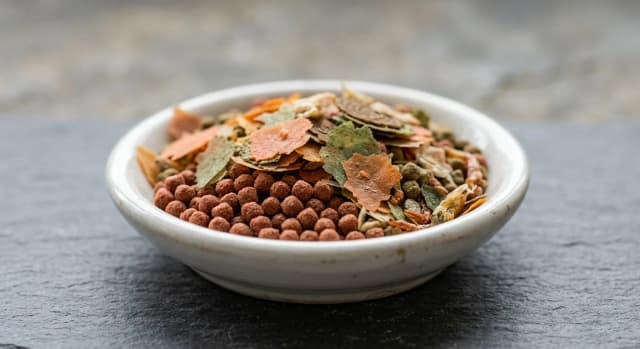
Quality nutrition supports Molly health and color
Mollies are omnivores that lean heavily toward plant matter. In the wild, they graze on algae all day. A good spirulina-based flake or pellet should be the staple food. Supplement with blanched vegetables like zucchini, cucumber, or spinach 2-3 times per week. They will also eat frozen bloodworms and brine shrimp for protein, but keep the diet mostly plant-based. Feed a pinch of flake twice daily. Mollies are voracious eaters and will keep eating long past when they should stop. Stick to the 2-minute rule. If there's food left after 2 minutes, you fed too much.
Behavior & Temperament
Mollies are generally peaceful but males can be pushy. They chase females relentlessly for breeding, and dominant males will sometimes bully subordinate males. Keep at least 2-3 females per male to distribute the harassment. An all-male group can work but watch for aggression. Mollies are mid to top level swimmers and stay active throughout the day. They are social fish that do better in groups of 4 or more. A single molly in a community tank will do okay, but a group shows more natural behavior. Sailfin males will display their dorsal fin to impress females and intimidate rivals, which is fun to watch.
Compatible Tankmates
Mollies work well with other livebearers like platies and swordtails. Corydoras, larger tetras, peaceful barbs, and bristlenose plecos are all good tankmates. Avoid keeping mollies with small, delicate fish like neon tetras or endlers since mollies can be pushy and outcompete them for food. Bettas are a bad match because mollies are too active and will stress a betta out. If you add salt to the water for your mollies, make sure all tankmates tolerate it. Most tetras and corydoras do not appreciate salt, which limits your stocking options. Snails are fine companions.
Common Health Issues
Mollies have a reputation for being disease-prone, and there's some truth to it. They are especially susceptible to a condition called "molly disease" or shimmying, where the fish rocks back and forth without moving forward. This is usually caused by poor water conditions, low temperature, or soft water. Fixing the environment often resolves it. Ich and fin rot are common, especially in stressed fish. White stringy feces can indicate internal parasites, treat with medicated food containing metronidazole. Mollies kept in optimal water conditions (hard, warm, possibly brackish) get sick far less often than mollies shoved into soft, cool community setups.
Breeding
Like all livebearers, mollies breed constantly. A female produces 20-60 fry every 4-6 weeks and can store sperm for months after a single mating. Fry are born large enough to eat crushed flake food immediately. In a well-planted tank, some fry survive naturally. If you want to raise a batch, move the pregnant female to a separate 10-gallon with a sponge filter when she looks very large and boxy. Remove her immediately after she drops fry. Molly fry grow fast and reach sellable size in 2-3 months. Local fish stores will often take them for credit, especially unusual color morphs. If you don't want babies, keep only males or only females.
Tankmates to Avoid
These species don't mix well with Molly. Tap a name for the full breakdown.
Frequently Asked Questions
Quick Stats
Related Guides
Compare
What You Need for Molly
Gear that works well for this species, based on what experienced keepers actually use.
Surface skimmer intake, adjustable flow, and a large media basket. Handles the heavier bioload that mollies produce compared to smaller livebearers.
Spirulina-rich sinking wafer that covers the plant-heavy diet mollies need. Doesn't fall apart as fast as cheaper veggie wafers.
Pure evaporated sea salt without additives. If you decide to run a slightly brackish molly setup, this is the standard product. 1 tablespoon per 5 gallons is the common dose.
Accurate thermostat with a slim profile. The 100W handles a 30-gallon molly tank and holds temperature within 1 degree.