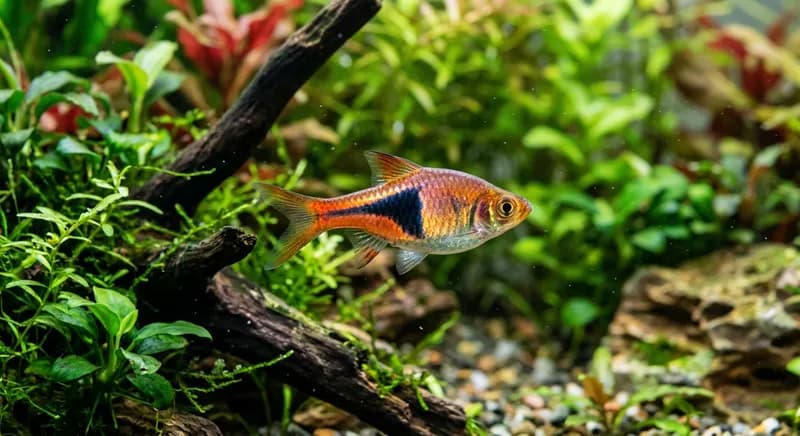
Harlequin Rasbora
Trigonostigma heteromorpha
Overview
Harlequin rasboras are the fish that quietly make every community tank better. They have a warm copper-orange body with a bold black triangular patch on the back half, and they school in a relaxed, elegant way that calms down the entire tank. They are hardy, peaceful, long-lived, and about as easy to keep as a tropical fish gets. If you want a schooling fish that looks great from day one and won't give you problems, harlequins are the answer.
Tank Setup
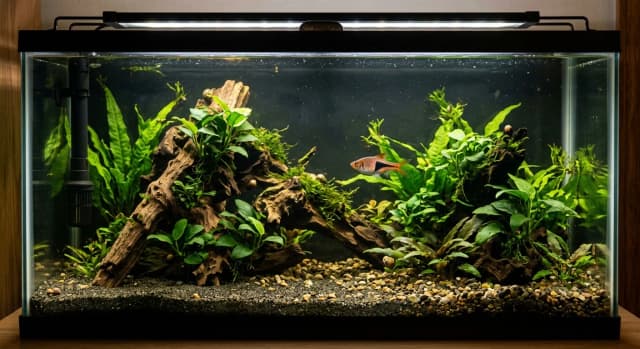
A well-setup aquarium suited to Harlequin Rasbora
A 10-gallon works for a small school of 8, but a 20-gallon gives them more room to display natural schooling patterns. Harlequins come from slow-moving, shaded streams in Southeast Asia, so they prefer dimmer lighting and some plant cover. A tank with a mix of live plants, driftwood, and open swimming space in the center suits them perfectly. They are not fussy about substrate. Sand or gravel, dark or light, they don't care. A gentle filter is ideal. Sponge filters or hang-on-back filters with adjustable flow both work. They can handle moderate flow but don't like being pushed around the tank. A lid is good practice since any small fish can jump, though harlequins are not notorious jumpers.
Water Parameters
Harlequin rasboras are flexible on water chemistry, which is part of their appeal. They do best in slightly acidic to neutral water, pH 6.0-7.5. Softer water is preferred but they adapt to moderate hardness without issue. Temperature 72-82 degrees, target 78. They handle minor fluctuations better than most tetras, which makes them more forgiving for newer keepers. A cycled tank is still mandatory. Zero ammonia, zero nitrite, and keep nitrates under 30 ppm with weekly 20-25% water changes. Harlequins are one of those species where stable conditions matter more than perfect numbers.
Diet & Feeding

Quality nutrition supports Harlequin Rasbora health and color
Harlequins eat anything you offer them. A quality tropical flake or micro pellet is the daily staple. Supplement with frozen bloodworms, frozen brine shrimp, or frozen daphnia a couple times per week. They feed in the mid-water column and will catch food as it drifts down. Feed a small pinch twice daily. They are not greedy feeders like livebearers. Harlequins eat what they need and tend to stop when full, which makes overfeeding slightly less of a risk. Still, remove any uneaten food after 2-3 minutes to keep water quality up.
Behavior & Temperament
Harlequins school in a loose, relaxed formation. They don't hold as tight a group as rummy nose tetras, but they clearly stick together and move as a coordinated unit. Keep at least 8 together. A group of 6 or fewer will scatter and hide more. They are 100% peaceful. No fin nipping, no chasing, no territorial behavior whatsoever. They sit in the middle of the peaceful spectrum. Active enough to be interesting, calm enough to coexist with shy species like bettas. They are most active during the day and rest near plants or substrate at night.
Compatible Tankmates
Harlequin rasboras are one of the most compatible community fish in the hobby. They work with tetras (neon, cardinal, rummy nose), corydoras, cherry barbs, small livebearers, cherry shrimp, and even bettas. Harlequins are one of the few fish that genuinely work as betta tankmates because they are calm, not colorful enough to trigger aggression, and stay in the mid-water where bettas don't patrol heavily. Avoid large cichlids and aggressive barbs like tiger barbs that will harass the school. In a large community tank, harlequins are the glue species that gets along with everything.
Common Health Issues
Harlequins are among the hardiest community fish available. Disease is uncommon in established, well-maintained tanks. Ich is the most likely issue, especially after the stress of transport and introduction to a new tank. Standard treatment: raise temperature to 82 degrees and medicate. Fin rot is rare but can occur in tanks with consistently poor water quality. The biggest risk factor for harlequins is shock from being moved into drastically different water parameters. Acclimate them slowly (drip method, 30-45 minutes) when adding to a new tank. Once established, they are tough fish that can live 5-8 years without major health events.
Breeding
Breeding harlequin rasboras is doable but requires some preparation. Unlike most egg scatterers, harlequins are egg depositors. The female flips upside down and lays eggs on the underside of broad-leaved plants like cryptocoryne or anubias. The male fertilizes them in the same position. To trigger spawning, soften the water to under 4 dGH and lower pH to 5.5-6.0. Condition the pair with protein-rich frozen foods for a week. Spawning usually happens in the morning under dim light. Remove the parents after spawning since they will eat the eggs. Eggs hatch in 24-28 hours. Fry are tiny and need infusoria for the first few days, then baby brine shrimp. Not a common home-breeding project, but rewarding when it works.
Tankmates to Avoid
These species don't mix well with Harlequin Rasbora. Tap a name for the full breakdown.
Frequently Asked Questions
Quick Stats
Related Guides
What You Need for Harlequin Rasbora
Gear that works well for this species, based on what experienced keepers actually use.
Gentle, adjustable flow that harlequins prefer. Customizable media basket so you can add extra biomedia for a school of 10+.
Made from whole salmon and other seafood. Doesn't cloud the water and harlequins take to it immediately. Good color enhancement over time.
Branchy structure provides visual barriers and resting spots. Leaches tannins that slightly soften and acidify water, which harlequins appreciate.
Reliable heater with adjustable dial. The 50W version is perfect for a 10-20 gallon harlequin setup.