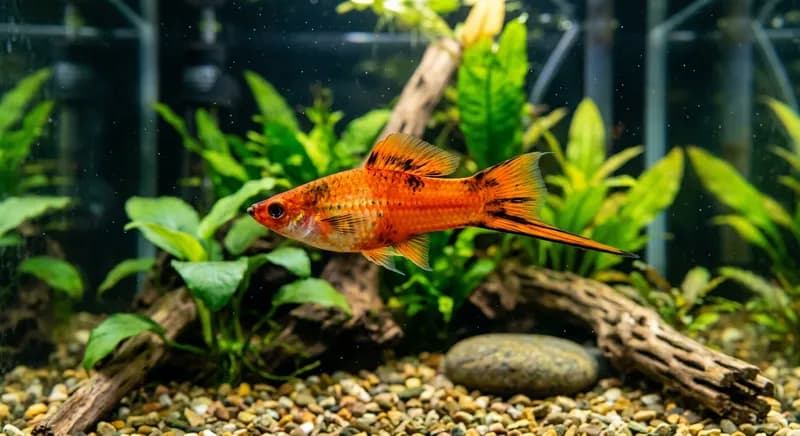
Swordtail
Xiphophorus hellerii
Overview
The swordtail gets its name from the elongated lower tail fin on males, which extends out like a blade. They are one of the larger livebearers, reaching 5-6 inches, and they need more room than most beginners expect. Swordtails are closely related to platies and can actually hybridize with them. Males can be feisty with each other, so tank setup and stocking ratios matter more here than with mellower livebearers.
Tank Setup
A 20-gallon is the true minimum for swordtails, and a 30-gallon long is better. These fish are active swimmers that use horizontal space. A tall hex tank is a poor choice for them. A standard rectangular 29-gallon or 30-gallon breeder works well. Filtration should be moderate to strong since swordtails produce decent waste for their size. A hang-on-back filter rated for your tank volume or slightly above is fine. Swordtails are good jumpers, probably the most escape-prone of the common livebearers. A tight-fitting lid is non-negotiable. Plant the sides and back of the tank but leave the center open for swimming. Hardy plants like java fern, amazon sword, and vallisneria do well in the harder water swordtails prefer.
Water Parameters
Swordtails share the livebearer preference for hard, alkaline water. pH 7.0-8.3, with 7.5-8.0 being ideal. They come from Central American rivers and streams with mineral-rich water. If your tap water is naturally soft, you may want to add a mineral supplement or crushed coral in the filter to buffer the pH up. Temperature 72-82 degrees, aim for 78. Swordtails are reasonably forgiving on exact numbers, but they don't tolerate ammonia or nitrite at all. A fully cycled tank is essential. Do 25-30% water changes weekly. If you're keeping them with other livebearers, the water parameters overlap nicely.
Diet & Feeding
Swordtails are true omnivores that lean toward the plant side. A spirulina-enriched flake or pellet makes a good base diet. They also enjoy blanched zucchini, peas, and cucumber. For protein, rotate in frozen bloodworms, brine shrimp, or daphnia 2-3 times per week. Feed a pinch twice daily. Swordtails are surface and mid-water feeders, so floating foods work better than sinking pellets. Like all livebearers, they will eat constantly if you let them. A slightly rounded belly is normal, but if fish look bloated, cut back on portions.
Behavior & Temperament
This is where swordtails differ from platies and mollies. Male swordtails can be semi-aggressive, especially toward each other. Two males in a small tank will chase and spar constantly. You have three options: keep a single male with 2-3 females, keep an all-male group of 4+ so aggression is spread out, or keep only females. A pair of males in a 20-gallon is the worst setup since the dominant one will bully the other relentlessly. Toward other species, swordtails are generally fine. They might chase smaller fish briefly but rarely cause harm. Females are peaceful. One interesting quirk: female swordtails can undergo sex reversal and develop the male sword extension, though this is uncommon.
Compatible Tankmates
Swordtails do well with other medium-sized, peaceful to semi-aggressive community fish. Platies, mollies, larger tetras, cherry barbs, zebra danios, and corydoras are all good matches. Avoid keeping them with guppies or endlers, which are too small and may be bullied or outcompeted. Bettas are a bad pairing since the swordtail's size and activity level will overwhelm a betta. Bristlenose plecos make excellent bottom-dwelling companions. If keeping multiple swordtail males, a larger tank (30+ gallons) with lots of visual barriers like plants and driftwood reduces territorial disputes.
Common Health Issues
Swordtails are generally healthy fish when kept in proper conditions. Ich is the most common issue, presenting as white dots on the body. Treat by raising temperature to 82-84 degrees and using ich medication. Fin rot shows up as fraying or darkening fin edges, almost always caused by poor water quality. Fix the water and the fins will regrow. Swordtails can be prone to muscle wasting disease, where the fish gradually loses body mass despite eating. This is often caused by internal parasites or fish tuberculosis (mycobacteria). Internal parasites respond to medicated food with levamisole or praziquantel. Mycobacteria has no reliable cure and is contagious, so remove affected fish promptly.
Breeding
Swordtails are livebearers and breed readily in home aquariums. Females produce 20-80 fry every 4-6 weeks. The fry are born free-swimming and relatively large. In a planted tank, some will survive predation. For serious breeding, set up a separate 10-gallon grow-out tank with a sponge filter. Move the gravid female when she looks very boxy and the gravid spot is dark. Remove her after she delivers. Swordtail fry grow quickly on crushed flake, baby brine shrimp, and microworms. Males develop their sword extension at around 3-4 months. Interesting genetics note: swordtails and platies can crossbreed, producing fertile hybrids. If you keep both species, the offspring may look unusual.
Tankmates to Avoid
These species don't mix well with Swordtail. Tap a name for the full breakdown.
Frequently Asked Questions
Quick Stats
Compare
What You Need for Swordtail
Gear that works well for this species, based on what experienced keepers actually use.
Customizable media basket lets you add extra biological filtration. Flow is adjustable, and it handles the bioload from a group of swordtails without blasting the tank.
Kelp and spirulina based with no fillers or artificial colors. Swordtails color up well on this, and the slow-sinking pellets match their feeding style.
Swordtails jump. A lot. A glass lid with a plastic back strip keeps them in the tank while allowing access for feeding and filter maintenance.
One of the most reliable heaters on the market. Holds temperature precisely and has a dry-run shutoff. The 100W version handles a 30-gallon swordtail tank.