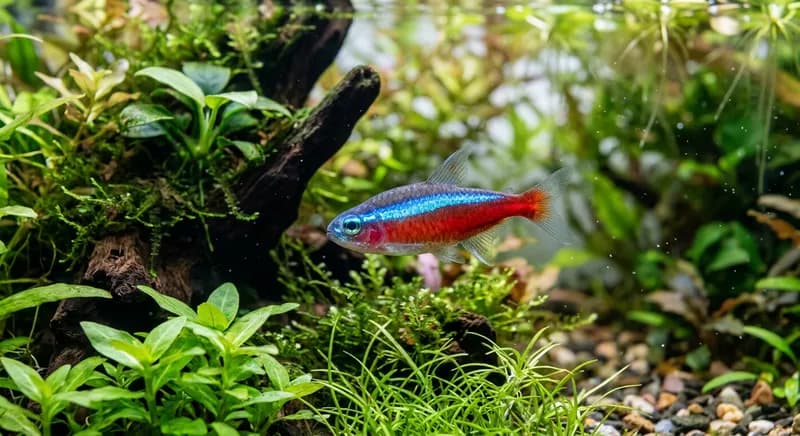
Cardinal Tetra
Paracheirodon axelrodi
Overview
Cardinal tetras are what most people picture when they think of a beautiful community aquarium. That electric blue stripe running from nose to tail, sitting above a vivid red belly that extends the full length of the body. Neon tetras get more press, but cardinals are the upgrade. The red covers the entire lower half of the fish, not just the back half like on neons. A school of 12+ cardinals in a planted tank with dark substrate is one of the best sights in the hobby.
Tank Setup
Cardinal tetras need a minimum of 15 gallons, but 20 gallons is where they really shine. They are a schooling species that needs horizontal swimming room to display their schooling behavior properly. A 20-gallon long is ideal. Use soft, dim lighting or provide shade with floating plants. Cardinals come from blackwater habitats in South America where the water is tea-colored from tannins and very little light penetrates. Indian almond leaves, driftwood, and dark substrate all help recreate this look. A sponge filter or a hang-on-back with adjustable flow works well. Cardinals don't like strong current. Plant the background and sides, and leave the front and center open for the school to swim through.
Water Parameters
This is where cardinal tetras get tricky. They strongly prefer soft, acidic water with a pH of 5.0-7.0. Wild-caught cardinals are especially sensitive and really want pH below 6.5 and very soft water (under 5 dGH). Tank-bred cardinals are more adaptable but still do best in softer water. If your tap water is hard and alkaline, cardinals are not the easiest choice. You can soften water with RO (reverse osmosis) mixed with tap, or use botanicals like Indian almond leaves and driftwood to lower pH naturally. Temperature 73-81 degrees, aim for 78. Weekly 20-25% water changes using water that matches the tank parameters. Drastic pH swings are more dangerous than a slightly off number.
Diet & Feeding
Cardinals are micro predators in the wild, eating tiny invertebrates and insect larvae. In the aquarium, a high-quality micro pellet or crushed tropical flake is the base diet. Supplement with frozen baby brine shrimp, frozen daphnia, and frozen bloodworms 2-3 times per week. The frozen foods bring out the best color. Feed a small pinch twice daily, only what the school can consume in 90 seconds. Cardinals have small mouths, so make sure food particles are appropriately sized. Crushed flake works better than whole flakes for them.
Behavior & Temperament
Cardinals are peaceful schooling fish. They should be kept in groups of at least 8, with 12 or more being noticeably better. In a large school, they display tighter formation swimming and the visual effect is stunning. They are mid-level swimmers, cruising through the open water column together. Cardinals are shy when kept in small numbers or in bright, bare tanks. In a properly set up tank with dim lighting and plenty of plant cover, they are bold and active. They completely ignore other species and mind their own business.
Compatible Tankmates
Cardinals belong in a peaceful community with other small, calm species. Neon tetras, rummy nose tetras, harlequin rasboras, and corydoras (especially panda corydoras) are classic tankmates. Cherry shrimp are safe with cardinals since the tetras' mouths are too small to eat adult shrimp, and they mostly ignore shrimplets. Endlers and other small livebearers work if the water parameters overlap. Avoid anything large or aggressive. Angelfish are often listed as cardinal tankmates, but adult angelfish will eat cardinals. Bettas can work in a large enough tank, but the soft water cardinals prefer often doesn't suit bettas. Swordtails and mollies prefer harder water, so the chemistry clash makes them poor partners.
Common Health Issues
Neon tetra disease (NTD) is the big one, and yes, it affects cardinals too despite the name. Symptoms include fading color, erratic swimming, cysts on the body, and a curved spine. There is no cure. Affected fish should be removed immediately since it is contagious. The good news is that NTD is less common in tank-bred fish from reputable sources. Ich can affect cardinals, but treat carefully. Raise temperature to 82 and use half-dose medication since cardinals are sensitive to many chemicals. Columnaris can present as white fuzzy patches, especially on new arrivals that are stressed from shipping. Quarantine new cardinals for 2 weeks before adding them to an established tank.
Breeding
Breeding cardinal tetras in captivity is challenging but possible. They are egg scatterers that need very specific conditions to spawn. The breeding tank should have extremely soft water (1-2 dGH), pH around 5.0-5.5, and dim lighting. Use a bare-bottom tank with spawning mops or fine-leaved plants. The pair will scatter eggs in the evening, and eggs are light-sensitive so keep the tank dark. Remove the parents after spawning since they will eat the eggs. Eggs hatch in 24-36 hours, and fry are tiny. Feed infusoria for the first week, then transition to baby brine shrimp. The difficulty of breeding is why most cardinals in the trade are still wild-caught from the Rio Negro basin in Brazil.
Frequently Asked Questions
Quick Stats
Related Guides
What You Need for Cardinal Tetra
Gear that works well for this species, based on what experienced keepers actually use.
Release tannins that soften water, lower pH naturally, and tint the water amber. Recreates the blackwater habitat cardinals thrive in.
Actively lowers pH and softens water. Dark color makes cardinal colors pop. Also supports live plant growth.
Semi-floating micro pellets sized right for cardinal mouths. Good protein content and color enhancement without fillers.
Dimmable with a sunrise/sunset mode. Cardinals look best under subdued lighting, and this light lets you dial it down while still growing plants.