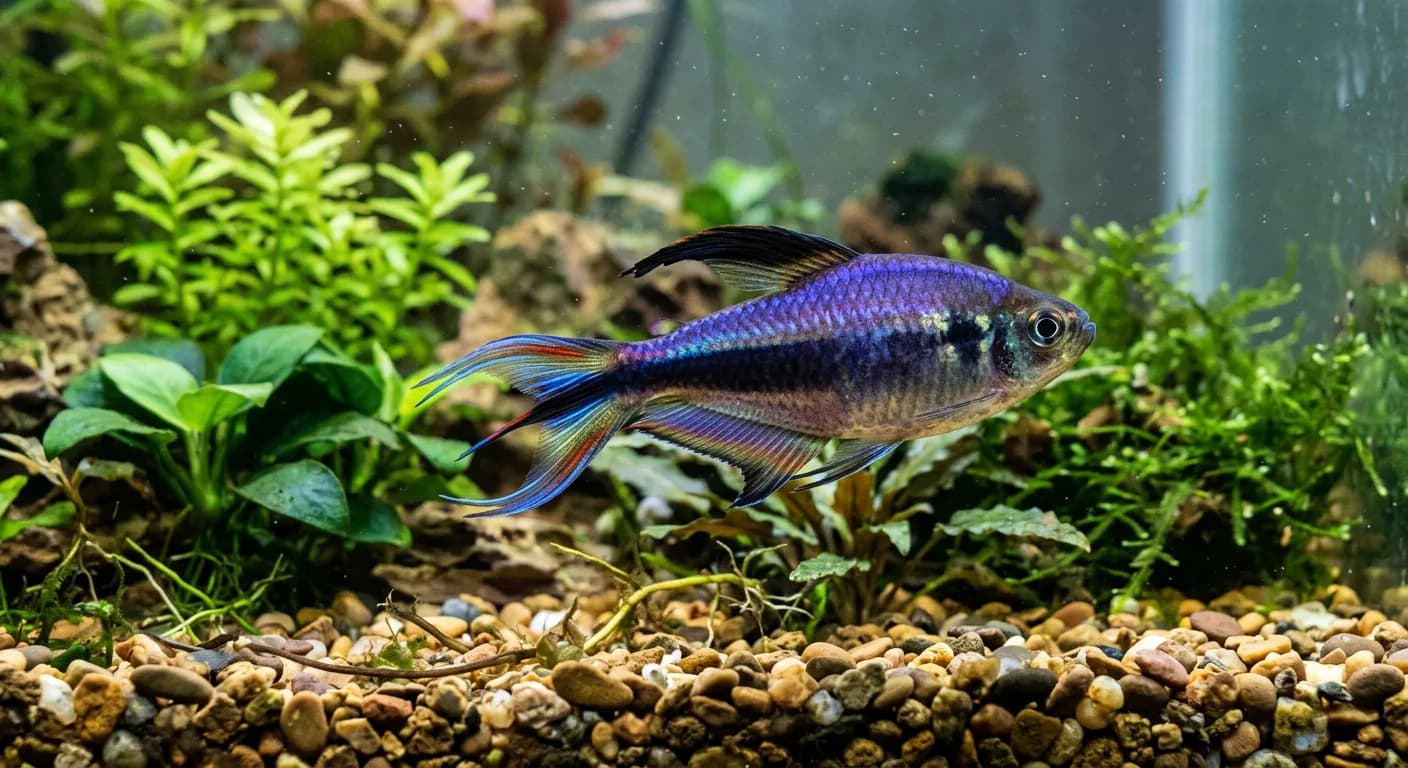
Emperor Tetra
Nematobrycon emilii
Overview
The Emperor Tetra is a striking little fish that brings sophisticated beauty to any community tank. Native to the slow-moving streams and rivers of Colombia, these fish feature a distinctive color pattern: an iridescent blue-gray body with a bold black stripe running from nose to tail, framed by orange or yellow accents in the fins. Males develop a more pronounced hook on their tail fin (the "imax" extension) as they mature, and their colors intensify with age and proper care. These are peaceful, schooling fish that do best in groups of six or more. A healthy Emperor Tetra school in a well-planted tank is genuinely captivating—their coordinated movements and subtle iridescence make them stand out even in tanks with more colorful residents. They are often overlooked in favor of more flashy tetras, but aquarists who discover them become devoted fans.
Tank Setup
A 20-gallon tank is the absolute minimum for a group of six Emperor Tetras, but a 30-gallon is strongly recommended. These fish need horizontal swimming space more than vertical height. They originate from Colombian blackwater streams with soft, slightly acidic water and abundant vegetation. Replicate this with a planted tank—java fern, anubias, amazon swords, and floating plants like water lettuce or frogbit all work well. Use dark substrate (dark sand or gravel) to make their colors pop. Filtration should be moderate—a hang-on-back filter rated for the tank size or a small canister filter works. Emperor Tetras prefer some water flow but not strong currents. They do best in slightly dimmer lighting, which also helps their iridescent colors stand out. Add driftwood or Indian almond leaves to gently tint the water and create that natural blackwater feel they evolved in. Keep the tank covered—they may jump when startled.
Water Parameters
Emperor Tetras are adaptable but thrive in specific conditions. Aim for pH between 5.5 and 7.5, with 6.5 being ideal. They prefer soft to moderately hard water (2-12 dGH). Temperature should stay between 73 and 84 degrees, with 78 being the sweet spot. They are sensitive to poor water quality, so maintain pristine conditions: ammonia and nitrite must always be zero, and keep nitrates under 20 ppm with weekly 25% water changes. Emperor Tetras are sensitive to temperature swings, so use a reliable heater and match new water temperature closely during water changes. They can adapt to harder water over time, but their colors and behavior are best in softer, slightly acidic conditions. If your tap water is very hard, consider using RO water or driftwood to soften it.
Diet & Feeding
Emperor Tetras are unfussy omnivores that will eat most aquarium foods. A quality flake or micro-pellet should form the daily diet—look for brands with good protein content and minimal fillers. Supplement with frozen foods 2-3 times per week: bloodworms, brine shrimp, and daphnia are all readily accepted. Live foods like baby brine shrimp or mosquito larvae bring out their best colors and conditioning for breeding. They are mid-water feeders that will rise to the surface for food but also browse along tank surfaces. Feed small amounts 2-3 times daily, only what they consume in 2-3 minutes. Emperor Tetras are not aggressive eaters and can be outcompeted by faster fish at feeding time. If housing with larger or faster tankmates, consider targeting food with a pipette or feeding in multiple spots to ensure everyone gets their share.
Behavior & Temperament
Emperor Tetras are peaceful, schooling fish with a calm demeanor. They spend most of their time swimming in a loose group through the middle of the tank, rarely bothering their tankmates. Males will occasionally display to each other by flaring their fins and showing off their colors, but this is mostly ceremonial—real aggression is rare. They are active but not frantic, which makes them ideal for community tanks with other peaceful species. A group of six or more will establish a subtle hierarchy, with dominant males showing the best colors. They are somewhat shy when first introduced to a tank and may hide for the first day or two, but will become more confident once settled. Emperor Tetras do well in biotope setups with other South American species but are equally happy in diverse community tanks. Their peaceful nature means they should be paired with equally gentle tankmates.
Compatible Tankmates
Emperor Tetras pair well with most peaceful community fish that can tolerate similar water parameters. Other small tetras like cardinals, neons, embers, and glowlight tetras make excellent tankmates. Corydoras species (bronze, panda, sterbai, pygmy) are great bottom-dwellers that won't compete for space. Rasboras, barbs (cherry barbs, not tiger barbs), and peaceful livebearers all work well. Small catfish like otocinclus and corydoras help keep the tank clean. Dwarf gouramis and honey gouramis share similar water preferences. Avoid aggressive or nippy fish: bettas may harass them, tiger barbs will nip their fins, and larger cichlids or oscars will simply eat them. They can be kept with angelfish in larger tanks, but monitor closely as some angelfish develop aggressive tendencies. Shrimp of all sizes make excellent tankmates—cherry shrimp, amanos, and blue velvet shrimp are all compatible.
Common Health Issues
Emperor Tetras are generally hardy when kept in appropriate conditions. The most common ailment is ich, which typically appears as white spots on the body and fins when water quality drops or temperature fluctuates. Treat with a gradual temperature raise to 86 degrees combined with aquarium salt or standard ich medication. They can be susceptible to fungal infections, which show as cottony growths on the body or fins—these usually indicate poor water quality or injury. Bacterial infections are less common but can occur in stressed or immunocompromised fish. Velvet disease (gold dust appearance) is occasionally seen and requires copper-based medication. The best prevention is maintaining excellent water quality, feeding a varied diet, and keeping them in proper school sizes. Quarantine new additions for at least two weeks before adding them to your display tank. Emperor Tetras have a decent lifespan of 5-8 years with proper care, but their colors tend to fade in older fish.
Breeding
breeding Emperor Tetras is achievable for dedicated aquarists, though it requires some preparation. Set up a separate breeding tank (10-20 gallons) with soft, acidic water (pH 5.5-6.5) and temperatures around 80 degrees. Use spawning mops or fine-leaved plants like java moss as egg-laying sites. Condition the breeding group with abundant live and frozen foods for 2-3 weeks. Males will display to females, and the pair will dance in the plants. Emperor Tetras are egg scatterers, and females can lay 50-100 eggs per spawning. Remove the adults after spawning—they will eat eggs and fry given the chance. Eggs hatch in 24-36 hours, and the fry are tiny and need infusoria or liquid fry food for the first few days. After about a week, they can accept freshly hatched baby brine shrimp. Fry grow slowly but steadily, reaching about half their adult size in 2-3 months. Separation by size is recommended as the fry grow, as they can be cannibalistic. Sexing adults is straightforward: males have the elongated tail fin (imax) and more intense coloration, while females are plumper and have shorter tails.
Tankmates to Avoid
These species don't mix well with Emperor Tetra. Tap a name for the full breakdown.
Frequently Asked Questions
Quick Stats
What You Need for Emperor Tetra
Gear that works well for this species, based on what experienced keepers actually use.
Rated for tanks up to 30 gallons with excellent biological filtration. The adjustable flow rate lets you create gentle currents suitable for Emperor Tetras. The sponge pre-filter keeps fry and shrimp safe while providing additional surface area for beneficial bacteria.
Insect-based formula with black soldier fly larvae as the first ingredient. High protein content supports color development and overall health. The small flake size is perfect for Emperor Tetras and other small community fish.
Adjustable thermostat maintains stable temperatures in the 73-84F range Emperor Tetras need. Compact design fits easily in smaller tanks. Includes automatic shut-off for safety. Works well for 20-30 gallon tanks.
Complete test kit measures pH, ammonia, nitrite, and nitrate. Essential for monitoring water quality in Emperor Tetra tanks, as they are sensitive to poor water conditions. Long-lasting liquid reagent formula provides 800+ tests.