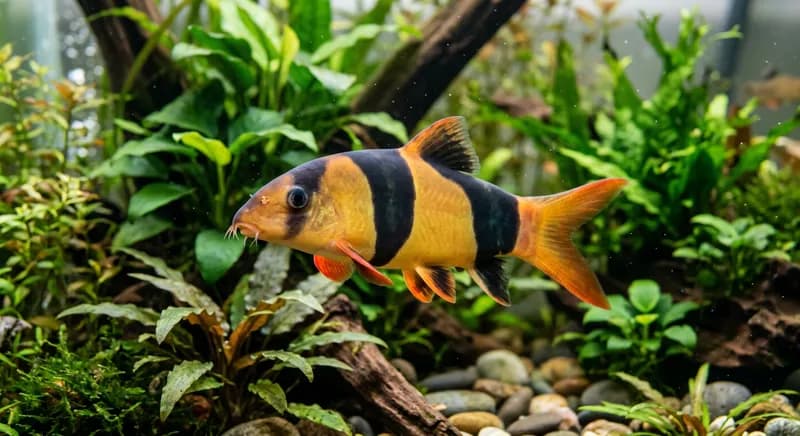
Clown Loach
Chromobotia macracanthus
Overview
Clown loaches are one of the most personality-packed freshwater fish you can keep. Orange body, three bold black bands, red fins, and behavior that ranges from hilarious to alarming. They click audibly when excited, wedge themselves into impossible spaces, and play dead by lying on their sides at the bottom of the tank. That last one has caused countless panicked forum posts from new owners who think their fish just died. It did not. It is sleeping. The problem with clown loaches is that most people buy them at 2-3 inches from a pet store and have no idea they grow to 10-12 inches. A full-grown school of 5 clown loaches needs a 125-gallon tank or larger. This is a 20+ year commitment to a fish that gets big and cannot be crammed into a 30-gallon for life. If you have the space and the long-term plan, clown loaches are incredibly rewarding. If you do not have a plan for a 100+ gallon tank in the next few years, pick a different loach.
Tank Setup
A 75-gallon tank is the absolute minimum for a small group of juveniles, with a clear upgrade path to 125+ gallons as they grow. These fish reach 6-8 inches within 2-3 years and eventually hit 10-12 inches. They need horizontal swimming space and lots of hiding spots. Use driftwood, caves, and PVC pipes to create shelters because clown loaches spend a lot of time wedged into tight spaces. Sand substrate is strongly preferred since they dig and sift through it. Gravel can irritate their barbels. Moderate to strong filtration is necessary because a school of 5 large loaches produces serious waste. A canister filter rated for the full tank volume (or oversized) is the standard choice. These fish are active and will rearrange lightweight decorations.
Water Parameters
Temperature between 77-86 degrees Fahrenheit with 82 as the ideal. Clown loaches like it warm, which is worth noting because it limits some tankmate options and speeds up metabolism (meaning more feeding and more waste). pH of 6.0 to 7.5 works, with slightly acidic being preferred. Soft to moderately hard water is ideal. Weekly 25-30% water changes are the baseline, and more frequent changes are better with a heavy bioload. Clown loaches are sensitive to nitrate buildup, so keep nitrates under 20 ppm. They are also notoriously sensitive to medications, particularly copper-based treatments. If you need to medicate, use half doses and monitor closely.
Diet & Feeding
Clown loaches are omnivores with big appetites. Sinking pellets or wafers should form the daily base. Supplement with frozen bloodworms, frozen brine shrimp, and blanched vegetables like zucchini and cucumber. They are one of the few fish that eat pest snails, and many aquarists specifically add clown loaches to tanks with snail problems. Feed twice daily, enough for the group to eat within 3-4 minutes. They are primarily bottom feeders but will swim to all levels for food. As they grow larger, increase the food size accordingly. A 10-inch clown loach eats significantly more than a 3-inch juvenile.
Behavior & Temperament
Clown loaches are social, active fish that should never be kept alone. A group of at least 5 is the minimum, and they become noticeably more active and confident in larger groups. They establish a hierarchy with a dominant individual, and there is constant interaction within the school. The "playing dead" behavior, where they lie on their side on the bottom, is normal and can happen at any time. They also make audible clicking sounds, especially during feeding or when excited. Clown loaches are generally peaceful toward other species but will eat small invertebrates like shrimp and snails. They are most active during dawn and dusk and may hide during bright midday lighting. Provide shaded areas and dimmer light periods to encourage natural behavior.
Compatible Tankmates
In a large tank, clown loaches work with many community species. Tiger barbs are a classic pairing because both are active and robust. Cherry barbs, zebra danios, rainbowfish, and larger tetras all work. Bristlenose plecos and larger corydoras share the bottom level peacefully. Angelfish and pearl gouramis are fine in a big enough setup. Avoid anything small enough to be eaten (ember tetras, celestial pearl danios, small shrimp). Snails will be consumed. Do not keep with aggressive cichlids that might harass the loaches. Because clown loaches prefer warm water (82 degrees), tankmates need to tolerate that temperature range.
Common Health Issues
Clown loaches are notorious for getting ich. Their small, embedded scales make them more susceptible than most fish. At the first sign of white spots, raise the temperature to 86 degrees (they tolerate this well) and treat with ich medication at half the normal dose. Full-dose medications can harm or kill clown loaches because they are scaleless in practical terms. This medication sensitivity extends to most treatments, so always start with half doses. Skinny disease (internal parasites) is another concern, especially in newly imported fish. If a loach is eating but losing weight, treat with praziquantel-based food. Bacterial infections can occur in poor water quality but respond to clean water and careful antibiotic use.
Breeding
Clown loaches are almost never bred in home aquariums. In the wild, they migrate upstream to spawn, and replicating those conditions is extremely difficult. Nearly all clown loaches in the hobby are wild-caught from Indonesia, which raises sustainability questions. Some commercial farms in Southeast Asia breed them using hormone injections, but home breeding remains essentially impossible. If your clown loaches spawn naturally, you have accomplished something that 99.9% of fishkeepers never will. For this reason, treat every clown loach as a long-term commitment, because replacing one from a breeding program is not an option.
Tankmates to Avoid
These species don't mix well with Clown Loach. Tap a name for the full breakdown.
Frequently Asked Questions
Quick Stats
Related Guides
What You Need for Clown Loach
Gear that works well for this species, based on what experienced keepers actually use.
Handles 75-125 gallon tanks with ease. The bioload from 5 large clown loaches demands serious filtration, and the FX4 delivers.
Sinks directly to the bottom where clown loaches feed. High protein with vegetable content. Break into pieces for juveniles.
300W handles 75-100 gallon tanks. Clown loaches need warm water at 82 degrees consistently, so a reliable heater is critical.
Fine sand that is gentle on loach barbels. Clown loaches dig and sift through substrate, and sharp gravel damages their sensitive mouths.
Accurate liquid tests for ammonia, nitrite, nitrate, and pH. High-bioload tanks need regular testing to catch problems early.