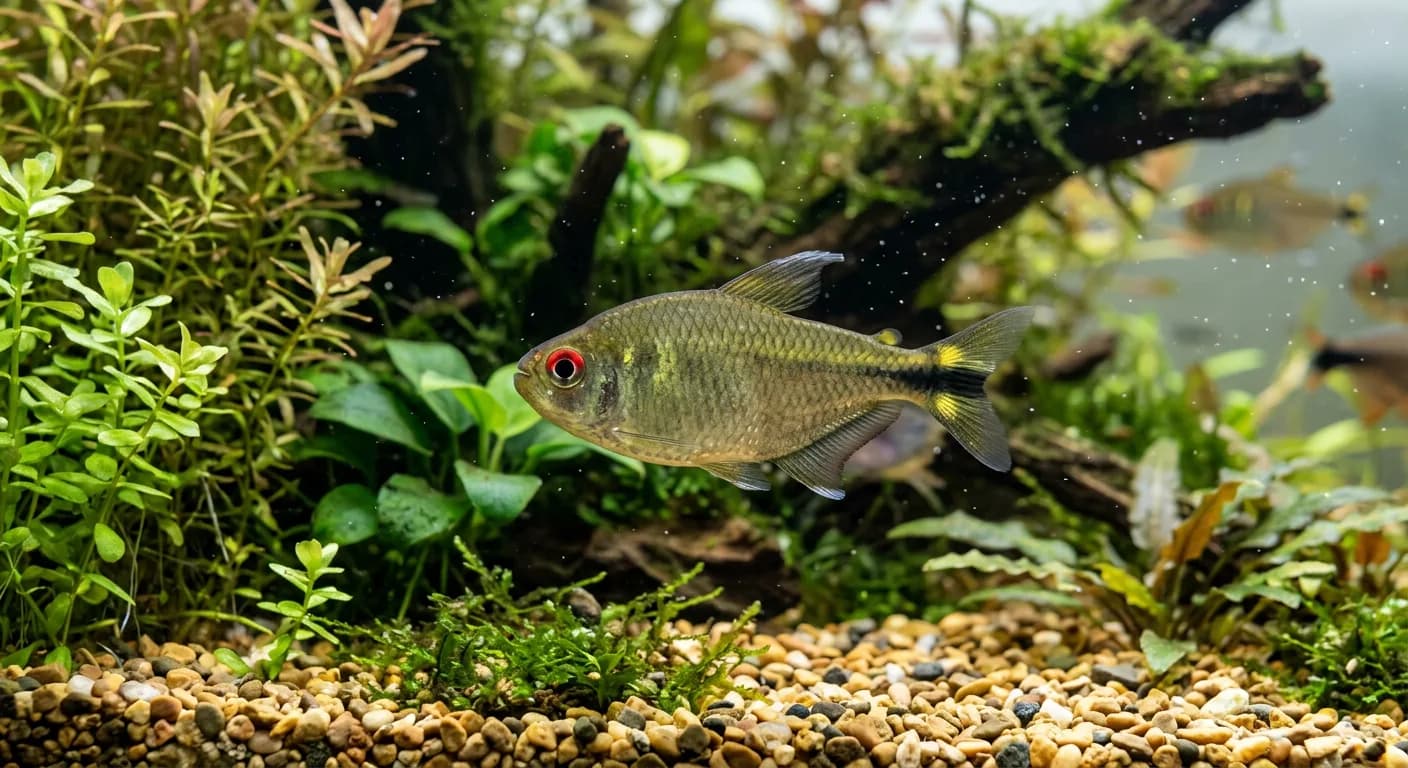
Red Eye Tetra
Moenkhausia sanctaefilomenae
Overview
The Red Eye Tetra is one of those underrated community fish that deserves more attention. It has a sleek, silvery body with a distinctive red patch right behind the eye — hence the name. This is a hardy, peaceful fish that tolerates a wide range of water conditions, making it perfect for beginners and experienced aquarists alike. Unlike some tetras that stay small and timid, Red Eye Tetras hold their own in a community tank without being aggressive. They school tightly and move as a coordinated group, which is genuinely mesmerizing to watch. Males can develop slightly more vibrant coloration as they mature, but females tend to be larger and fuller-bodied. These fish are often overlooked in favor of neons or cardinals, but they bring the same schooling behavior with a more robust constitution. A group of 6-8 in a 30-gallon tank will give you years of reliable, entertaining activity.
Tank Setup
A 20-gallon is the minimum for a group of 6, but a 30-gallon is ideal and lets you keep a larger school. Red Eye Tetras come from the rivers of Paraguay and southern Brazil, where the water is warm, slightly acidic, and receives plenty of light. They do best in a planted tank with open swimming space in the center. Vallisneria, java fern, anubias, and amazon swords all work well. Use dark substrate to bring out their silvery body color and make the red eye pop. Filtration should provide moderate flow — they like some current but not a blast. A hang-on-back filter works perfectly for a 20-30 gallon setup. These are not jumpers like some other tetras, but a covered tank is still a good idea. Lighting should be moderate to bright to showcase their colors. Live plants help stabilize water parameters and give these active swimmers places to rest and explore.
Water Parameters
Red Eye Tetras are forgiving fish when it comes to water chemistry. They adapt to pH between 5.5 and 7.5, though slightly acidic to neutral (6.5-7.0) brings out their best coloration. They handle moderately soft to moderately hard water (4-12 dGH). Temperature should stay between 73 and 84 degrees, with 78 being ideal. These are tougher than most tetras and tolerate brief temperature spikes and minor water quality issues better than sensitive species. That said, ammonia and nitrite must always be zero. Nitrates should stay under 20-30 ppm with weekly 25% water changes. They are not fussy about GH or KH, making them a great choice for people on municipal water supplies. Wild-caught specimens may need more specific conditions, but tank-bred fish are extremely adaptable.
Diet & Feeding
Red Eye Tetras are uncomplicated omnivores that will eat almost anything. A quality flake or micro pellet is the daily staple. Omega One flakes, Fluval Bug Bites, or New Spectrum pellets all work well. They are mid-water feeders that eagerly chase food as it drifts down. Supplement with frozen bloodworms, brine shrimp, or daphnia 2-3 times per week. They also nibble on algae and will accept blanched vegetables like zucchini. Feed twice daily, only what they finish in 2-3 minutes. These are enthusiastic eaters that will outcompete slower, more timid tankmates. Watch that bottom-dwellers still get their share. Their robust appetite and varied diet contribute to their overall hardiness and vibrant appearance. Color-enhancing foods with natural pigments help maintain their silvery sheen.
Behavior & Temperament
Red Eye Tetras are active, peaceful schooling fish that spend most of their time in the middle of the water column. They school tightly, especially when startled or when larger fish are present. A group of 6+ will establish a natural hierarchy and swim in a coordinated pattern that is a joy to watch. Males occasionally display to each other by flaring their fins, but actual aggression is rare. They are peaceful with all tankmates that are not large enough to eat them. Their activity level is moderate — more energetic than sedate tetras like neons, but not as manic as danios. They do well with other peaceful community fish and are confident enough to hold their own without being nippy. They appreciate having plants and decorations to break up sight lines and provide security. A well-established school will often venture to the front of the tank to greet their owners.
Compatible Tankmates
Red Eye Tetras pair well with most peaceful community fish that can handle similar water parameters. Other tetras (neon, cardinal, ember, rummy-nose, lemon, glowlight) make excellent shoaling companions. Corydoras (bronze, sterbai, panda, pygmy) are great bottom-dwellers that share their peaceful temperament. Rasboras, barbs, and danios all work as mid-water community fish. Livebearers like guppies, platies, mollies, and swordtails share their hardiness and easygoing nature. Bottom cleaners like bristlenose plecos, otocinclus, and kuhli loaches help keep the tank clean. Avoid large, aggressive fish like cichlids, Oscars, or silver dollars that would see them as food. Tiger barbs and dwarf puffers are too aggressive and will harass them. They are also not ideal companions for slow-moving, long-finned fish like bettas or angelfish.
Common Health Issues
Red Eye Tetras are remarkably healthy fish when kept in proper conditions. The most common issue is ich, usually triggered by temperature drops during water changes or stress from shipping. Standard heat treatment (raise to 86 degrees over 48 hours) combined with aquarium salt usually clears it up. They can occasionally develop fungal infections, which appear as white cottony patches. Treat with antifungal medications like methylene blue or potassium permanganate. Internal parasites are rare but can occur in wild-caught specimens, showing as weight loss despite normal appetite. Medicated food with praziquantel handles most intestinal parasites. Fin rot can occur in poor water quality and is treated by improving water conditions and, if needed, antibacterial medications. The single best preventive measure is consistent water quality and a varied, nutritious diet. Tank-bred Red Eye Tetras are extremely resilient and rarely have issues when properly maintained.
Breeding
Breeding Red Eye Tetras is achievable in a home aquarium, though it requires some setup and patience. Condition a breeding group (one male with two females) with live and frozen foods for 2 weeks. Set up a separate breeding tank (10-20 gallons) with spawning mops or fine-leaved plants like java moss. Use slightly acidic, softer water (pH 6.0-6.5, 2-4 dGH) and keep the temperature at 78-80 degrees. Spawning typically occurs in the early morning. Males chase females through the plants, and the female scatters eggs among the plants or on the substrate. Adults will eat the eggs, so remove them immediately after spawning. Eggs hatch in 24-48 hours, and the fry become free-swimming 3-4 days later. Fry are tiny and need infusoria or liquid fry food for the first week, then can transition to freshly hatched baby brine shrimp. Growth is relatively fast, and fry reach about half an inch within 2-3 months. Sexual maturity occurs around 6-8 months.
Tankmates to Avoid
These species don't mix well with Red Eye Tetra. Tap a name for the full breakdown.
Frequently Asked Questions
Quick Stats
What You Need for Red Eye Tetra
Gear that works well for this species, based on what experienced keepers actually use.
Rated for tanks up to 30 gallons with excellent biological and mechanical filtration. The multi-stage design provides clean, healthy water without excessive flow. Quiet operation and easy media replacement make it perfect for a Red Eye Tetra setup.
Adjustable 100W heater suitable for 20-40 gallon tanks. Simple dial temperature control for the 73-84F range Red Eye Tetras need. Compact design fits discreetly in smaller tanks. Automatic shut-off prevents overheating.
Complete liquid test kit measures pH, ammonia, nitrite, and nitrate. Essential for monitoring water quality in a Red Eye Tetra tank. Long-lasting reagents provide hundreds of tests. Accurate readings help prevent common health issues.
Insect-based formula with black soldier fly larvae as the first ingredient. High protein content supports health and coloration in Red Eye Tetras. Small flake format is perfect for their mouth size and floats briefly before sinking.