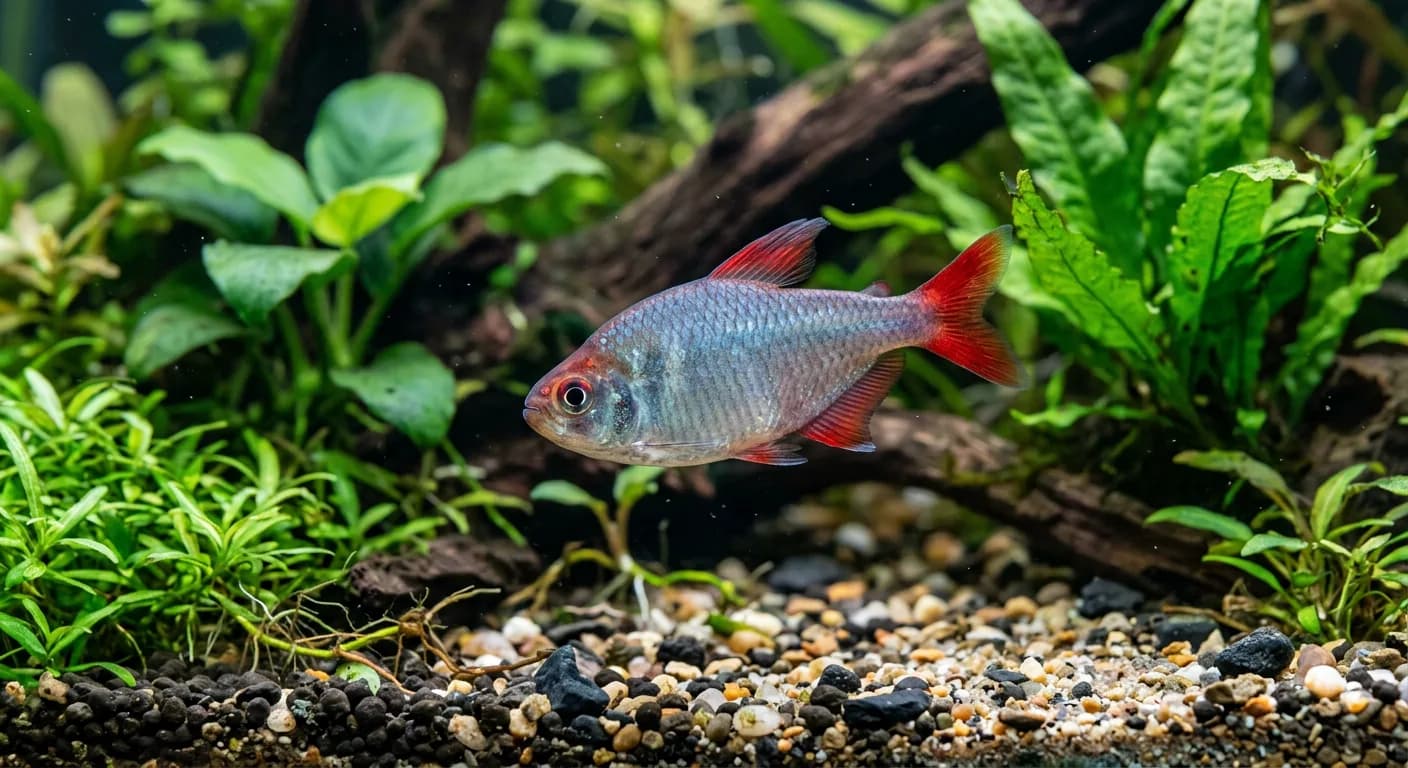
Columbian Tetra
Hyphessobrycon columbianus
Overview
Columbian tetras are the underrated workhorses of the tetra world. Native to the rivers of Colombia in South America, these fish combine the schooling behavior and elegance of popular tetras with a striking color palette that does not get enough attention. The body is a silvery-blue with a distinct dark stripe running horizontally through the middle, ending in a bright red spot at the tail base. Males develop elongated dorsal fins as they mature, adding to their visual appeal. They reach about 2.5 inches, making them a bit larger than neons but still small enough for community tanks. What sets Columbians apart is their personality. They are active, confident swimmers that hold their own in a community tank without being aggressive. A school of 6+ moving through a planted tank is a graceful display of coordinated movement that never gets old.
Tank Setup
A 20-gallon is the minimum for a group of 6, but a 30-gallon is ideal. Columbian tetras come from the rivers of Colombia, where the water is warm, slightly acidic to neutral, and flows with moderate current. They appreciate a planted tank with open swimming space in the center and along the sides. Vallisneria, java fern, anubias, and crypts all work well. Add driftwood and dried leaves to mimic their natural environment and provide hiding spots. Use sand or fine gravel as substrate. Filtration should provide gentle to moderate current, turning over the tank 4-6 times per hour. A hang-on-back filter or canister filter works well. Avoid strong flow, as these are not strong swimmers compared to some other tetras. Keep the tank covered, as these active fish can jump when startled or during feeding frenzies. Good lighting brings out their best colors, and a dark substrate makes the blue and red coloration really pop.
Water Parameters
Columbians are adaptable fish that do well in a range of conditions. Aim for a pH between 6.0 and 7.5, with slightly acidic water being ideal. They tolerate moderately hard water but prefer softer to moderate hardness. Temperature should stay between 72 and 82 degrees, with 77 being the sweet spot. They are reasonably hardy once established, but like all tetras, they need excellent water quality. Ammonia and nitrite must always be zero. Keep nitrates under 20 ppm with weekly 25% water changes. Their larger size compared to many small tetras means they produce a decent bioload, so do not overstock. They are more forgiving of occasional parameter swings than some sensitive species, but consistent water quality will keep them colorful and active.
Diet & Feeding
Columbian tetras are unfussy omnivores that will eat almost anything. A quality flake or small pellet is the daily staple. Omega One Small Fish Flakes, Fluval Bug Bites, or New Life Spectrum Micro Pellets all work well. Because they have slightly larger mouths than tiny tetras, they can handle slightly bigger food. Supplement with frozen bloodworms, brine shrimp, or daphnia 2-3 times per week. They are mid-water feeders that will opportunistically grab food from the surface as it drifts down. Feed 2-3 times daily, only what they finish in 2-3 minutes. A well-fed school is a healthy school with brighter colors. They are not aggressive feeders, so make sure shyer tankmates get their share. Color-enhancing foods with natural pigments help maintain the red tail spot and blue body sheen.
Behavior & Temperament
Columbian tetras are active, schooling fish that do best in groups of 6 or more. They swim together in a coordinated school, often hovering in a loose formation in the mid-water column. Males will occasionally display to each other by spreading their fins and intensifying their colors, but actual aggression is rare. They are peaceful with other species and make excellent community fish. Their confidence sets them apart from some shyer tetras. They are large enough to hold their own but small enough not to bully other fish. They are not fin nippers, but their activity level may stress very timid species. A school of 8-10 in a 30-gallon tank is a beautiful sight, with the whole group moving as one through the plants. They are day-active fish that are most animated during feeding times and lights-on periods.
Compatible Tankmates
Columbians pair well with most peaceful community fish of similar size. Other small tetras like neon tetras, cardinal tetras, glowlight tetras, and ember tetras make excellent companions. Harlequin rasboras and cherry barbs share similar water preferences and temperament. Bottom-dwelling corydoras, including bronze, panda, sterbai, and pygmy varieties, are excellent tankmates that occupy a different level of the tank. Dwarf gouramis add some visual contrast without being aggressive. Otocinclus and bristlenose plecos handle algae cleanup. Rainbowfish like boesemani add movement and color. Shrimp, including cherry, ghost, and amano, are generally safe as long as the tetras are well-fed. Avoid housing them with large cichlids, oscars, or silver dollars that would see them as food. Fin nippers like tiger barbs will stress these gentle fish. Avoid bettas, which may be harassed by the active schooling behavior.
Common Health Issues
Columbian tetras are generally hardy fish with few specific health problems. The most common issue is ich, which often appears after stress from shipping, handling, or poor water quality. Standard ich treatment with raised temperature and aquarium salt is effective. They can be susceptible to fungal infections if injured or kept in poor water conditions. Columnaris is occasionally seen, presenting as white patches or cotton-like growths. Treat with antibiotics like kanamycin or furan-2. Because they are active swimmers, they can be damaged by sharp decorations or aggressive tankmates. Quarantine new fish for at least 2 weeks before adding them to the main tank. The best prevention is maintaining excellent water quality, feeding a varied diet, and keeping them in a proper school. Columbians that are kept in optimal conditions are vibrant, active fish that rarely encounter serious health problems.
Breeding
Breeding Columbian tetras is moderately challenging but achievable in a home aquarium. They are egg scatterers that do not provide parental care. Set up a separate breeding tank (10-20 gallons) with very soft water (2-4 dGH), slightly acidic pH (6.0-6.5), and temperatures around 80 degrees. Use spawning mops or fine-leaved plants like java moss for the fish to deposit eggs on. Condition the breeding pair with live and frozen foods for 1-2 weeks. Spawning usually occurs in the early morning. The female will scatter eggs among the plants, and the male will follow to fertilize them. Remove the adults after spawning, as they will eat the eggs. Eggs hatch in 24-36 hours, and the fry become free-swimming 3-4 days later. Fry are tiny and need infusoria or liquid fry food initially, then graduate to baby brine shrimp. Growth is moderate, with fry reaching about 0.5 inches in 2 months. The characteristic red tail spot and blue body coloration develop around 3-4 months of age.
Tankmates to Avoid
These species don't mix well with Columbian Tetra. Tap a name for the full breakdown.
Frequently Asked Questions
Quick Stats
What You Need for Columbian Tetra
Gear that works well for this species, based on what experienced keepers actually use.
Rated for tanks up to 30 gallons with excellent biological filtration. The adjustable flow rate lets you create gentle to moderate current suitable for Columbian tetras. The sponge pre-filter protects fry and shrimp from being drawn into the intake.
50W heater suitable for 10-30 gallon tanks. Adjustable temperature dial lets you precisely hit the 72-82F range Columbians need. Submersible design distributes heat evenly through the tank.
Complete liquid test kit measures pH, ammonia, nitrite, and nitrate. Essential for monitoring water quality in community tanks where parameters can shift. Includes detailed instructions for accurate testing.
Insect-based formula with black soldier fly larvae. Small granule size is perfect for mid-sized tetras. The formula supports vibrant coloration and overall health in tropical fish.