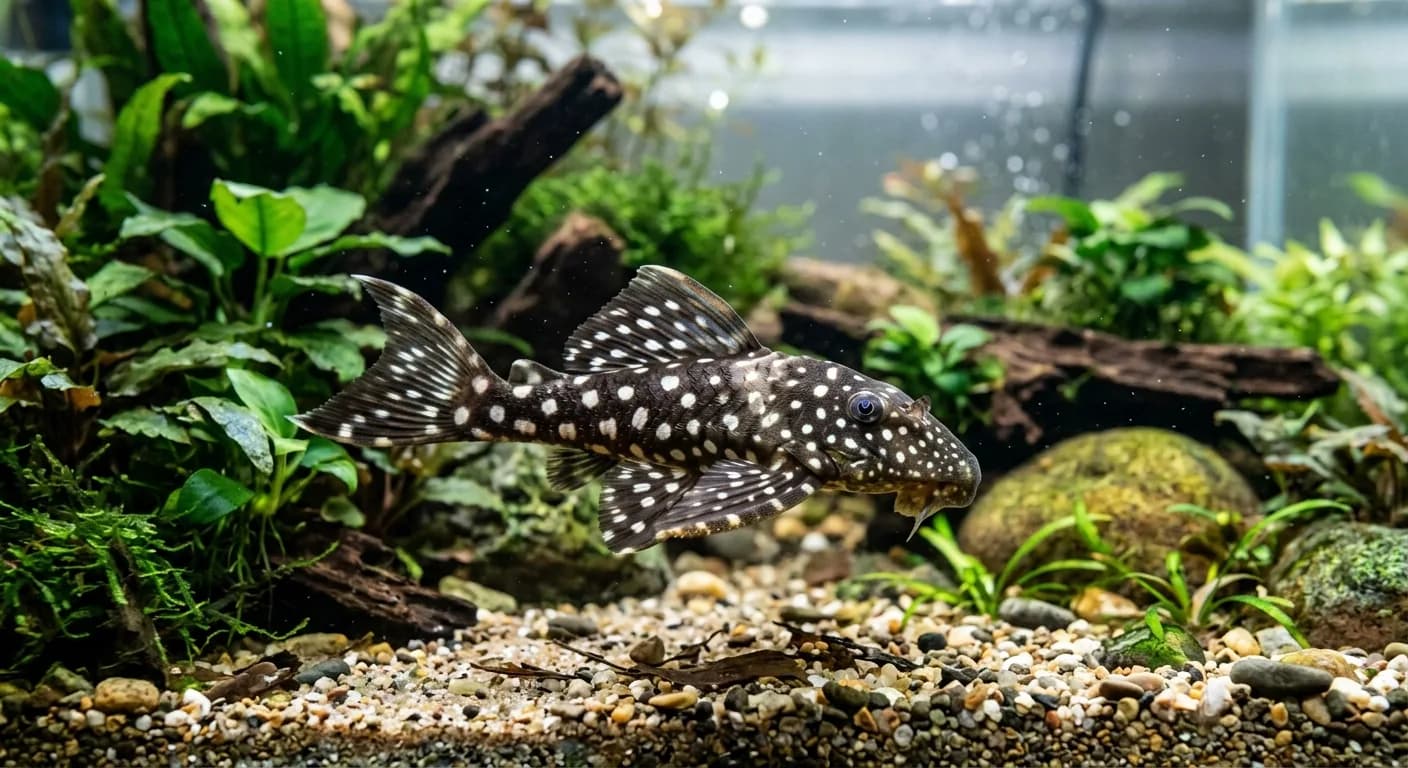
Snowball Pleco
Hypancistrus inspector
Overview
Snowball plecos are one of the most striking plecos you can keep in a reasonably sized tank. The jet-black body is covered in bright white spots that look like someone flicked paint across a chalkboard. Each fish has a unique spot pattern, and the contrast gets more dramatic as they mature. These are not your typical algae-eating plecos. Snowball plecos are carnivores that need meaty foods and won't survive on leftover flakes and algae. They come from fast-moving rivers in Venezuela where they live in rocky crevices and caves. In the aquarium, they absolutely must have hiding spots. A bare tank with just plants will stress them out completely. Think caves, driftwood with hollows, and rock formations they can wedge into. They are peaceful with tankmates but can be territorial with other bottom-dwellers, especially other plecos. One per tank is the safest approach unless you have a very large setup with multiple territories.
Tank Setup
Start with a 30-gallon tank minimum, though 55 gallons gives you much more flexibility for tankmates and territories. Snowball plecos need excellent water quality and high oxygen levels to match their natural river habitat. Use a powerful filter that turns over the tank 6-8 times per hour. A canister filter with spray bar creates good surface agitation for oxygen exchange. Substrate should be sand or smooth gravel to protect their delicate barbels when they forage. The most important element is hiding places. Provide at least 2-3 caves or hollow decorations they can completely disappear into. Driftwood, ceramic caves, and stacked rocks all work. They feel most secure when they can back into a tight space with only their head showing. Lighting can be moderate since they are mostly nocturnal, but good light supports plant growth which helps with water quality. Keep the tank covered with a tight-fitting lid. While not jumpers like some plecos, they can get startled and launch themselves during water changes or tank maintenance.
Water Parameters
Snowball plecos are more sensitive to water quality than common plecos. They need soft to moderately soft water with a pH between 6.0 and 7.5. Temperature must stay warm at 79-86°F, with 82°F being ideal. They come from oxygen-rich rivers, so dissolved oxygen levels matter more than with most tropical fish. Strong filtration and surface agitation are non-negotiable. Ammonia and nitrite must be zero, and nitrates should stay under 20 ppm. Weekly water changes of 25-30% are essential, and some keepers do twice-weekly changes if bioload is high. These plecos are intolerant of parameter swings, so use a reliable heater and test water regularly. When buying one, ask about the current tank conditions and match them as closely as possible during acclimation. Rapid changes in pH or temperature can trigger stress and disease in newly imported fish.
Diet & Feeding
Snowball plecos are carnivores, not algae eaters. Their diet should be 70-80% protein-based foods. Sinking carnivore pellets form the daily staple. Supplement with frozen bloodworms, brine shrimp, and blackworms 2-3 times per week. Many keepers also offer live foods like blackworms or tubifex when available. They will eat sinking wafers designed for bottom feeders, but check the ingredients. High-protein, low-plant matter formulas work best. Feed once daily in the evening after the tank lights go out. Snowball plecos are shy and may not compete well with aggressive tankmates at feeding time. If they seem thin or you rarely see them, try feeding late at night when the tank is quiet. Fresh vegetables like zucchini or sweet potato can be offered occasionally, but they should not make up more than 20% of the diet. Some individuals ignore plant matter entirely. Watch their body condition and adjust feeding amounts accordingly. A well-fed snowball pleco has a rounded belly but not a bloated appearance.
Behavior & Temperament
Snowball plecos are peaceful, shy fish that spend most of their time hidden in caves or crevices. They are most active at night when they emerge to forage for food. During the day, you might only see the tip of a nose sticking out of a cave. This is normal behavior, not a sign of illness. They use their sucker mouths to rasp food from surfaces and to anchor themselves in currents. Unlike common plecos, they rarely venture into the middle or upper portions of the tank. Their territorial behavior is limited to the bottom level and usually only involves chasing away other plecos or bottom-dwellers that get too close to their chosen cave. They are not aggressive toward fish that swim in higher levels of the tank. Snowball plecos can live alone or with a mate, but keeping multiple males requires a large tank with separate territories. Females are generally less territorial than males. During breeding condition, males may become more active and spend time cleaning and defending a specific cave.
Compatible Tankmates
Snowball plecos work well with most peaceful community fish that prefer neutral to slightly acidic water and warm temperatures. Small to medium tetras like cardinals, neons, and rummy-nose make excellent tankmates. Rasboras, cherry barbs, and ember tetras also work well. Corydoras species are generally compatible, though watch for competition over bottom space and food. Dwarf cichlids like rams and apistos can coexist peacefully as long as breeding territories don't overlap. Angelfish, honey gouramis, and pearl gouramis are good choices for the upper levels. Livebearers like platies and mollies work if you can maintain the slightly acidic water snowball plecos prefer. Avoid large, aggressive fish that might harass them or outcompete them for food. Other plecos should be avoided unless you have a very large tank. Fast, nippy fish like tiger barbs may stress them out. Large predatory fish like oscars will eventually try to eat them, even though the snowball pleco's spines make them a difficult target.
Common Health Issues
Snowball plecos are sensitive to poor water quality and can develop bacterial infections if ammonia or nitrite levels spike. The most common problem is fin rot, which appears as frayed or discolored fin edges. This usually responds to improved water quality and antibacterial medications if caught early. Ich can affect snowball plecos, but treat carefully since many medications are toxic to scaleless fish. Raise temperature gradually to 86°F and use ich medications specifically labeled as safe for catfish and plecos. Internal parasites are sometimes an issue with wild-caught specimens, showing up as weight loss despite normal feeding. Treat with medicated food containing praziquantel. Constipation can occur if they are fed too many dry foods without enough variety. Offer frozen or live foods regularly to prevent this. Stress-related illnesses are common if they lack adequate hiding places or are kept in poor water conditions. A stressed snowball pleco will stay hidden constantly, refuse food, and show pale coloration. The best prevention is stable water parameters, good filtration, proper diet, and sufficient caves for security.
Breeding
Breeding snowball plecos in home aquariums is challenging but possible for experienced keepers. They are cave spawners that require specific conditions to trigger breeding behavior. Set up a dedicated breeding tank of at least 75 gallons with multiple clay or ceramic caves that have openings just large enough for the male to enter. Water should be soft (2-8 dGH), slightly acidic (pH 6.0-6.8), and warm (84-86°F). Condition a proven pair with high-quality foods for 4-6 weeks. The male will clean and defend a chosen cave, often spending days preparing it. When ready, the female deposits 20-40 large eggs in the cave, and the male fertilizes them. The male guards the eggs and fans them with his pectoral fins for 7-10 days until they hatch. The fry are large enough to take baby brine shrimp immediately but grow slowly. Remove the female after spawning since the male may become aggressive. Breeding is more likely during cooler months or after simulating a wet season with increased water changes and slightly cooler temperatures. Success requires excellent water quality, mature fish (2+ years old), and considerable patience.
Tankmates to Avoid
These species don't mix well with Snowball Pleco. Tap a name for the full breakdown.
Frequently Asked Questions
Quick Stats
What You Need for Snowball Pleco
Gear that works well for this species, based on what experienced keepers actually use.
High flow rate and customizable media provide the strong biological and mechanical filtration snowball plecos need. Multiple media baskets allow you to fine-tune filtration for optimal water quality.
Reliable temperature control for the warm 79-86°F range snowball plecos require. Fully submersible design works well with the high water flow these fish need.
High-protein sinking pellets formulated specifically for carnivorous bottom feeders. The pellets soften quickly and won't cloud the water when used as a staple diet.
Fine, smooth substrate that won't damage delicate barbels when the pleco forages. Black color creates a striking contrast with the white spots and provides a natural-looking riverbed appearance.