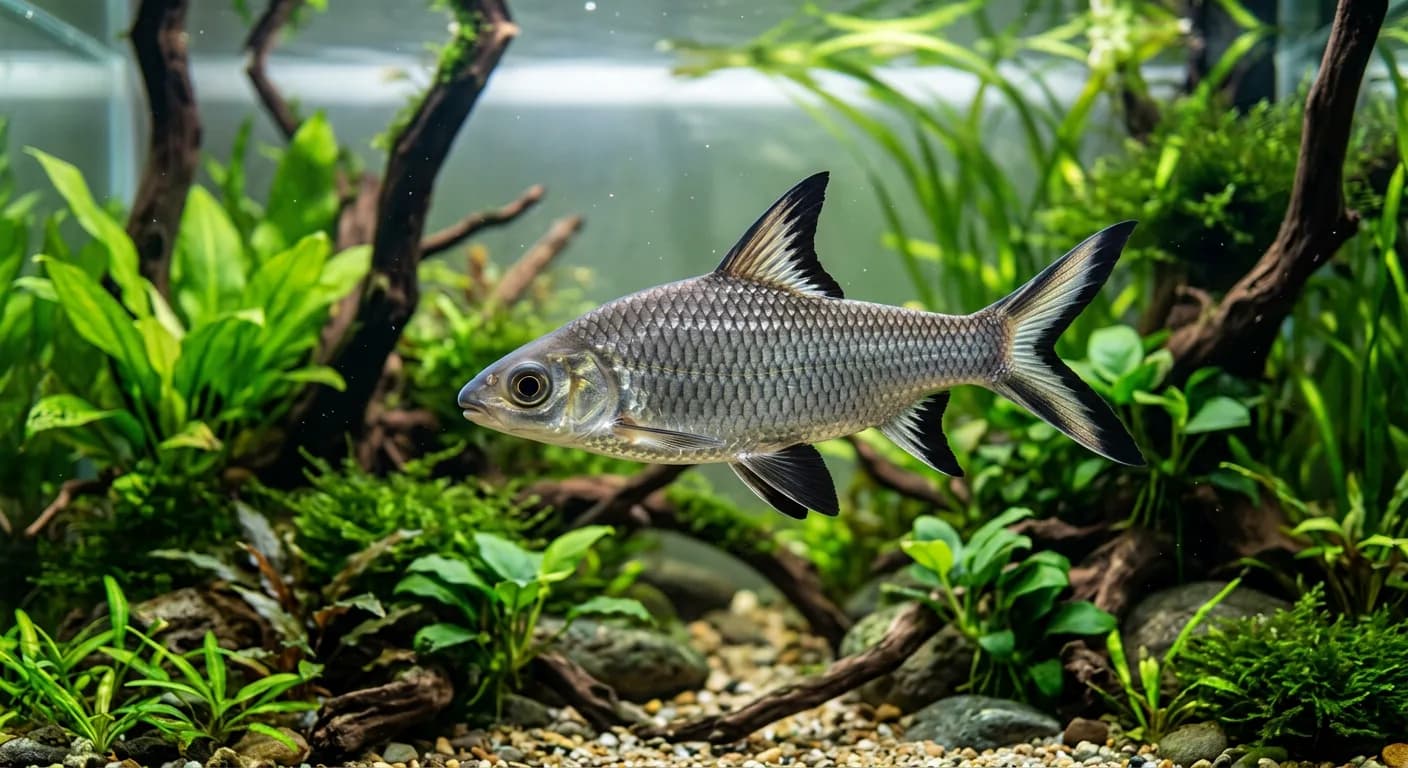
Bala Shark
Balantiocheilos melanopterus
Overview
Bala Sharks are one of the most striking fish in the freshwater hobby. The silver body with black-edged fins and the torpedo shape make them look like actual sharks, but their temperament is the opposite. They are peaceful schoolers from the rivers of Southeast Asia, where they swim in large groups through fast-moving water. In the wild, they reach 14 inches. In a home aquarium, most stop around 12. They are popular fish, but they are commonly sold at 2-3 inches when they are juveniles, which misleads a lot of buyers about what they are actually getting. A group of six full-grown Bala Sharks in a 125-gallon tank is a genuinely impressive display. Six of them crammed into a 40-gallon breeder is a problem. Buy them only if you can commit to the space.
Tank Setup
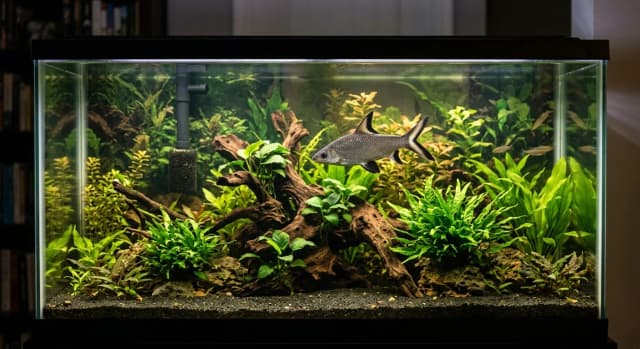
A well-setup aquarium suited to Bala Shark
A 75-gallon tank is the hard minimum for a small school, and even then you should be planning your upgrade to 125 gallons within a year or two. Bala Sharks are built for open water. They need long tanks with horizontal swimming space, not tall narrow ones. A 6-foot tank suits them far better than a 4-foot tank of equal volume. Use a secure, heavy lid with no gaps. Bala Sharks are powerful jumpers and will clear a standard glass top if they are startled. Substrate can be sand or fine gravel. They are not bottom dwellers, but they will graze along the floor occasionally. Add some tall plants and driftwood for visual security, but leave at least 60-70% of the tank as open water. Run a canister filter or a large HOB rated for twice your tank volume. Bala Sharks produce a lot of waste relative to most community fish and need strong filtration to stay healthy.
Water Parameters
Bala Sharks come from the Chao Phraya and Mekong river basins in Thailand, Cambodia, and Malaysia, where water is moderately soft and slightly acidic to neutral. They adapt well to a wider range in captivity: 72-82 degrees Fahrenheit, pH 6.0 to 8.0. Most tap water in the United States falls in this range without adjustment. Aim for 77 degrees as a daily target. Stability matters more than hitting exact numbers. A tank that holds steady at 75 degrees is better than one that swings from 72 to 80. Do weekly water changes of 25-30% to keep nitrates under 20 ppm. Bala Sharks are sensitive to ammonia and nitrite spikes, particularly when they are juveniles. A fully cycled tank with a strong filter is not optional.
Diet & Feeding
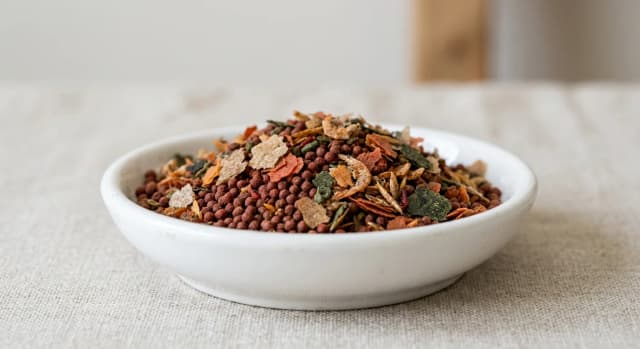
Quality nutrition supports Bala Shark health and color
Bala Sharks are opportunistic omnivores and eat nearly anything. Start with a high-quality flake or pellet as the base of their diet. Supplement 2-3 times a week with frozen or live foods: bloodworms, brine shrimp, daphnia, and glass worms all work well. They also eat blanched vegetables. Zucchini, spinach, and peas cut into small pieces are accepted readily. Feed 2-3 times daily, giving only what they finish within 2-3 minutes per feeding. Bala Sharks have fast metabolisms and grow quickly, so consistent quality feeding matters especially for juveniles. As they get larger, transition to medium-sized pellets that match their mouth size. Flakes become less efficient once they are past 6 inches.
Behavior & Temperament
Bala Sharks school tightly and need groups of six or more to feel secure. A single Bala Shark in a tank will spend most of its time stressed, hiding, and prone to disease. Two or three together is not much better. Six is the minimum for the schooling behavior that makes them worth keeping in the first place. In a proper group, they swim together constantly, draft off each other, and are active throughout the day. They are not aggressive toward other species and will not fin-nip or harass tankmates. They do bolt when startled, which is how they end up on the floor. If you see them darting suddenly, check the tank for a possible stressor: a loud noise source, a reflection, or something new that spooked them. They settle into a new tank slowly and may hide for the first 1-2 weeks.
Compatible Tankmates
Bala Sharks get along with most community fish that can hold their own in a large tank. Good matches include tiger barbs, tinfoil barbs, larger tetras like black skirts and bleeding hearts, large danios, rainbowfish, plecos, and similarly sized cichlids that are not highly territorial. Avoid keeping them with very small fish under 1.5 inches. Once Bala Sharks reach full size, a neon tetra is a snack, not a tankmate. Oscar fish are a poor match in either direction: Oscars may attack Bala Sharks, and the combined waste load from both species is heavy. Avoid aggressive cichlids entirely.
Common Health Issues
Ich is the most common problem, showing as small white spots the size of salt grains across the body and fins. It is almost always triggered by a sudden temperature drop, a stressed immune system from shipping or poor water quality, or introduction of an infected fish. Raise the tank temperature to 82-84 degrees Fahrenheit and treat with a copper-based ich medication following the label exactly. Remove carbon from the filter during treatment since it will absorb the medication. Bala Sharks are also susceptible to bacterial infections, which typically appear as frayed fins, red streaks, or ulcers on the body. These are almost always secondary to poor water quality. Fix the water first, then treat if symptoms persist after a water change. Skin flukes present as scratching behavior against surfaces or flashing. Treat with praziquantel. Internal parasites are possible in wild-caught fish and show as wasting despite a good appetite.
Breeding
Breeding Bala Sharks in home aquariums is extremely difficult and rarely happens outside of commercial facilities. They are egg-scatterers that need very large tanks, specific hormonal triggers, and conditions that closely mimic their native river habitat to spawn. Most hobbyists cannot replicate the volume of water, flow rate, and seasonally-timed rainfall cycles that trigger spawning. Distinguishing males from females is also unreliable by visual inspection alone. If you ever see spawning behavior, remove the parents after eggs are laid since they will eat them. Fry require infusoria or commercial liquid fry food for the first week before they can take baby brine shrimp.
Tankmates to Avoid
These species don't mix well with Bala Shark. Tap a name for the full breakdown.
Frequently Asked Questions
Quick Stats
What You Need for Bala Shark
Gear that works well for this species, based on what experienced keepers actually use.
Powerful filtration for large tanks. Handles the bioload from messy Bala Sharks with ease.
High-quality flakes with balanced nutrition. Bala Sharks love these and their colors stay vibrant.
Comprehensive test kit for monitoring water quality. Essential for large tanks with active fish.
Reliable heater for large tanks. Durable construction with accurate temperature control.