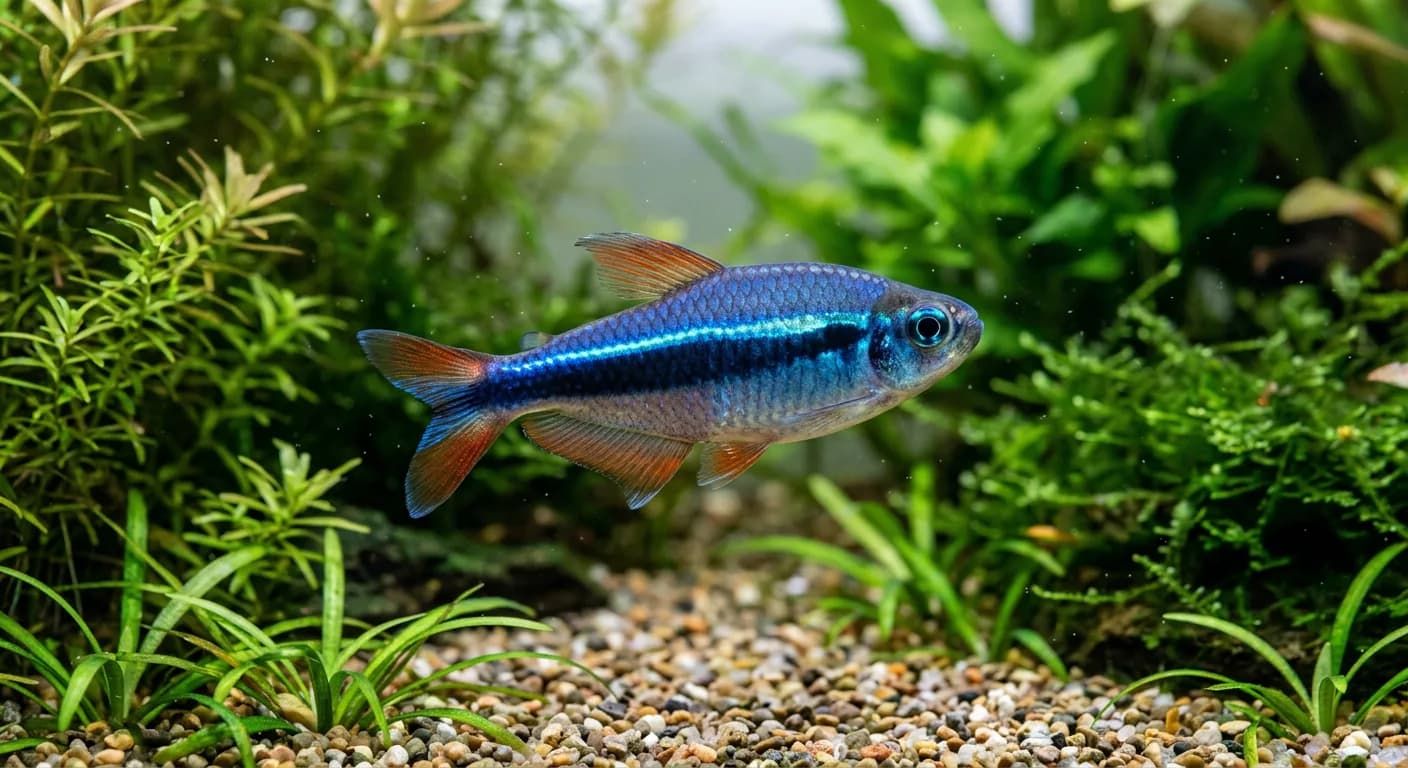
Blue Emperor Tetra
Inpaichthys kerri
Overview
The Blue Emperor Tetra is one of the most striking small tetras you can add to a community tank. Males display a brilliant iridescent blue body with a distinctive black stripe running through the tail and into the body, while females are more subdued with a silvery-gray appearance and less intense coloration. These fish bring a touch of elegance to any planted aquarium. Despite their royal name, they are remarkably peaceful and adaptable, making them an excellent choice for both beginner and experienced aquarists. They are a relatively rare find in local fish stores but are well worth seeking out for their unique coloration and schooling behavior. Blue Emperor Tetras are active swimmers that do best in groups of six or more, where they will establish a loose hierarchy and display their best colors.
Tank Setup
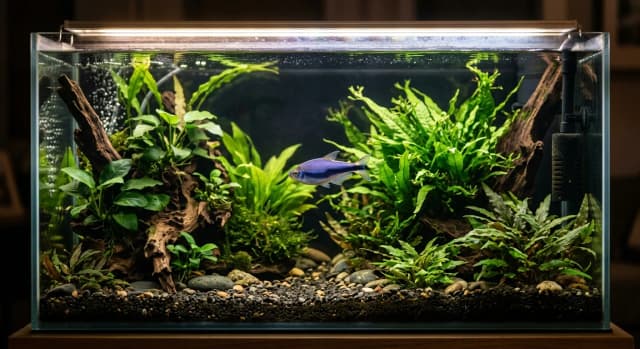
A well-setup aquarium suited to Blue Emperor Tetra
A 20-gallon tank is the minimum for a school of six Blue Emperor Tetras and works well for this active species. A 30-gallon provides more swimming space and stability if you have the room. These fish are native to the rivers of Brazil, specifically the Rio Aripuanã and Rio Roosevelt basins, where the water is warm, soft, and slightly acidic. They do best in a well-planted tank with subdued lighting, which mimics their natural habitat and helps them feel secure. Driftwood, leaf litter, and botanicals all help create the soft, acidic water conditions they prefer. Vallisneria, java fern, anubias, and amazon swords all work well. Use sand or fine gravel as substrate. Filtration should be gentle to moderate, as these fish do not appreciate strong currents. A hang-on-back filter or sponge filter works well. Keep the tank covered, as they may jump when startled.
Water Parameters
Blue Emperor Tetras are adaptable but prefer softer, slightly acidic water. Aim for a pH between 6.0 and 7.5, with 6.5 being ideal. They do well in soft to moderately hard water (2-12 dGH). Temperature should be kept between 72 and 79 degrees, with 78 as the sweet spot. They are fairly adaptable within this range but do not tolerate high temperatures well. Ammonia and nitrite must always be zero. Keep nitrates under 20 ppm with weekly 25% water changes. They are fairly hardy once established, but like all tetras, they are sensitive to sudden parameter changes. Acclimate new arrivals slowly using the drip method. These fish do well in blackwater setups with tannins from driftwood or Indian almond leaves.
Diet & Feeding

Quality nutrition supports Blue Emperor Tetra health and color
Blue Emperor Tetras are omnivores that are not particularly picky eaters. A quality flake or small pellet should form the basis of their diet. They particularly enjoy small frozen foods like bloodworms, brine shrimp, and daphnia, which help maintain their vibrant coloration. Feed small amounts 2-3 times daily, only what they can finish in 2-3 minutes. They are middle feeders and may be outcompeted by faster swimmers at feeding time, so watch that everyone gets their share. Color-enhancing foods with natural pigments can help bring out the blue in males. They also appreciate occasional vegetable matter like blanched spinach or zucchini. Avoid overfeeding, as this leads to poor water quality and health problems.
Behavior & Temperament
Blue Emperor Tetras are peaceful, schooling fish that spend most of their time in the middle of the water column. They are active but not frantic, and their movements are graceful rather than darting. In a school, males will occasionally display to each other by flaring their fins and showing off their colors, but this is rarely aggressive. They are skittish when kept in too-small groups, so six is the minimum starting number. The more you keep, the more natural their behavior and the better their colors will develop. They are ideal community fish that will not bother shrimp or snails, and they are too small to bother most other fish. They do well with other peaceful community fish and are best kept away from large, aggressive, or fin-nipping species.
Compatible Tankmates
Blue Emperor Tetras are excellent community fish that get along with a wide variety of peaceful tankmates. They pair well with other small tetras like neon tetras, cardinal tetras, ember tetras, and rummy-nose tetras. Rasboras, cherry barbs, and small danios all make good companions. Bottom-dwellers like corydoras (bronze, panda, sterbai, pygmy) and kuhli loaches are excellent additions. Small peaceful catfish like otocinclus work well. They are safe with all types of peaceful shrimp and snails. Avoid keeping them with bettas, angelfish, or other fish that may see them as food or that are overly aggressive. Large cichlids, Oscars, and other large predatory fish should be avoided entirely.
Common Health Issues
Blue Emperor Tetras are generally hardy when kept in appropriate conditions. The most common health issue is ich, which typically occurs after temperature drops or stress from shipping. Standard ich treatment with raised temperature (86 degrees over 48 hours) and aquarium salt is effective. They can also be susceptible to fungal infections, which often appear as white cottony growths. Improving water quality is the first step in treating fungal infections, followed by antifungal medications if needed. Internal parasites may occur in wild-caught or imported specimens, showing up as weight loss despite a good appetite. Medicated food with praziquantel handles most internal parasites. The best prevention is consistent water quality, a varied diet, and keeping them in a proper school. Quarantine new additions for at least two weeks before adding them to your main tank.
Breeding
Breeding Blue Emperor Tetras is moderately challenging but achievable with some preparation. They are egg scatterers that do not provide parental care. To breed them, set up a separate tank (10-15 gallons) with soft, acidic water (pH 6.0-6.5) and a temperature around 80 degrees. Use spawning mops or fine-leaved plants like java moss as substrate for the eggs. Condition the breeding pair with high-protein foods like live or frozen brine shrimp and bloodworms for 1-2 weeks. Spawning typically occurs in the morning, with the female scattering 50-150 eggs among the plants. Remove the adults after spawning, as they will eat the eggs. Eggs hatch in 24-48 hours, and the fry become free-swimming 3-4 days later. Fry are tiny and need infusoria or liquid fry food initially, then graduate to baby brine shrimp. Growth is relatively fast compared to some other tetra species.
Tankmates to Avoid
These species don't mix well with Blue Emperor Tetra. Tap a name for the full breakdown.
Frequently Asked Questions
Quick Stats
What You Need for Blue Emperor Tetra
Gear that works well for this species, based on what experienced keepers actually use.
Rated for tanks up to 30 gallons with excellent biological filtration. The multi-stage filtration system handles the bioload of a Blue Emperor Tetra school. Adjustable flow rate lets you create the gentle current these fish prefer.
Insect-based formula with black soldier fly larvae as the first ingredient. High protein supports health and coloration in Blue Emperor Tetras. The small flake size is perfect for these tiny mid-water feeders.
Fully submersible heater with adjustable temperature control. The 100W rating is ideal for 20-30 gallon tanks. LED display shows current temperature at a glance for the 72-79F range Blue Emperor Tetras need.
Complete liquid test kit measures pH, ammonia, nitrite, and nitrate. Essential for monitoring water quality in planted tanks where Blue Emperor Tetras thrive. Accurate enough for breeding setups.