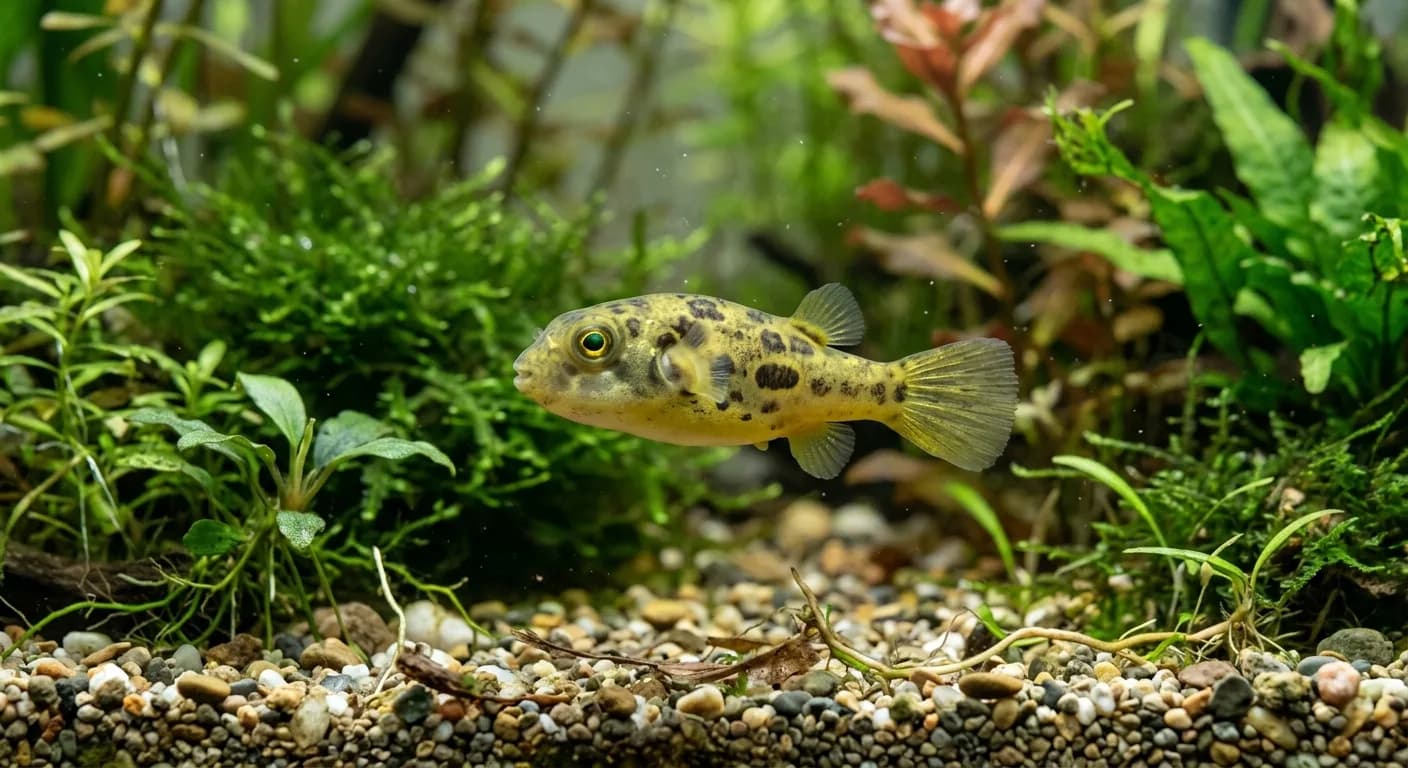
Pea Puffer
Carinotetraodon travancoricus
Overview
Pea puffers are tiny terrors that have captured the hearts of many aquarists. At just over an inch long, they are one of the smallest pufferfish species you can keep, but what they lack in size they make up for in personality. These little fish have big attitudes. They are curious, intelligent, and each one has a distinct personality. Some are bold and will interact with you through the glass, while others are more shy and reclusive. The scientific name Carinotetraodon travancoricus tells you they come from the Western Ghats region of India, where they live in slow-moving streams and rice paddies. The common name comes from their size - they are about the size of a pea. What you need to know before getting one is that they are aggressive and will eat almost anything that moves and fits in their mouth. They are also notoriously difficult to keep because they require a diet rich in snails to wear down their ever-growing teeth. Without snails, their teeth will overgrow and cause serious health problems.
Tank Setup
The minimum tank size is 10 gallons per pea puffer. This sounds small, but these fish are territorial and each one needs its own space. A single pea puffer in a 10-gallon is fine, but if you want more than one, you need significantly larger tanks with plenty of line-of-sight breaks so they can't see each other constantly. Many keepers keep a single male with several females in larger tanks, but even this requires careful monitoring. Provide plenty of plants, especially floating plants like frogbit or water lettuce that provide shade and security. Java moss, java fern, and anubias all work well. Add hardscape like driftwood, rocks, or PVC pipes to create hiding spots. Pea puffers are not plant destroyers like some other puffers, so you can plant heavily. Use a gentle filter since they come from slow-moving waters and do not appreciate strong current. A sponge filter or low-flow hang-on-back works well. Lighting can be moderate. Keep the tank covered tightly, as some pea puffers are jumpers, especially when startled.
Water Parameters
Pea puffers are adaptable to a range of conditions, which makes them somewhat forgiving on water parameters. They do well in pH between 6.5 and 8.0, and can handle both soft and moderately hard water. Temperature should stay between 74 and 82°F, with 78°F being ideal. The most important thing about water quality is stability. They are sensitive to sudden changes in parameters, so match the conditions of the tank they came from when you first get them. Do not do large water changes in the first week after adding them. Otherwise, maintain clean water with weekly 20-30% water changes. Ammonia and nitrite must always be zero. They are not particularly sensitive to nitrates but keeping them low is always better. One thing to note is that they are scaleless, so be careful with medications. Use medications specifically labeled as safe for scaleless fish.
Diet & Feeding
The diet is the most critical aspect of keeping pea puffers healthy. They are obligate carnivores that need a diet based primarily on snails. In the wild, they eat mostly freshwater snails, and their teeth are adapted to crushing snail shells. In captivity, you must provide a steady supply of snails or their teeth will overgrow and cause serious problems. Ramshorn snails and bladder snails are the most common and easiest to culture. You need a breeding colony of snails to keep up with demand. Supplement with other foods like bloodworms, brine shrimp, daphnia, and mysis shrimp. Some will eat frozen or even dry foods, but these should be occasional treats, not staples. Feed small amounts 2-3 times per day. A well-fed pea puffer has a slightly rounded belly. If you see their teeth protruding from their mouth, that is a sign of serious neglect and you need to provide more snails immediately. Trimming their teeth is possible but very difficult and stressful for the fish.
Behavior & Temperament
Pea puffers have some of the strongest personalities in the aquarium hobby despite their tiny size. They are intelligent and will learn to recognize their owners, often coming to the front of the tank when they see you. They are also aggressive and territorial. A single male in a species tank will be happy and display interesting behaviors. Multiple males will fight, often to the death. Males can be identified by their more intense coloration and the dark stripe along their back. They are curious and will explore every corner of the tank. They can be nippy toward slow-moving tankmates or fish with long fins. They are not a 'community' fish in any sense of the word, despite what pet stores might suggest. The best setup for most people is a single pea puffer in a planted tank where it can thrive as a centerpiece fish. If you want more than one, you need a large tank with multiple territories and should be prepared to separate them if aggression becomes a problem.
Compatible Tankmates
The short answer is that pea puffers have very limited compatible tankmates. They will eat anything small enough to fit in their mouth, and they are aggressive toward most fish. The only safe tankmates are large, fast-swimming fish that the puffers simply cannot catch, and even this is risky. Some keepers have had success with small danios in heavily planted tanks where the danios can escape to areas the puffer cannot reach, but this is not guaranteed to work and requires a large tank with lots of cover. The safest approach is to keep pea puffers in a species-only tank. If you want tankmates, the only reliable option is large snails like mystery snails or nerite snails, which the puffers will occasionally interact with but cannot eat. Even shrimp are not safe. Amano shrimp are sometimes kept with pea puffers, but the puffer will likely harass or kill them over time.
Common Health Issues
The most common health issues in pea puffers are related to diet and牙齿 overgrowth. Without enough snails, their teeth will grow too long and prevent them from eating properly. This is a medical emergency that requires either providing plenty of snails immediately or, in severe cases, having a vet trim the teeth. Another common issue is bacterial infections from poor water quality. Pea puffers are somewhat sensitive to water conditions and can develop red spots, fin rot, or other bacterial issues if water is not kept clean. Treat by improving water quality and using antibacterial medications safe for scaleless fish. Internal parasites are occasionally a problem, especially in wild-caught specimens, causing weight loss and lethargy. Treat with medicated foods. Ich can affect them, but use treatments specifically labeled as safe for scaleless fish. The best prevention is excellent water quality, a varied diet with plenty of snails, and careful quarantine of new additions.
Breeding
Breeding pea puffers is possible in the home aquarium and is actually one of the more rewarding aspects of keeping them. Males and females can be differentiated by coloration and behavior. Males are more colorful with brighter yellows and a distinct dark line along their back. Females are more drab and often show a rounder belly when carrying eggs. To breed them, condition a pair with plenty of high-quality foods including lots of snails. Spawning typically occurs in the early morning. The male will chase the female, and if she is receptive, she will lay eggs on plants or decorations. He will fertilize them. After spawning, remove the parents as they will eat the eggs. The eggs hatch in about 7-10 days depending on temperature. The fry are tiny and need infusoria or liquid fry food initially, graduating to baby brine shrimp as they grow. Raising the fry is challenging but doable with attention to water quality and constant access to tiny snails for when they are large enough to eat them.
Tankmates to Avoid
These species don't mix well with Pea Puffer. Tap a name for the full breakdown.
Frequently Asked Questions
Quick Stats
What You Need for Pea Puffer
Gear that works well for this species, based on what experienced keepers actually use.
Gentle sponge filter providing gentle filtration without strong currents that pea puffers dislike. Also hosts beneficial bacteria and is easy to clean. The 3-pack provides backups.
Reliable adjustable submersible heater for the 74-82°F range pea puffers need. Compact size fits well in small tanks. Digital display shows temperature clearly.
High-protein sinking pellets that some pea puffers will accept. Useful as an occasional supplement, though snails must remain the primary food source.
Essential test kit for monitoring water parameters. Pea puffers need stable water, so regular testing helps catch problems before they become serious.