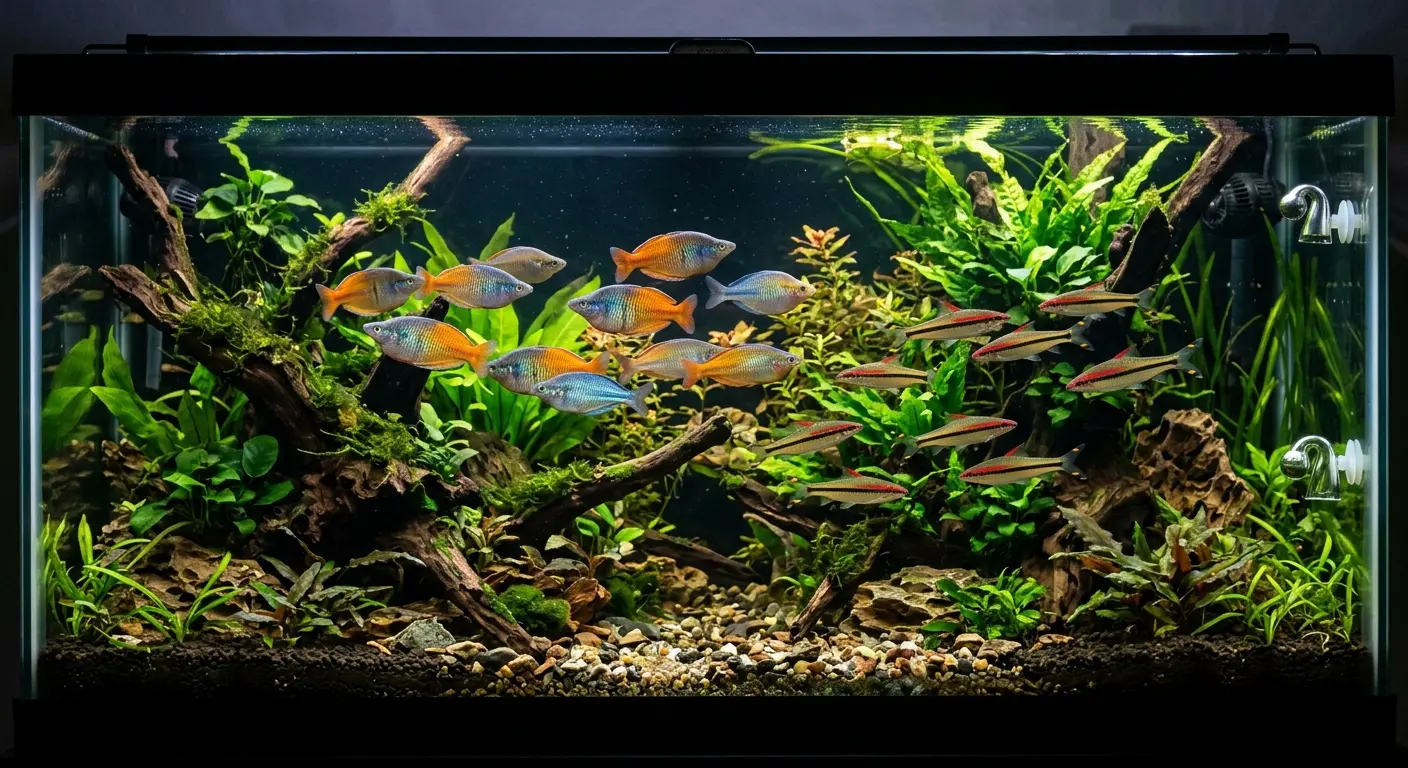
Best Fish for a 55 Gallon Tank (Species, Stocking Plans, and What to Avoid)
The 55 gallon sells well for a reason. At 48 inches long with 55 gallons of water, it's large enough to keep fish that demand real swimming room and stable water chemistry, but still fits against a wall in a normal room without major furniture rearrangement. The standard dimensions are 48x13x21 inches. The 13-inch depth is the only limitation: it's narrower front-to-back than a 40 breeder, which matters for bottom-dwelling territory. The 21-inch height, however, opens up cichlids and larger fish that smaller tanks can't comfortably handle. This guide covers what actually thrives at 55 gallons and how to build stock lists that work long-term.
01
What Changes at 55 Gallons
Moving from a 20 or 29 gallon to a 55 changes what's possible more than any other tank upgrade. Water chemistry becomes genuinely stable. Not just stable enough to survive, but stable enough to keep sensitive species without constant testing and intervention. Temperature swings of more than half a degree overnight become unusual rather than expected.
The 48-inch length means you can run schools of 15-20 small fish and still have room for other species. Schooling behavior improves dramatically with tank length because the fish have room to form genuine formations rather than circling back on themselves.
What the 55 does well: - Community builds with multiple species in true schools - Medium to large cichlids that need swimming room - Rainbowfish setups: they're active fish and 48 inches gives them room to run - The full long-term life of a single large fish like an oscar - Species that need stable parameters: discus, German blue rams, Apistogramma
The 13-inch depth trade-off:
A 55 gallon is narrower than a 40 breeder at 13 inches versus 18 inches. For cichlids that guard territory on the bottom, this matters. A pair of larger cichlids can end up facing each other across the narrow width with nowhere to retreat. The 55 gallon is better for mid-water and upper-water fish than for large bottom-territory holders. If you want territorial cichlids, a 75 gallon (48x18 inches) is a meaningfully better option than a 55 for that specific use case.
02
Large Centerpiece Fish
Oscar (1, or Mated Pair in 75+)
A single oscar is one of the best pets in the aquarium hobby. They recognize their owner, beg for food, rearrange their decorations, and develop distinct personalities. In a 55 gallon, one oscar has the space to live a full, comfortable life at its 10-12 inch adult size. Two oscars in a 55 gallon get cramped as adults, and unless they're a bonded pair you'll see aggression. For a single oscar, 55 gallons is the minimum; for two, start with 75.
The trade-off: oscars are messy fish that produce significant waste. A 55 gallon with one oscar needs a powerful canister filter running at 5-10x turnover, weekly 25-30% water changes, and no tankmates smaller than 4-5 inches. You can keep them with other large, semi-aggressive fish (severum cichlids, large catfish), but any fish that fits in an oscar's mouth becomes food.
Firemouth Cichlid (1 Pair)
Firemouth cichlids are medium cichlids from Central America that reach 6 inches. Males have an impressive threat display where they flare their red throat pouch to look larger. They're territorial when breeding but manageable in a community with fish that stay out of their territory.
A pair of firemouths in a 55 gallon with dither fish (fast mid-water fish that break line of sight between the pair and other fish) is a classic cichlid community setup. Temperature 75-82F, pH 6.5-8.0. They're significantly hardier than German blue rams and tolerate beginner water management better.
Severum Cichlid (1-2)
Severums are South American cichlids that reach 8-10 inches and develop a genuinely gentle personality for a fish that size. Gold and green color varieties exist; both have distinctive dark banding that fades as the fish matures. They're compatible with smaller cichlids like firemouths and with large, fast-moving tetras and barbs that they can't catch easily.
One severum in a 55 gallon community or a mated pair works well. They're relatively peaceful for their size. Not the fish you want to put with tetras, but not as aggressive as oscars or green terrors.
Angelfish (3-5)
A 55 gallon can support a proper group of angelfish in a way smaller tanks can't. Three to five juvenile angels grown up together in a 55 gallon will often pair off naturally, with the dominant pair eventually excluding others. The standard advice is to either keep a single angel or 5+, avoiding the 2-3 range where one dominant fish relentlessly bullies the others.
The 21-inch height of a 55 gallon suits angelfish well. Stock with medium-sized tetras and rainbowfish, not small tetras that will get eaten.
03
Schooling Fish for a 55 Gallon
Rainbowfish (8-12)
The 48-inch length of a 55 gallon is built for rainbowfish. They're fast, active swimmers that look cramped in smaller tanks. A group of 8-12 (boesemani, Australian, or turquoise varieties) in a 55 gallon will school loosely across the full tank length, the males displaying constantly to each other and showing their best colors. Rainbowfish prefer pH 7.0-8.0, temperature 74-80F, and harder water than most tropical fish.
Denison Barbs (6-8)
Denison barbs need a 48-inch tank to move properly. In a 55 gallon, a group of 6-8 can run the full length of the tank, turn around, and do it again. At 4-6 inches each, a school of Denison barbs running the full length of a 55 gallon is hard to beat visually. They prefer temperatures of 72-77F and pH 6.5-7.5.
Larger Tetras (12-15)
The 55 gallon suits larger tetra species that feel cramped in smaller tanks. Black skirt tetras, Buenos Aires tetras, and serpae tetras all reach 2-3 inches and look better in groups of 12-15 than the 8-10 you might keep in a smaller tank. Larger tetras are also more compatible with medium cichlids than small tetras. A firemouth cichlid ignores a 3-inch black skirt tetra but will try to eat a 1.5-inch neon.
Fluval Bug Bites Tropical Fish Food
Protein-forward food that works for cichlids, barbs, tetras, and rainbowfish. Small pellet size suits most mid-water fish while larger pellets work for cichlids.
04
Bottom Dwellers and Cleanup
Clown Loaches (4-5)
A 55 gallon is the minimum appropriate size for a clown loach group, and only barely. Clown loaches reach 12 inches and need schools of at least 4-5. In a 55 gallon they'll have adequate swimming room for most of their life, but truly large adults (10+ inches) will eventually feel cramped. If you plan to keep clown loaches long-term, plan for an upgrade to 75+ gallons within 3-5 years.
That said, clown loaches are charismatic, social fish that are genuinely worth the effort. They learn to recognize their owners, play together, and make clicking sounds when content. A group of 4-5 clown loaches in a 55 gallon cichlid setup or large community is a real highlight.
Yoyo Loaches (4-6)
If clown loaches feel like too much commitment, yoyo loaches are the right-sized alternative. At 4-6 inches, a group of 4-6 fits a 55 gallon comfortably without requiring an upgrade. They behave similarly to clown loaches: active, social, and willing to eat snails. Temperature 72-82F, pH 6.0-7.5.
Cory Schools (8-10)
A 55 gallon runs a larger cory school than smaller tanks. Eight to ten bronze or sterbai corydoras use the full bottom and look more natural in larger groups. The 13-inch depth of a 55 gallon is adequate for cories, though the 40 breeder's 18-inch depth gives them more territory. Still, a large cory school in a 55 gallon is satisfying and practical.
Siamese Algae Eater (2-3)
True Siamese algae eaters (not flying foxes, which are often mislabeled) are the best algae-eating fish in the hobby. They eat black beard algae, hair algae, and film algae that most other species ignore. At 6 inches, 2-3 work well in a 55 gallon. Verify you're buying true SAEs: they have a solid black stripe extending into the tail fin. False SAEs have the stripe ending at the tail.
05
Stocking Plans
The Cichlid Community 1 pair firemouth cichlids + 10 black skirt tetras + 6 bronze corydoras + 1 bristlenose pleco
A classic cichlid community setup. The firemouths claim their territory in one area, the tetras school in open water, the cories cover the bottom. Temperature 76-80F, pH 7.0-7.5. The tetras need to be large enough that the firemouths don't try to eat them. Black skirts at 2-3 inches are safe.
The Rainbowfish Tank 10 boesemani rainbowfish + 6 denison barbs + 6 yoyo loaches + 1 bristlenose pleco
Hard water build (pH 7.2-7.8, temperature 74-78F). Boesemani and Denison barbs share similar parameter preferences, making water management straightforward. No cichlid drama, but plenty of movement and color. The yoyo loaches add activity at the bottom.
The Large Community 5 angelfish + 12 rummy-nose tetras + 8 sterbai corydoras + 5 amano shrimp
For the dedicated planted tank keeper. Rummy-noses and sterbai handle the 78-80F that angels prefer. Dense planting breaks line of sight between the angels as they establish hierarchy. Amano shrimp are large enough that adult angels usually ignore them. Photographically, this is one of the cleanest builds you can put in a 55 gallon.
The Oscar Solo Setup 1 oscar + 1 bristlenose pleco
An oscar doesn't need company. It IS the company. Strong canister filtration (rated for 100+ gallons), weekly 30% water changes, and feeding 2-3 times per week with a varied diet. Decorations get rearranged constantly, so keep them heavy and secured. The bristlenose handles glass algae that builds up between cleaning sessions.
06
Equipment Notes
Filtration
A 55 gallon needs a canister filter running at 5-8x turnover (275-440 GPH) for a moderately stocked community. For cichlids or heavily stocked tanks, push toward 8-10x. A Fluval 307 at 303 GPH handles a lightly stocked community; for cichlids or an oscar, the Fluval FX6 or a second filter running in parallel is appropriate.
The 55 gallon is too large for hang-on-back filters to work well as the primary filter. A canister filter keeps the visual cleaner and provides better biological filtration for a tank this size.
Heating
A 200-300W heater handles a 55 gallon. For stable temperature-sensitive species like discus or German blue rams, two smaller heaters running in parallel provide redundancy. If one fails, the other maintains temperature while you replace it. For standard community tanks at 76-78F, a single 200W unit is sufficient.
Water Changes
Fifty-five gallons of water change is the threshold where most people switch from bucket and siphon to a Python No Spill or similar drain-and-fill system. Running 60 feet of hose to your nearest drain and sink saves significant time and makes weekly 25-30% changes actually sustainable long-term.
Fluval 307 Canister Filter
Handles tanks up to 70 gallons. The right match for a 55 gallon community tank: strong biological filtration without the bulk of the FX6.
Python No Spill Clean and Fill (25 ft)
At 55 gallons, carrying buckets is a real chore. The Python connects to a faucet and lets you drain and refill without lifting anything.
Table of Contents
Related Content
Essential Gear
Best Aquarium Heater for Fish Tanks
Hitop Adjustable Aquarium Heater
Best Filter for a 55 Gallon Tank
Fluval 307 Performance Canister Filter