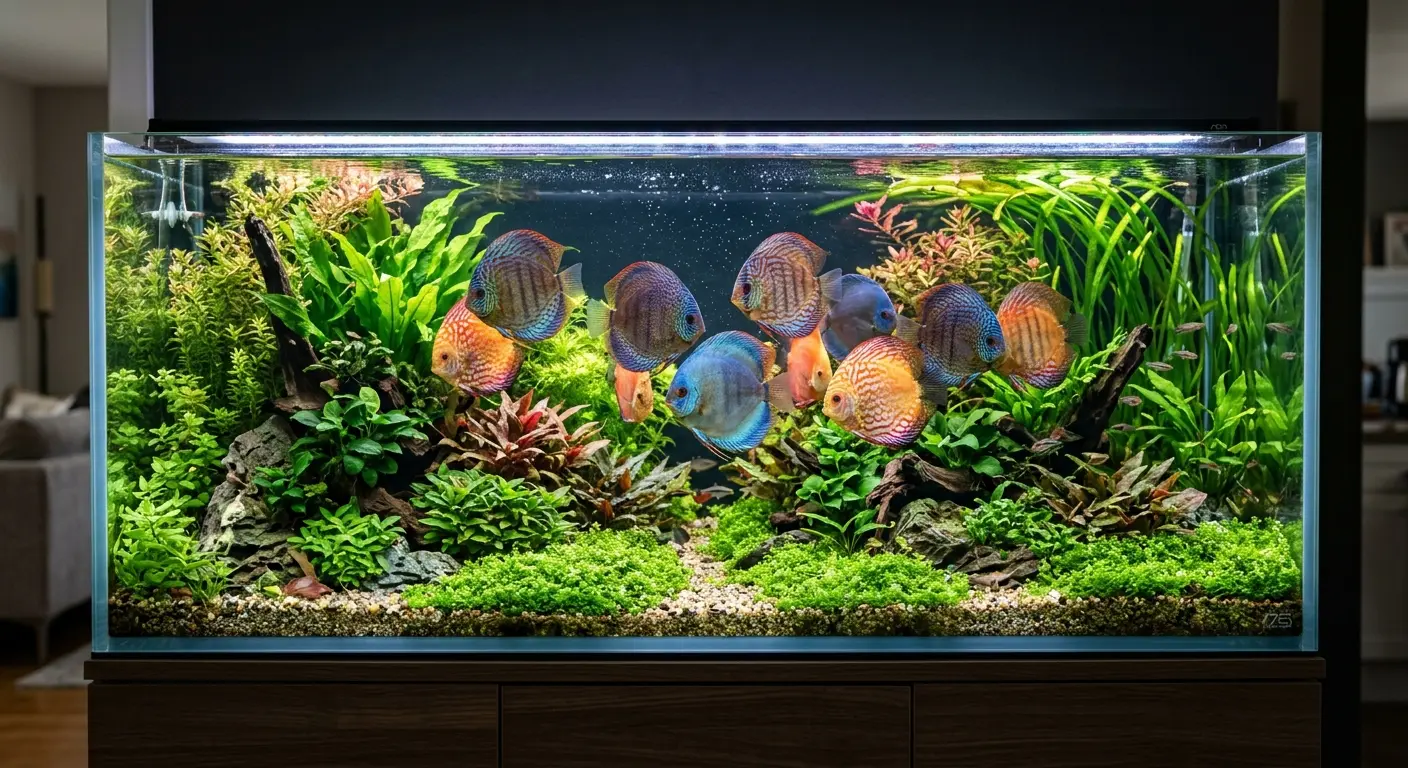
Best Fish for a 75 Gallon Tank (The Tank Where Everything Is Possible)
The 75 gallon tank is where the hobby opens up completely. At 48 inches long and 18 inches deep, it shares its length with a 55 gallon but is 5 inches wider front-to-back. That extra depth changes what's possible. Discus, larger cichlids, proper clown loach groups, and large planted setups all require the floor space and water volume that a 75 gallon provides. The water chemistry stability at this size means genuinely sensitive fish finally have a realistic chance at long-term health. If you've been in the hobby for a year or two and are ready to commit to a serious setup, the 75 gallon is where most experienced keepers land.
01
What the 75 Gallon Unlocks
The 75 gallon's defining feature is the 18-inch depth combined with 48-inch length. Compare this to a 55 gallon: same length, but 5 more inches of front-to-back footprint. That depth makes the biggest difference for three things.
Bottom territory: A pair of large cichlids in a 75 gallon can stake out corners that are genuinely separated. In a 55 gallon, the 13-inch depth means the two ends of a cichlid pair's territory are always close enough to cause conflict. In a 75, a mated pair can spawn in one corner while the rest of the tank maintains normal life.
Aquascaping depth: A properly aquascaped 75 gallon looks like you're looking into a miniature forest. Foreground plants, open sand areas, midground arrangements, and tall background plants can all exist at different depths. The result is a sense of perspective that narrower tanks can't replicate.
Water stability: At 75 gallons, temperature, pH, and hardness hold steady between maintenance days in a way that lets you keep fish with tighter parameter requirements. Discus, which require 82-86F stable, and wild-type cichlids that need soft acidic water, both become realistic long-term options.
What the 75 requires more of: space (it weighs 700+ pounds when full), a stand rated for the weight, a more powerful filter, and larger water changes. A Python or similar water change system stops being optional and becomes necessary for weekly maintenance.
02
Premium Centerpiece Fish
Discus (4-6)
Discus are the most demanding freshwater fish commonly available, and a 75 gallon is the minimum tank for keeping them properly. They need warm water (82-86F), soft and very slightly acidic conditions (pH 5.5-7.0), excellent water quality, and daily or near-daily partial water changes to truly thrive. In a properly maintained 75 gallon, a group of 4-6 discus is a display few freshwater tanks match.
They're social fish that need groups. Lone discus develop stress behaviors and often refuse to eat. Four to six gives them enough company to feel secure without the pecking order issues that emerge in larger groups in smaller tanks.
Discus eat a specific diet: frozen bloodworms, beef heart (controversial but effective), and high-quality discus pellets. They won't adapt to basic flake food. Feed multiple times daily with small amounts they finish completely. If you're not ready for that feeding regimen and water change schedule, keep discus as an aspiration and work toward it.
Green Terror (1-2 Compatible Pair)
Green terrors are large, aggressive South American cichlids that reach 10 inches. Males develop a striking turquoise and orange coloration with a distinctive nuchal hump as they mature. A single green terror is manageable in a 75 gallon with large, tough tankmates. A mated pair is a serious long-term project. A breeding green terror pair will dominate the tank and requires tankmates large and fast enough to survive the aggression.
Green terrors eat fish they can catch and fit in their mouths. Keep them with fish 4 inches or larger. They work well with other large South American cichlids, large barbs like Denison barbs, and large catfish.
Clown Loaches (5-6) as Centerpiece
Clown loaches are technically bottom dwellers, but in a 75 gallon a group of 5-6 adult clown loaches become the entire show. They reach 12 inches, develop rich orange and black banding, and form highly social groups with complex behavior. Adults play-fight, pile on top of each other, and lie on their sides (which alarms new keepers but is normal behavior).
Clown loaches take 5-10 years to reach full size, so a 75 gallon works for a long time. Eventually very large adults would appreciate more space, but most hobbyists run adult clown loach groups in 75-gallon setups successfully for years.
03
Large Schooling Fish
Boesemani and Australian Rainbowfish (10-15)
A 75 gallon handles a large, mixed rainbowfish school in a way smaller tanks can't. Ten to fifteen rainbowfish, mixing boesemani (blue-green head, orange body), Australian (silver with red and blue fin accents), and turquoise (silver-green body with red fins), create a constantly moving display of coordinated color. Males display to each other all day, which means you see their best colors all the time.
pH 7.0-8.0, temperature 74-80F. Harder water, which makes them less compatible with discus but very compatible with African cichlids, rainbowfish from different localities, and many barb species.
Denison Barbs (8-10)
A proper school of Denison barbs belongs in a 75 gallon or larger. Eight to ten of these 4-6 inch torpedo-shaped fish running back and forth across 48 inches is a genuinely memorable sight. They're expensive (expect to pay significantly more per fish than common barbs) but the impact of a full school is worth it.
Temperature 72-77F, pH 6.5-7.5. They're more cold-tolerant than most tropical fish, which limits your pairing options with warm-water species.
Congo Tetras (10-12)
A school of 10-12 Congo tetras in a 75 gallon shows off these fish the way they're meant to be seen. Males reach 3 inches with iridescent body coloring and extended fin edges that develop at maturity. In a large planted tank with good lighting, a group of Congo tetras has a shimmering quality that photographs beautifully. Slightly soft, slightly acidic water (pH 6.0-7.5, temperature 75-81F).
Hikari Sinking Carnivore Pellets
Dense, protein-forward sinking pellets for large cichlids, loaches, and catfish. Dissolves slowly, reducing the cloudiness that floating cichlid pellets cause.
04
Bottom Dwellers
Clown Loaches (5-6)
If you're not building the tank around them, clown loaches are excellent bottom dwellers in a 75 gallon cichlid or rainbowfish setup. At 5-6 per group, they have the social cohesion to behave naturally and the territory to avoid stress. They eat snails (useful for mystery snail control), leftover food, and sinking pellets.
Bronze or Sterbai Corydoras (10-12)
A group of 10-12 cories in a 75 gallon is a display in itself. They form genuine foraging parties across the full tank bottom, responding to feeding time as a coordinated group. Sterbai handle the warmer temperatures (75-84F) needed for discus and rainbowfish; bronze cories work for community builds at standard temperatures.
Pictus Catfish (2-3)
Pictus catfish are active, long-whiskered catfish that reach 5 inches. A group of 2-3 in a 75 gallon actively patrols the lower half of the water column rather than sitting still like many catfish. They're significantly more active than plecos or cories but require some care. Their sharp pectoral spines can tangle in nets and damage other fish they brush against. Feed them sinking carnivore pellets and frozen foods.
Siamese Algae Eaters (3-4)
Three to four true Siamese algae eaters keep a 75 gallon's glass, hardscape, and plants clean. In setups with black beard algae problems, they're the best option: no other commonly available fish eats it reliably. At 6 inches, they're large enough to handle themselves in a cichlid community.
05
Stocking Plans
The Discus Planted Tank 5 discus + 10 cardinal tetras + 8 sterbai corydoras + 5 otocinclus
Warm (82-84F), soft, slightly acidic water (pH 6.0-7.0). Dense planting with Amazon swords, vallisneria, and anubias. Cardinals and sterbai handle the warm temperatures; otos keep plants spotless. The discus are the centerpiece and require daily water changes of 10-15% to maintain the pristine water quality they need. This is a high-commitment setup that rewards careful maintenance with a display you won't find anywhere else.
The South American Biotope 1 pair green terrors + 10 Congo tetras + 8 sterbai corydoras + 2 pictus catfish
Moderately soft water (pH 6.5-7.2, temperature 78-82F). The green terrors claim the lower territory, Congo tetras school in the middle and upper water column, cories and pictus work the bottom. Congo tetras are large enough to avoid becoming food. This setup requires watching the green terrors to make sure they're not getting too aggressive with tankmates.
The Rainbowfish Tank 12 boesemani rainbowfish + 8 Denison barbs + 5 clown loaches + 2 siamese algae eaters
Hard water build (pH 7.2-7.8, temperature 74-78F). No cichlid complications: all species are compatible and reasonably peaceful. The clown loaches handle snail control and bottom activity. SAEs keep algae managed. This is a visually spectacular low-drama tank for experienced keepers who don't want the aggression management of a cichlid setup.
The Large Community 3 angelfish + 12 harlequin rasboras + 5 pearl gouramis + 8 bronze corydoras + 1 bristlenose pleco
Soft to moderate water (pH 6.8-7.5, temperature 76-80F). Angels claim the upper tank, pearl gouramis add additional centerpiece-level fish without competing, harlequins provide a tight-schooling mid-water layer, and cories cover the bottom. The bristlenose handles algae. This is an ambitious community build. Monitor the angelfish hierarchy as they mature.
06
Equipment for a 75 Gallon
Filtration
A 75 gallon needs a canister filter running at 5-8x turnover for a community setup (375-600 GPH). For cichlids or heavily stocked tanks, push toward 8-10x (600-750 GPH). The Fluval FX6 (925 GPH) is overspec for most 75 gallon setups but is appropriate for large cichlids or discus that require pristine water. Running two medium canister filters in parallel provides redundancy. If one clogs or fails, the tank doesn't crash.
Heating
For a standard community at 76-80F, a single 300W heater handles a 75 gallon. For discus requiring 82-86F, two 200W heaters running in parallel are the safer approach. If one heater sticks open in a hot summer, two heaters at 50% output each won't cook your fish the way a single 300W heater running continuously can.
Water Changes
Seventy-five gallons is where a water change system becomes essential. Carrying buckets to change 18-20 gallons weekly is a physical chore that leads to skipped maintenance and deteriorating water quality. A Python No Spill or similar drain-and-fill system turns a 20-minute bucket relay into a 10-minute faucet connection. For discus keeping the daily partial water changes, this system pays for itself in the first month.
Python No Spill Clean and Fill (25 ft)
At 75 gallons, water changes without a siphon-to-faucet system become genuinely unsustainable. The Python connects to a standard faucet for drain and fill in one tool.
Fluval 307 Canister Filter
Two of these running in parallel give you redundant filtration and the turnover rate a fully stocked 75 gallon needs, without the cost of the FX6.
Table of Contents
Related Content
Essential Gear
Best Aquarium Heater for Fish Tanks
Hitop Adjustable Aquarium Heater