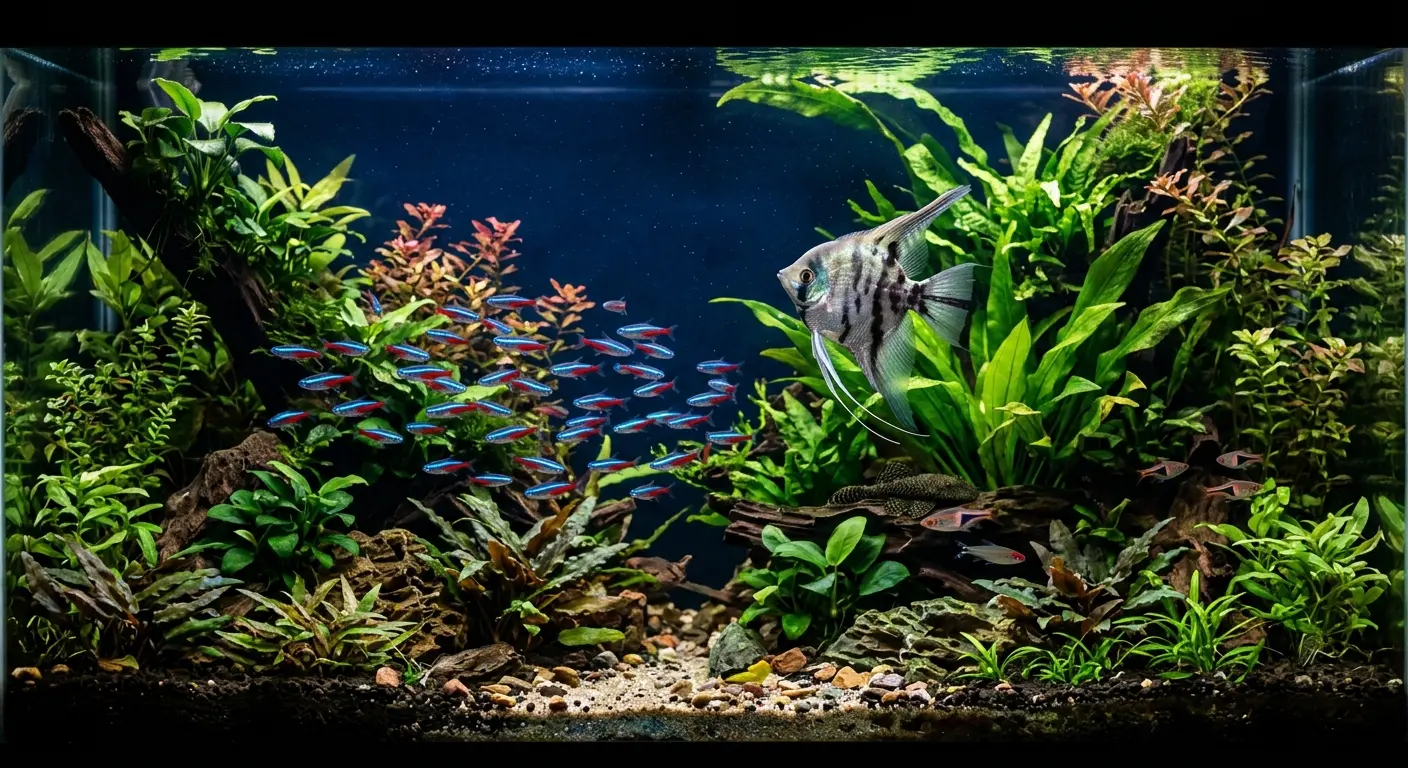
Best Fish for a 29 Gallon Tank (Stocking Plans That Work)
The 29 gallon doesn't get much attention, but it should. It sits between the cramped 20 and the commitment of a 55, and it opens up species you can't reasonably keep below it. Most importantly, it's the smallest tank where a single angelfish actually lives well long-term. The standard dimensions are 30 inches wide by 12 inches deep by 18 inches tall, and that extra height compared to a 20 gallon is what makes the difference. Your stocking options jump significantly, water chemistry stays more stable than smaller tanks, and you finally have room to run a proper community with schools that look right. This guide covers everything I'd put in a 29 gallon and a few things I'd leave out.
01
What Makes the 29 Gallon Different
The 29 gallon's defining feature is its height. At 18 inches tall, it's 6 inches taller than a 20 gallon long, and that vertical space opens up species with different swimming requirements. It also means better water stability: larger water volume buffers temperature swings and dilutes ammonia spikes faster than a 20 gallon.
The footprint is almost identical to a 20 long (30 inches wide), which means it fits in most of the same spaces. The difference is depth on the shelf or stand, which is the same 12 inches. So if you're upgrading from a 20, you likely don't need a new stand, just a taller tank.
What you gain over a 20 gallon:
More room for taller fish. Angelfish, pearl gouramis, and taller-bodied species all benefit from the extra vertical space. You can also fit longer-finned fish more comfortably, since they need room to turn without catching fins on the substrate.
Slightly more bioload capacity. You're not adding dramatically more fish, but you can push schools a bit larger or run a combination that would feel tight in a 20.
Better planting options. Tall background plants like vallisneria, amazon sword, and bacopa can grow to their natural height without immediately reaching the surface. This matters for plant aesthetics and gives fish more cover.
The main limitation: narrow footprint. At 12 inches deep, the 29 gallon is narrower than most people expect. Bottom-dwelling species that need territory, like cichlids and loaches, feel cramped. A 40 breeder (18 inches deep) is a better choice if bottom territory is your priority. The 29 works best for fish that use the full water column rather than competing for floor space.
02
Centerpiece Fish
Angelfish (1-2): The Obvious Choice
The 29 gallon is the classic angelfish tank for good reason. A single angelfish has room to grow to its full 6-inch body height, claim some territory, and behave like an angelfish is supposed to behave. The 18-inch height is a genuine fit, not a compromise.
Two angels in a 29 gallon is possible but requires getting a bonded pair. If you add two unrelated angelfish, odds are decent they'll eventually fight. One often ends up hiding in a corner, stressed and unable to eat properly. Raise two together from juveniles, let a pair bond naturally, and a 29 works fine for them long-term. Randomly combine two adults and you're likely to have problems.
Angels eat small fish. Neon tetras, ember tetras, and similar 1-1.5 inch fish become food once your angelfish is full grown. Cardinal tetras, harlequin rasboras, and cherry barbs at 2 inches are usually fine, but nothing is guaranteed with a hungry angel.
Pearl Gourami (1 Male + 1-2 Females)
Pearl gouramis are the angelfish alternative if you want something elegant without the feeding risk. Males have a pearlescent pattern with an orange-red throat and long, threadlike ventral fins. Females are smaller and less colorful but still attractive. They reach 4-5 inches and occupy the upper water column, filling the same space an angelfish would without the size and aggression.
A single male or a trio of one male and two females works well in a 29. Keep more females than males if you run multiples. Males display aggressively toward each other but are generally peaceful with other species.
Pearl gouramis are hardier than dwarf gouramis and tolerate a wider range of water conditions (temperature 74-82F, pH 6.0-8.0). They eat flake and pellet foods readily and rarely cause problems in community tanks.
Honey Gourami (2-3)
If you want something smaller than a pearl gourami, honey gouramis work in pairs or small groups in a 29. A male-female pair or two males (watched for aggression) and one or two females gives you active, personality-driven fish at the surface without dominating the tank. They're gentler than pearl gouramis and safer with very small tankmates.
03
Schooling Fish
Harlequin Rasboras (12-15)
Harlequin rasboras are my first recommendation for the 29 gallon schooling layer. At 1.5 inches, you can run a proper school of 12-15 without overloading the bioload, and they school reliably, meaning they actually stay together instead of drifting apart like tetras sometimes do. Their copper body and black triangle patch look great against green plants and dark substrate.
They're hardier than most tetras, tolerating pH from 6.0 to 7.8 and temperatures from 72-80F. That flexibility means they work alongside almost any centerpiece fish choice. Fifteen harlequins moving in formation through a planted 29 gallon looks genuinely impressive.
Cardinal Tetras (10-12)
Cardinals are the better choice if you want pure visual impact and your tank is mature. The full-body red and blue stripe is more dramatic than neon tetras, and in a 29 gallon you can keep a school large enough to look spectacular. Ten to twelve cardinals at 76-78F in soft, slightly acidic water is one of the best-looking setups you can build.
The catch is they need established water chemistry. Don't rush them into a new tank. Wait until ammonia and nitrite have been at zero for 3-4 weeks, and test weekly once you add them. They're less tolerant of fluctuations than harlequins.
Cherry Barbs (8-10)
Cherry barbs add something different: color that shifts with mood. Males in breeding condition turn deep crimson red and display to each other constantly without actual fighting. A group of 8-10 with a mix of males and females gives you interesting behavior rather than just passive schooling. They're more active foragers than tetras, picking through plants and the lower-middle water column.
They're also genuinely tough: temperature 68-79F, pH 6.0-8.0. Cherry barbs tolerate conditions that would stress more delicate species, making them good insurance in a community tank where you're still learning your water.
Fluval Bug Bites Tropical Fish Food
Black soldier fly larvae as the first ingredient. Works for tetras, rasboras, barbs, and gouramis. One food that covers the whole community.
04
Bottom Dwellers
Bronze Corydoras (6-8)
Six to eight bronze cories are the default bottom-dweller recommendation for a 29 gallon community tank. They form foraging parties that sweep across the substrate together, handle a wide temperature and pH range, and stay peaceful with every common community fish. Bronze cories handle temperatures from 68-78F and pH from 6.0-8.0.
The main consideration in a 29 gallon is substrate depth. Corydoras need fine sand rather than sharp gravel. Their barbels are sensory organs that get damaged on rough substrate, leading to infection. Pool filter sand or play sand over the full tank floor, or at minimum a 12-inch sand section, keeps them healthy.
Kuhli Loaches (5-6)
Kuhli loaches bring a completely different energy than corydoras. They're nocturnal, burrowing, eel-like fish that spend the day wedged into hiding spots and come out at night to forage. A group of 5-6 in a 29 gallon with fine sand, driftwood, and a few caves gives you a hidden colony that you'll occasionally catch moving through the tank at dusk or during feeding.
The trade-off is visibility. If you want active daytime bottom movement, cories are better. If you want something unusual that your guests won't find at every pet store, kuhli loaches are worth the patience. Temperature 74-82F, pH 6.0-7.0.
Bristlenose Pleco (1)
One bristlenose pleco handles algae maintenance for a 29 gallon. At 4-5 inches fully grown, they fit without taking over the tank the way a common pleco would. They need driftwood to rasp on (fiber source), hiding spots, and supplemental algae wafers when natural algae runs low.
Important note: if you run corydoras AND a bristlenose pleco, that's a significant bottom-level bioload for a 29 gallon. Make sure your filtration is rated well above the tank size and stay consistent with weekly water changes.
05
Complete Stocking Plans
The Angelfish Community 1 angelfish + 10 harlequin rasboras + 6 bronze corydoras + 3 nerite snails
The angel claims the center of the tank and the upper water column. Rasboras school around the middle and below. Cories work the bottom. Nerites handle glass and hardscape algae. Temperature 76-78F works for all four. Add the angel last, after all other fish are established.
The Pearl Gourami Planted Tank 1 pearl gourami male + 2 pearl gourami females + 12 cardinal tetras + 6 bronze corydoras + 5 amano shrimp
Built for a planted tank at 76-78F with slightly soft water (pH 6.5-7.2). The pearl gourami trio provides the centerpiece, cardinals fill the mid-water with color, cories handle the bottom, and amano shrimp keep plants clean. In a well-planted 29 gallon, this combination photographs exceptionally well.
The Cherry Barb Tank 2 pearl gouramis + 10 cherry barbs + 6 kuhli loaches + 3 nerite snails
Lower-maintenance setup that still delivers great visual variety. Pearl gouramis at the surface, cherry barbs showing off in the mid-water, kuhli loaches providing unexpected bottom activity after dark. Temperature 74-78F, pH 6.5-7.5.
The Beginner Community 10 neon tetras + 6 bronze corydoras + 1 honey gourami + 3 nerite snails
If you're coming from a 10 or 20 gallon and want reliable success, this is the build. Every species in it is proven, hardy, and widely available. It's not the most adventurous stock list, but after 6 months of success you'll have the experience to try something more challenging.
06
What to Skip at 29 Gallons
Two Unrelated Angelfish
Two angelfish that didn't grow up together in a 29 gallon will likely fight. As they grow and claim territory, the dominant fish will chase the other until it's stressed, won't eat, and eventually dies. If you want two angels, raise them together from juveniles and let them pair bond naturally. If they pair, great. If they don't, have a plan for separating them.
Clown Loaches
Clown loaches are sold as small juveniles but reach 12 inches. They need schools of 5+ and 75+ gallon tanks as adults. In a 29 gallon, they'll grow steadily and be miserable within a year. Kuhli loaches are the right-sized alternative.
Tiger Barbs Without a Species Tank
Tiger barbs are fin-nippers. In a community tank with gouramis, bettas, or long-finned angelfish, they cause real problems. If you love the look of tiger barbs, a species tank or a tank with other short-finned barbs works, but they don't belong in a community build with any fish that has flowing fins.
Common Plecos
The 2-inch baby at the fish store will become a 12-18 inch waste machine. A bristlenose pleco reaches 4-5 inches and does the same algae work. There's no reason to buy a common pleco for a tank under 75 gallons.
07
Equipment Notes
Filtration
A 29 gallon needs a filter rated for at least 40-50 gallons to get adequate biological filtration for a stocked community. The AquaClear 30 or AquaClear 50 are the standard recommendations. The extra media capacity over a cheaper hang-on-back filter makes a real difference in long-term water stability.
If you're going to a planted tank, a sponge filter plus a small hang-on-back filter gives you gentle flow that won't stress gouramis or uproot plants while still providing adequate biological filtration.
Heating
A 150W adjustable heater handles a 29 gallon. The 18-inch tank height means the water column takes slightly longer to heat than a 20 gallon long, so skip the 100W models recommended for smaller tanks. Place the heater near the filter output for even heat distribution and verify with a separate thermometer.
Lighting
If you're keeping live plants, the stock lighting that comes with most 29 gallon kits is underpowered. A dedicated full-spectrum LED in the 30-inch size (6500K range) makes a significant difference for low to medium-light plants. For a fish-only tank, the kit light is fine.
AquaClear 20 Power Filter
Customizable media basket. Swap the carbon for extra biological media. Quiet and reliable for tanks up to 30 gallons with moderate stocking.
API Freshwater Master Test Kit
Liquid reagents are far more accurate than test strips. The standard kit for monitoring ammonia, nitrite, nitrate, and pH during cycling and routine maintenance.
Table of Contents
Related Content
Essential Gear
Best Aquarium Heater for Fish Tanks
Hitop Adjustable Aquarium Heater
Best Filter for a 29 Gallon Tank
Seachem Tidal 35 Power Filter