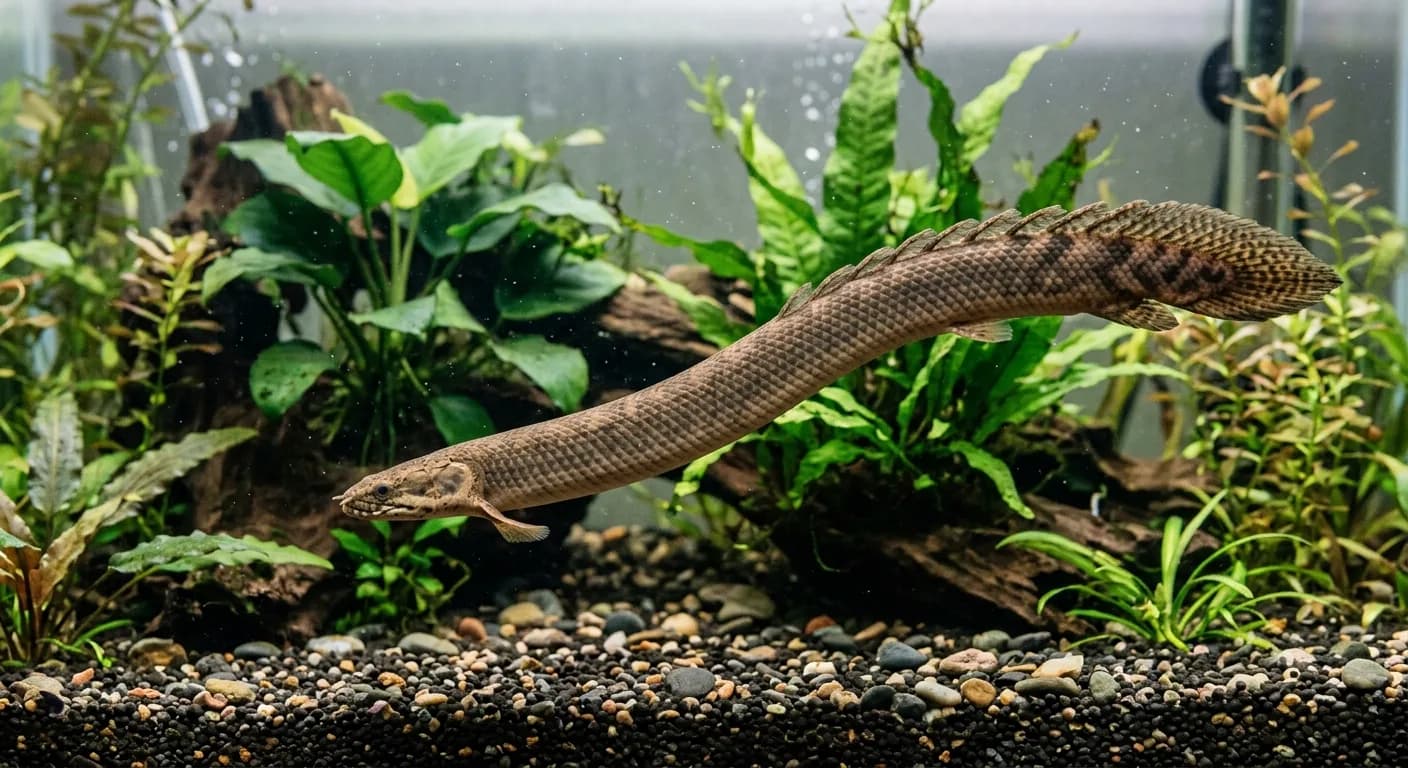
Rope Fish
Erpetoichthys calabaricus
Overview
Rope fish are some of the most unusual freshwater fish you can keep. They look like a cross between an eel and a catfish, with a long, sinuous body and a series of spines along their back. Their olive-green to brown coloration with a lighter belly helps them blend into the leaf litter and debris on the river floor. What makes rope fish special is their combination of predator instincts and surprising intelligence. They can recognize their owner and even learn to take food from your hand. They are nocturnal by default but often adjust to daytime activity in well-established tanks. The biggest thing to know about rope fish is that they are escape artists. They can squeeze through incredibly small gaps and will absolutely find any hole in your tank lid. A tight-fitting lid is not optional, it is mandatory. Lose the lid for even one night and you will find a crispy dried fish on the floor in the morning. The second thing to know is that they are predators. Anything small enough to fit in their mouth is food. This limits your tankmate options significantly.
Tank Setup
A 55-gallon tank is the absolute minimum for a single rope fish, but 75-100 gallons is much better for an adult. These fish get big and need horizontal swimming space more than vertical height. They are bottom-dwellers that like to explore along the substrate, so floor space matters most. Provide a sandy or smooth gravel substrate so they can burrow without damaging their delicate skin. Include plenty of hiding spots: PVC pipes, caves, driftwood with hollows, and dense planting. Java fern and anubias attached to driftwood work well since rope fish don't disturb planted tanks. Lighting should be dim. They are nocturnal and prefer subdued lighting. Use a powerful canister filter or sump that can handle the bioload of a large predatory fish. Current is optional; they come from still or slow-moving waters in the wild. The most critical element is the lid. Use clips or seals to keep it absolutely secure. Use silicone to seal any gaps around filter holes or heater cords. Many keepers double-stack lids as a safety measure.
Water Parameters
Rope fish are adaptable to a wide range of conditions, which is one reason they are considered good for intermediate keepers. pH can range from 6.0 to 8.0, and they tolerate both soft and moderately hard water. Temperature should stay between 72 and 82°F, with 77°F being ideal. They are not particularly sensitive to water quality, but like all fish, they do best in clean water with zero ammonia and nitrite. Nitrates should stay under 40 ppm, which is manageable with weekly 25% water changes. The one thing they are sensitive to is copper-based medications. Never use copper in a tank with rope fish. They are scaleless and can be harmed by many medications that are safe for scaled fish. When treating for ich or parasites, use medications specifically labeled as safe for scaleless fish.
Diet & Feeding
Rope fish are carnivores and need a protein-rich diet. In the wild, they eat small fish, insects, and crustaceans. In the aquarium, they readily accept meaty foods. Earthworms are one of their favorites and make an excellent staple. Offer them 2-3 times per week. Bloodworms, frozen shrimp, and feeder fish can round out the diet. Some rope fish accept sinking pellets or wafers, especially if trained from a young age, but many refuse prepared foods entirely. Feed two to three times per week. Overfeeding is a bigger risk than underfeeding. One or two earthworms per feeding is plenty for an adult. Younger fish can eat more frequently. Feed in the evening when they are most active. Some rope fish learn to take food from tongs or even your fingers, which is a fun bonding experience. Just be careful with your fingers - they have small teeth that can accidentally nip if they get excited.
Behavior & Temperament
Rope fish have a unique personality that appeals to many fishkeepers. They are smart and can recognize their owners, often coming to the front of the tank when they see you approach. They are also ambush predators that spend much of their time lying in wait for prey to swim by. During the day, they often hide in caves or under decorations, emerging at dusk to patrol their territory. They are generally peaceful with fish too large to eat, but will absolutely consume any fish small enough to fit in their mouth. This is not aggression, it is just their nature. They are not territorial or aggressive toward similarly sized fish. One interesting behavior is their ability to breathe air. Rope fish have a modified swim bladder that allows them to gulp air from the surface. This is a normal behavior and they will do this occasionally, especially in water with lower oxygen. If you see them doing this frequently, it might indicate poor water conditions or low oxygen levels.
Compatible Tankmates
Choosing tankmates for rope fish requires careful thought. The golden rule is: anything small enough to fit in their mouth will become food. This rules out most small tetras, rasboras, guppies, platies, and most community fish. Good tankmates include large, robust fish: synodontis catfish, bichirs, clown loaches, flag tetras, congo tetras, silver dollars, and tinfoil barbs. All of these are too large to be eaten and occupy different levels of the tank. Avoid any fish under 3 inches when fully grown. Also avoid aggressive cichlids like oscars or jaguar cichlids that might harass the rope fish. Invertebrates like shrimp and snails are not safe with rope fish and will be eaten. A single rope fish can also be kept alone, which is actually a common and satisfying setup. They do not need conspecifics and are quite happy as the only fish in a species tank.
Common Health Issues
Rope fish are generally hardy when kept in appropriate conditions. The most common health issue is injuries from jumping or escaping. A rope fish that has jumped and dried on the floor is usually dead, but occasionally one is found in time if it is still damp and immediately returned to water. Internal parasites can be a problem, especially in wild-caught specimens. Symptoms include weight loss despite good appetite and stringy white feces. Treat with medicated foods containing praziquantel. Bacterial infections can occur in poor water conditions, presenting as red spots, ulcers, or frayed fins. Improve water quality first, then treat with antibacterial medications safe for scaleless fish. Fungal infections sometimes appear on injuries or in dirty water, looking like white cottony growths. Salt baths or antifungal medications can help. The best prevention is excellent water quality, a tight lid, and careful quarantine of any new additions.
Breeding
Breeding rope fish in home aquariums is extremely rare and poorly documented. They are not commonly bred in captivity, and most available fish are wild-caught or farm-raised in Asia. If breeding were to occur, it would likely require a very large tank (200+ gallons), excellent water quality, and carefully matched pairs. Males and females are difficult to tell apart. There are no obvious external differences. The breeding behavior is not well understood. What is known is that they are egg-scatterers and likely do not provide parental care. Given the difficulty and lack of documented success, most hobbyists enjoy rope fish as single specimens rather than attempting to breed them. Focus on providing excellent care for a single fish rather than trying to reproduce them.
Tankmates to Avoid
These species don't mix well with Rope Fish. Tap a name for the full breakdown.
Frequently Asked Questions
Quick Stats
What You Need for Rope Fish
Gear that works well for this species, based on what experienced keepers actually use.
Reliable hang-on-back filter with biological wheel providing beneficial bacteria colonization. Good flow rate for 55-75 gallon tanks and easy media customization.
Reliable submersible heater with adjustable temperature control for the 72-82°F range rope fish need. Durable construction suits large tank setups.
High-protein sinking pellets formulated for carnivorous fish. Some rope fish accept pellets, making them a convenient staple if your fish takes to them.
Inexpensive, smooth substrate that won't damage rope fish skin when they burrow. Large particle size prevents debris buildup and is easy to vacuum.