Arowana
Osteoglossum bicirrhosum
Overview
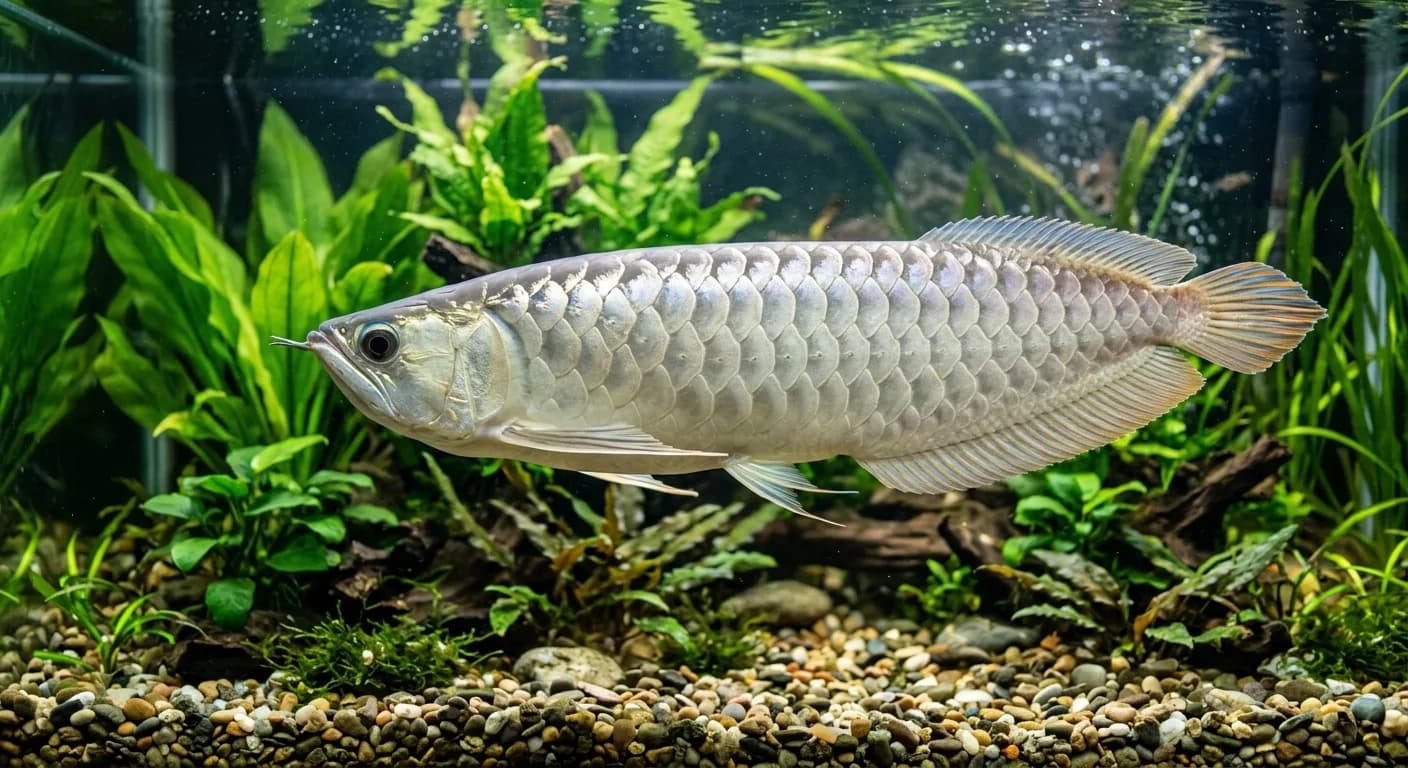
The silver arowana is one of the most impressive freshwater fish you can keep, and one of the most demanding. Native to the Amazon Basin, this fish has a long, streamlined body, large scales, and a distinctive upturned mouth adapted for catching prey at the surface. It can leap 3-4 feet out of the water to snatch insects, birds, and small mammals from overhanging branches. That jumping ability shows up in captivity as a daily behavior in tanks that feel too small or lack proper covers. If you keep an arowana, your tank lid needs to be solid, gap-free, and able to survive a 30-pound fish slamming into it at speed. A juvenile bought at 4-6 inches can reach 12-18 inches within a year under good conditions. By age 3, it will be pushing 24 inches. A full-grown silver arowana in a properly sized tank patrols the top of the water column with slow, powerful sweeps, occasionally tilting to scan the surface. The mouth-closing animation is fast and violent, a reminder that this is a predator, not a pet. Tank size matters more than any other factor. 250 gallons is the absolute floor for a juvenile or young adult. A mature arowana needs 400 gallons or more. These are not display fish you put in a 75-gallon and upgrade later. You buy the tank first, then the fish.
Tank Setup
Start with 250 gallons minimum, plan for 400 gallons once the fish reaches full size. Arowanas are horizontal swimmers that need length more than height, though a tall tank with good surface area works. A 300-gallon footprint of 96 by 24 inches gives an adult room to turn without wedging itself against the glass. Use sand or smooth gravel as substrate. Arowanas dig less than eels, but a soft substrate is safer if the fish ever brushes against the bottom. Decorate the perimeter with large pieces of driftwood, smooth river rocks, and sturdy plants like anubias or java fern attached to hardscape. Leave the center and top of the tank open. Arowanas do not use caves or PVC pipes the way eels do. They want open water. Strong filtration is required. Arowanas are messy eaters and produce a heavy bioload. A Fluval FX6 canister filter handles a 400-gallon setup well. A pair of canister filters running in parallel is better for a large system. Aim for 6-8x tank volume turnover per hour. Arowanas are jumpers. Every gap in your tank cover, every wire pass-through, every filter intake opening at the top of the tank is an escape route. Seal everything. Silicone the gaps. Use a rigid tank lid with no flex. If your arowana can fit its body through a space, it will find it.
Water Parameters
Temperature: 75-86F, with 82F as the sweet spot. This is a wide range, but stability matters more than hitting a specific number. pH between 6.5 and 7.5. Soft to moderately hard water mirrors their Amazon origin. Ammonia and nitrite must be zero at all times. Nitrates above 20 ppm cause skin and gill irritation that shows as redness and excess mucus production. Weekly water changes of 25-30% keep nitrate low. These fish are sensitive to poor water quality in ways that smaller, hardier species are not. Their large body mass means contaminants concentrate faster in proportion to their physiology. Use a liquid test kit, not strips. Strips are inaccurate for the parameters that matter most with large cichlids and arowanas. If the fish stops eating or surfaces frequently despite a covered tank, test the water before anything else.
Diet & Feeding
Arowanas are obligate carnivores. In the wild they eat insects, fish, crustaceans, and occasionally small vertebrates. In captivity, pellets are the practical daily staple. Hikari Sinking Carnivore Pellets are a good choice for arowanas kept in tanks with faster-moving dither fish. The sinking format lets the arowana take food at its own pace rather than competing with tankmates at the surface. Feed 2-3 times daily, only what the fish finishes in 3-5 minutes. Supplement with frozen foods 2-3 times per week: prawn, squid, fish fillet, and bloodworms add variety and encourage natural hunting behavior. Whole feeder fish are technically acceptable but carry parasite risk. Quarantine feeder fish for 2 weeks before using them, or skip them entirely. Avoid beef heart and other mammalian proteins. Arowanas digest them poorly, and the excess fat causes liver problems. Variety matters more than volume. Rotate between pellets, frozen seafood mixes, and occasional live or frozen fish to keep the fish healthy and active. An arowana that gets bored on a monotonous diet stops eating.
Behavior & Temperament
Arowanas are solitary, territorial fish. A single arowana in a large tank will claim the entire top of the water column and patrol it constantly. This is normal behavior, not stress. The fish is patrolling its territory. In the wild, arowanas are ambush predators that wait for prey to come to them. In a tank, they learn the feeding schedule and become anticipatory, swimming to the front of the glass when someone approaches. They recognize their keeper. This has been documented in feeding studies. Two arowanas in the same tank will fight, sometimes to the death. Even a male and female pair require a tank large enough that the dominant fish can establish a separate territory. Mixing an arowana with other large fish is possible if the tank is genuinely massive and the tankmates are too large to be seen as food. Oscars, large catfish, and tinfoil barbs work. Anything small enough to fit sideways in the arowana's mouth will eventually disappear. The rule is simple: if it fits in the mouth, it becomes food.
Compatible Tankmates
Compatible only with fish too large to be eaten. Oscars in the 10-inch-plus range make reasonable tankmates in tanks of 400 gallons or more. Flowerhorn cichlids of similar size work but expect territorial disputes. Large catfish like pictus and iridescent sharks are active bottom dwellers that the arowana ignores because they do not compete for surface space. Silver dollars are peaceful, fast-swimming, and too thick-bodied to be easy prey. Tinfoil barbs are active and grow to 12-14 inches, making them poor food candidates. Clown loaches are compatible as bottom dwellers in large tanks. Avoid any fish under 6 inches. Neon tetras, guppies, corydoras, and ghost shrimp are food. Angelfish and discus are too slow and high-bodied to survive in an arowana tank. Mixing an arowana with any cichlid smaller than 10 inches invites conflict and injury.
Common Health Issues
Arowanas are prone to several specific problems. Dropsy shows up as scales that stick out like a pinecone, caused by fluid accumulation from kidney or liver failure. It is usually secondary to poor water quality or an internal bacterial infection. Early intervention with antibiotics in a separate hospital tank is the only chance. Fin rot and tail rot are bacterial infections that attack damaged fins. They start as milky white edges and progress to bloody stubs. Poor water quality and fights with tankmates are the usual triggers. Treat with kanamycin or furan-2. Arowanas are ich-prone when temperatures fluctuate, just like most tropical fish. The white salt-grain spots appear on the body and fins. Heat treatment to 86F over 48 hours while maintaining that temperature for 10 days clears most ich. Add aquarium salt at 1 tablespoon per 5 gallons. The most common owner-caused problem is a bent spine. An arowana kept in a tank too small for too long develops a permanent spinal deformity. It cannot be corrected. Prevention is the only option. If your arowana's back starts to curve, the tank is too small.
Breeding
Breeding arowanas in captivity is rare and difficult. Males are mouthbrooders. After a courting display, the female deposits eggs and the male fertilizes them, then collects all viable eggs into his mouth where he carries them for 50-60 days until they hatch. A male carrying a full brood of 50-150 eggs refuses to eat and should not be disturbed. Removing a male from the tank during this period causes it to spit the eggs prematurely. Fry require live food: baby brine shrimp, daphnia, and small earthworm pieces. Growth is slow for the first 6 months, then accelerates. Sexual maturity arrives at 3-4 years. Sexing adults visually is difficult. Males have a broader head and more intense coloration, but these differences are subtle. Commercial breeding of silver arowanas happens mostly in Southeast Asian fish farms, where selective breeding has produced several color morphs including Malaysian golden, red, and super red arowanas. These captive-bred morphs are far more common in the hobby than wild-caught silver arowanas.
Tankmates to Avoid
These species don't mix well with Arowana. Tap a name for the full breakdown.
Frequently Asked Questions
Quick Stats
What You Need for Arowana
Gear that works well for this species, based on what experienced keepers actually use.
Handles up to 400 gallons with 530 GPH flow rate. Multi-stage filtration handles the heavy bioload of a large carnivore. Self-priming pump works reliably in large, complex setups. The best canister option for arowana tanks in the 250-400 gallon range.
High-protein sinking pellet formulated for large carnivores. Promotes healthy scale development and color. Slow-sinking format lets arowanas feed at their preferred depth without competing with surface-dwelling tankmates.
Full-spectrum LED with timer modes that simulate natural daylight cycles. Bright enough to support live plants in a large tank while bringing out the silver metallic sheen of arowana scales. Programmable sunrise and sunset functions reduce stress for shy fish.
Tests for ammonia, nitrite, nitrate, pH, high-range pH, and KH. Essential for monitoring water quality in a high-bioload tank where a single water quality spike can be lethal. Liquid reagents are more accurate than strips for the precision required in large-fish systems.