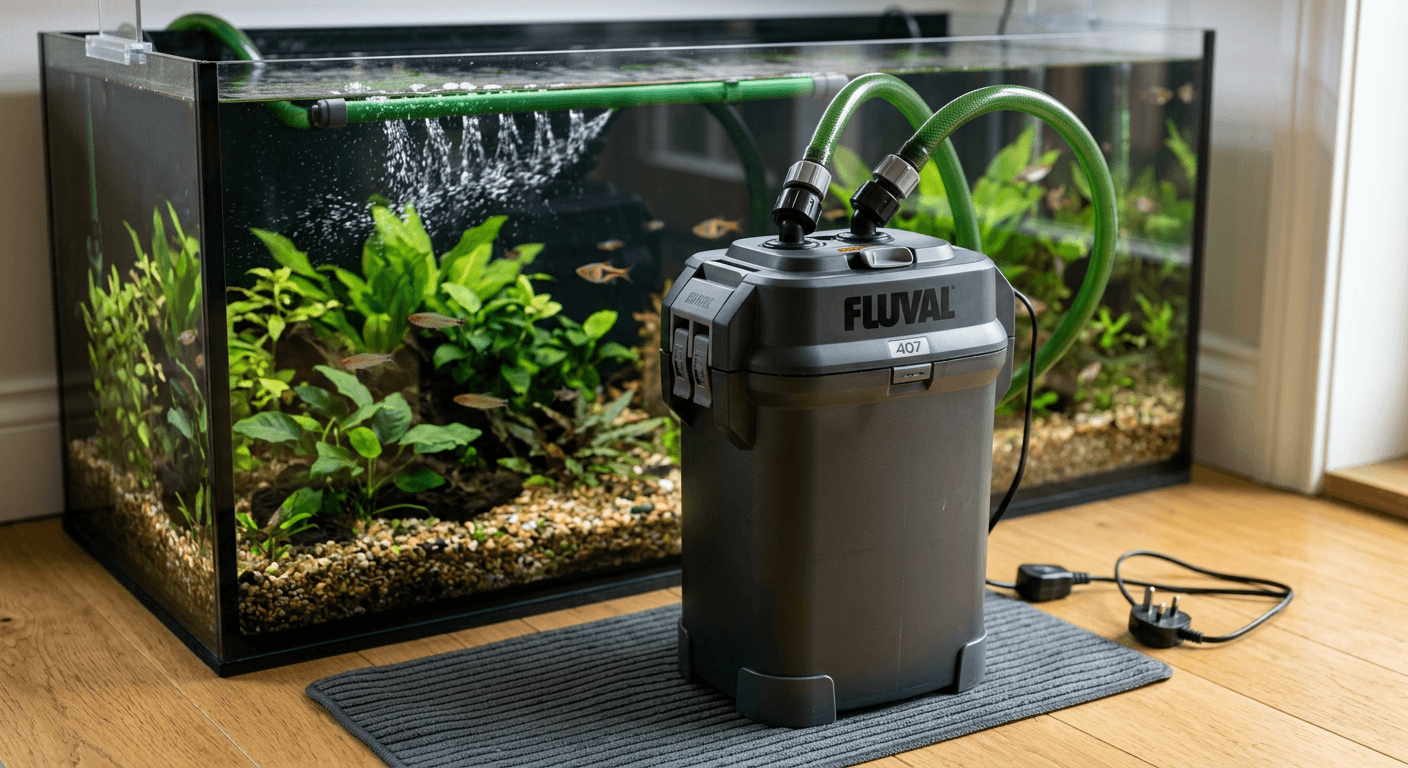
Best Canister Filter for Freshwater Aquariums
Canister filters are overkill for most beginner tanks but necessary for big tanks, planted tanks, or anything with a heavy bioload. They sit below the aquarium in the cabinet, pull water down through stacked media trays, and push it back up into the tank. More media volume means more biological filtration. Quieter operation than most HOBs. And because the filter is out of sight, your tank stays cleaner looking. The trade-off is price, complexity, and the occasional leak if you do not set it up right.
Our Picks
Fluval 307
Best OverallThe Fluval 307 is a workhorse canister rated for tanks up to 70 gallons. It pushes 303 GPH through three media baskets that you can load however you want. The motor is quiet enough that you will forget it is running. Fluval's quick-disconnect valves make maintenance less of a pain than older canister designs, and the self-priming button means you do not have to suck on a hose to get it started. It is not cheap, but it is the filter most planted tank owners settle on after trying cheaper options.
Pros
- • 303 GPH flow rate handles tanks up to 70 gallons comfortably
- • Three media baskets for customizable filtration stages
- • Self-priming button, no manual siphon needed
- • Very quiet once running, almost inaudible from a few feet away
Cons
- • Expensive compared to HOB filters with similar tank ratings
- • Hoses and connections need to be seated properly or they leak
- • Cleaning requires disconnecting hoses and opening the canister, which takes more effort than rinsing a HOB sponge
SunSun HW-302 Canister Filter
Budget PickThe SunSun HW-302 is the budget canister that half the hobby swears by and the other half warns you about. Here is the honest version: it works. The 264 GPH flow rate is good for tanks up to 75 gallons on paper, though 55 gallons is more realistic. It comes with three media trays and a built-in UV sterilizer on some models. The build quality is below Fluval's, the fittings feel cheaper, and you will probably want to replace the included media with better stuff. But at roughly a third of the Fluval's price, it gets a lot of fishkeepers running canister filtration who otherwise could not afford it.
Pros
- • Costs a fraction of comparable Fluval or Eheim canisters
- • 264 GPH flow rate with three media trays
- • Some models include a built-in UV sterilizer
- • Handles mid-size tanks (30-55 gallons) without issues
Cons
- • Build quality is noticeably cheaper, especially the hose fittings
- • Included filter media is low quality, plan to replace it
- • Priming can be finicky on initial setup
- • Customer support is minimal if something breaks
When You Need a Canister Filter (and When You Do Not)
GPH and tank size. The turnover rule still applies: you want 4-6x your tank volume per hour in flow rate. A 55 gallon tank needs 220-330 GPH. The Fluval 307 at 303 GPH fits that range. The SunSun at 264 GPH is on the lower end but still within range for a 55 gallon tank that is not heavily stocked. For a 75 gallon or bigger, you are looking at the Fluval 407 or running two canisters.
Media baskets are the whole point. A canister filter's advantage over a HOB is the sheer volume of media it holds. You can run coarse sponge in the bottom tray for mechanical filtration, ceramic rings or bio balls in the middle for biological filtration, and fine floss or Purigen in the top for polishing. This layered approach gives you cleaner water and more stable parameters than a HOB can manage.
Priming. Getting a canister filter started for the first time is the most annoying part. Water needs to fill the canister before the motor can push it. The Fluval 307 has a self-priming button that pumps water down into the canister. The SunSun requires some manual convincing. Either way, you only deal with this during setup and after deep cleanings.
Why canister over HOB for planted tanks. Two reasons. First, canisters do not agitate the surface as much as HOBs, which means less CO2 off-gassing. If you are injecting CO2 for a planted tank, surface agitation is your enemy. Second, canisters let you run the intake and output wherever you want in the tank using the hose placement, which gives you better control over water flow patterns.
Canister vs. HOB for big tanks. For anything over 40 gallons, a canister filter is the better choice. HOBs rated for 50+ gallons exist, but they are loud, create a lot of surface disturbance, and do not hold nearly as much biological media as a canister. Once you cross the 40 gallon threshold, the canister's benefits outweigh its added complexity.
Leak prevention. Most canister leaks happen at the hose connections, not the canister itself. Double-check that the quick-disconnect valves are locked before turning the filter on. Seat the O-ring properly when closing the canister after cleaning. Vaseline on the O-ring helps with the seal and makes it easier to open next time. Keep the canister below the tank, because gravity is what drives the siphon.