Do Fish Get Lonely? The Social Needs of Aquarium Fish
The question is fair, but the answer is more specific than yes or no. Fish do not experience loneliness the way mammals do. But many species have evolved to live in groups, and keeping them alone creates measurable stress that shortens their lives. Whether your fish needs company depends entirely on the species.
01
How Fish Experience Social Needs
Fish are not lonely in the way a dog left alone all day is lonely. There is no evidence they experience subjective emotional states like loneliness. But that does not mean social isolation is harmless.
Schooling fish evolved in groups because groups offered survival advantages. When a predator attacks a school of 200 fish, any individual has a much lower chance of being the one that gets eaten. The school also confuses predators through what researchers call the predator confusion effect. And when one fish detects a threat and reacts, that alarm response travels through the group in milliseconds. A single fish gets none of this.
The nervous system of a schooling fish is calibrated for group life. When you remove that fish from a group, its body registers the change as a threat. Cortisol levels rise. Studies on isolated zebrafish and other cyprinids have documented measurable cortisol elevation compared to fish kept in groups. Chronically elevated cortisol suppresses the immune system, reduces appetite, and accelerates aging. These are not metaphors for sadness. They are physiological changes with real consequences.
The distinction worth holding onto: loneliness is a subjective emotional state. Isolation stress in schooling fish is an objective physiological state. The fish is not sad. But it is running on stress hormones around the clock, and that will kill it faster than good water quality can save it.
02
True Schooling Fish: Minimum Groups of 6
Some fish are non-negotiable about groups. Keep them in groups of six or more or accept that you are keeping them in a state of chronic stress.
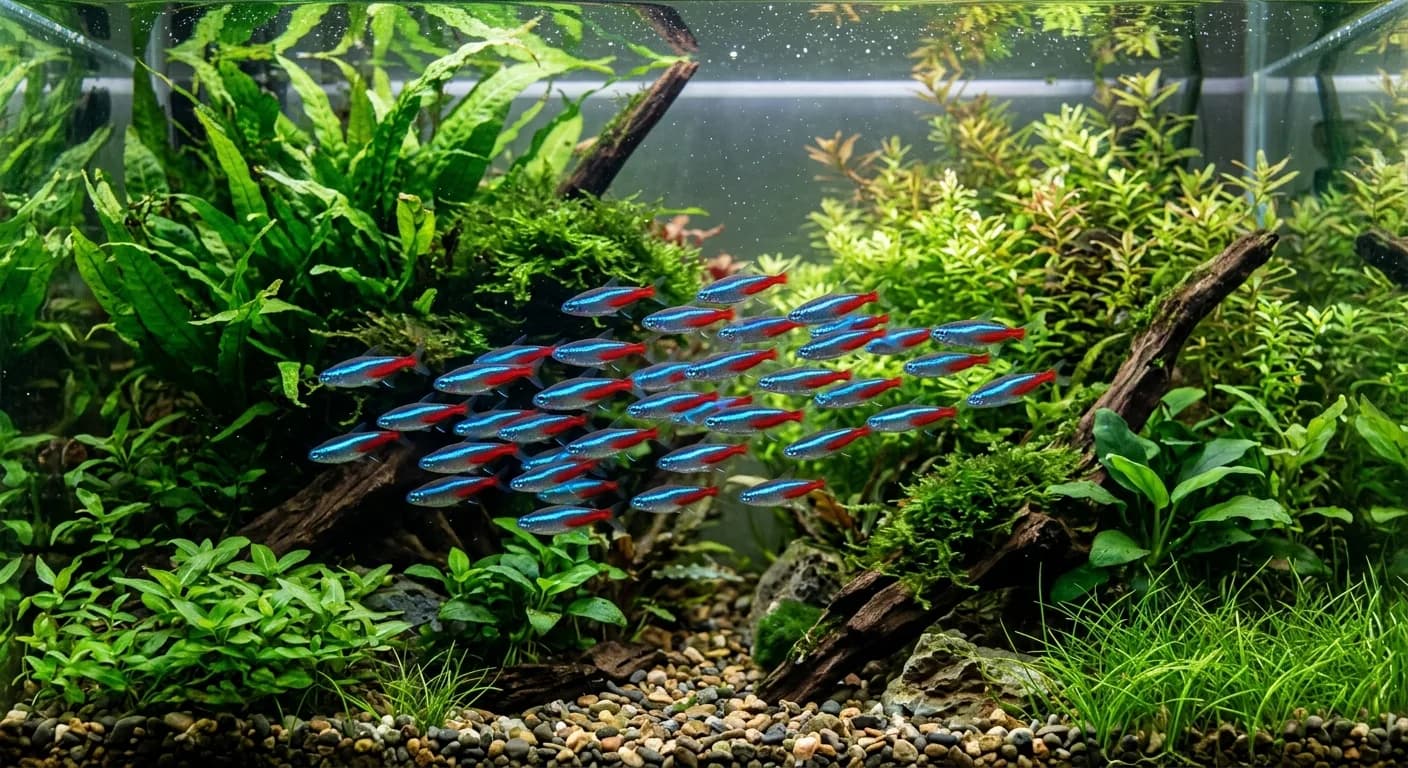
Neon tetras are the obvious example. A single neon tetra in a planted tank looks like a mistake. They spend most of their time hiding, their color fades noticeably, and they often stop eating. Add five more and you get a completely different animal: bold, active, feeding normally. The same pattern holds for cardinal tetras, rummy-nose tetras, ember tetras, and most other small schooling tetras.
Corydoras are frequently the worst victims of this misunderstanding. People buy one or two as bottom cleaners and wonder why they just sit in a corner. Bronze corydoras, panda corydoras, sterbai corydoras -- they are all social. A solo cory will typically park itself in one spot, barely forage, and show none of the active rooting and scurrying behavior that makes them interesting. Six corydoras of the same species look like they are running a search party. One corydoras looks like it is waiting to die.
Other species that need groups of at least 6: harlequin rasboras, cherry barbs, zebra danios, chilli rasboras, and celestial pearl danios. For most of these, 8 to 10 is better than 6. The group needs enough mass that individual fish feel the statistical protection of numbers working.
The visible stress signs in these fish when kept alone or in pairs: constant hiding during the day, significant color loss, refusal to eat, and erratic darting movements when startled. Color is a reliable indicator. A neon tetra kept in a proper school looks almost luminescent. The same fish kept alone looks washed out within weeks.
03
The Difference Between Schooling and Shoaling
These terms get used interchangeably, but they mean different things and the distinction matters for how strictly you need to follow the group minimums.
Shoaling is the general behavior of fish grouping together. A shoal is any loose aggregation of fish of the same species that stay near each other. They are aware of each other and react to each other but are not tightly coordinated.
Schooling is a specific, synchronized subset of shoaling. A school moves in tight formation, with fish matching each other's direction and speed in real time. It looks almost choreographed. This synchronized movement is the behavior that maximizes predator confusion. It requires a larger group to function, and fish that attempt to school in small numbers are essentially trying to run a program their group is too small to execute.
Most aquarium fish are technically shoalers rather than tight schoolers. Harlequin rasboras, for instance, form loose shoals but do not always move in perfect synchrony. Zebra danios are tight schoolers and noticeably more agitated in small groups because they are trying to school and cannot.
The practical upshot: tight schoolers like danios and rummy-nose tetras are more sensitive to small group sizes than loose shoalers. Both need groups. But if you have five rummy-nose tetras instead of six, you will see stress behaviors in ways you might not with five harlequin rasboras instead of six. Six is still the right minimum for both, but the tight schoolers have less tolerance for being slightly under.
04
Fish That Do Fine Alone
Not every fish needs company. Some evolved in conditions where being near other members of their own species was a liability, not an advantage.
Bettas are the clearest case. Male bettas will fight each other to injury or death. In the wild, they hold individual territories and encounter other males only to compete. Keeping a male betta with another male betta is not failing to provide company, it is forcing a fight. Female bettas can sometimes be kept in groups, called sororities, but this requires careful setup and observation. A single male betta in a properly sized, well-planted tank is not deprived of anything it needs.
Most cichlids are territorial by nature and do not benefit from being housed with conspecifics. Oscars do fine alone or in bonded pairs. Many of the smaller Central American cichlids, like convict cichlids and firemouths, form pairs and defend territory against everything else. Keeping them solo causes no visible stress.
Larger plecos are solitary. A common pleco or bristlenose pleco has no interest in other plecos and often shows aggression when they share space. They do not need a companion.
Pufferfish, whether freshwater or brackish, are aggressive enough that isolation is frequently the humane choice. A dwarf puffer kept with other fish often spends its time harassing them. Isolation removes that problem without creating a new one.
The underlying logic for all of these fish: they evolved in contexts where grouping provided no advantage, or where group living actively increased conflict over food and territory. Their nervous systems are not calibrated for group life, so removing the group removes nothing they need.
05
How to Tell If Your Fish Is Stressed by Isolation
The behavioral signs of social stress in schooling fish are fairly consistent, though they overlap with other problems, so some diagnostic work is still needed.
The most common indicators: hiding during hours when the fish is normally active, color loss compared to how the fish looked when you first got it, refusal to come out for food or eating very little, glass surfing (pacing the tank walls repeatedly), erratic burst swimming with no obvious cause, and spending most of the time at the extreme top or bottom of the water column.
Glass surfing specifically is worth flagging. A fish that paces the glass is trying to go somewhere. In schooling species kept alone, this often represents an attempt to find conspecifics. In community fish, it can also signal poor water quality, so this symptom requires ruling out the basics first.
Before concluding the problem is social stress, check the obvious variables. Ammonia and nitrite should be zero. Nitrates should be under 20 ppm. Temperature should be in range for the species. If water quality is clean and the fish is still showing these behaviors, social isolation is a reasonable next suspect.
Color loss as a diagnostic tool: it is most useful when you have a baseline. If you bought the fish and it was vivid when it arrived, then faded over the following weeks without any change in water parameters, that is a meaningful signal. Color loss from isolation tends to be gradual and consistent. Color loss from disease or water quality problems tends to be faster and often comes with physical symptoms like clamped fins.
06
What to Do About It
If you are keeping a schooling fish alone and recognize that as the problem, the fix is adding more of the same species. Not different species. Not a different fish for company. More of the same species.
A tetra does not benefit from being housed with a corydoras. These fish do not recognize each other as conspecifics. The tetra is still looking for other tetras. The social signals it evolved to send and receive are species-specific. Mixed-species housing satisfies a human intuition about company that does not map onto how fish social systems actually work.
For most small schooling tetras and corydoras, the minimum addition to an isolated fish is five more, bringing the group to six. If you already have two or three, add enough to reach six at minimum. Ten is often better than six.
If your tank is too small to house a proper group, that is the real constraint. A 5-gallon tank cannot ethically house six neon tetras and anything else. The options are upgrading the tank or rehoming the fish to someone with a tank that can support a group. Keeping a schooling fish alone indefinitely because you do not have space for a proper group is the least good outcome.
For fish like bettas that are genuinely solitary, the answer is not adding more bettas. It is making sure the single fish has adequate space, cover, and enrichment. A betta in a 10-gallon planted tank with hiding spots and a varied diet is not suffering from lack of company.
07
Species-by-Species Quick Reference
Neon tetras: minimum 6, prefer 10 or more. One of the most visibly stressed fish when kept alone or in small numbers. Color fade and hiding are reliable indicators something is wrong.
Corydoras (bronze, panda, sterbai, and most other species): minimum 6 of the same species. Cross-species mixing does not substitute. A solo cory will often park in a corner and stop foraging.
Bettas: solitary, at least for males. Do not need companions. Do not add another male. Female sororities require planning and close observation.
Guppies: fine alone but notably more active and bold in small groups. A single guppy in a community tank will usually be fine. A single guppy in a species tank is sub-optimal.
Goldfish: do well alone and do not show the same isolation stress patterns as schooling fish. They benefit from company and will often interact with tankmates, but a single goldfish in a proper setup is not a welfare concern.
Discus: strongly prefer groups of 6 or more. Keeping fewer than 4 in a tank tends to result in aggression from dominant fish concentrating on fewer subordinates. A group distributes that attention.
Angelfish: can be kept solo but pairs are common and usually stable once a bonded pair forms. Groups work in larger tanks. Keeping a single angelfish is not an ethical problem, though they do respond to conspecifics.
Zebra danios: minimum 6, prefer 8 or more. Tight schoolers. More sensitive to small group sizes than loose shoalers. Visibly more active and coordinated in proper numbers.
Table of Contents
Related Content
Popular Fish Species
Essential Gear
Best Filter for a 20 Gallon Tank
Aquaneat 3-Pack Biosponge Filter
Best Aquarium Heater for Fish Tanks
Hitop Adjustable Aquarium Heater
Frequently Asked Questions
Sources & Further Reading
- Galhardo L, Oliveira RF. Psychological Stress and Welfare in Fish. Annual Review of Animal Biosciences, 2009.
Review of stress physiology in fish, including cortisol elevation in isolated individuals and the relationship between social environment and immune function.
- Pitcher TJ. Functions of Shoaling Behaviour in Teleosts. The Behaviour of Teleost Fishes, 1986.
Foundational work on schooling and shoaling behavior, covering predator confusion, dilution effect, and alarm signaling in group-living fish.
- Zebrafish Social Behavior and Cortisol Studies, NCBI
Research documenting measurable cortisol differences between isolated zebrafish and those kept in groups, supporting the physiological basis of isolation stress.