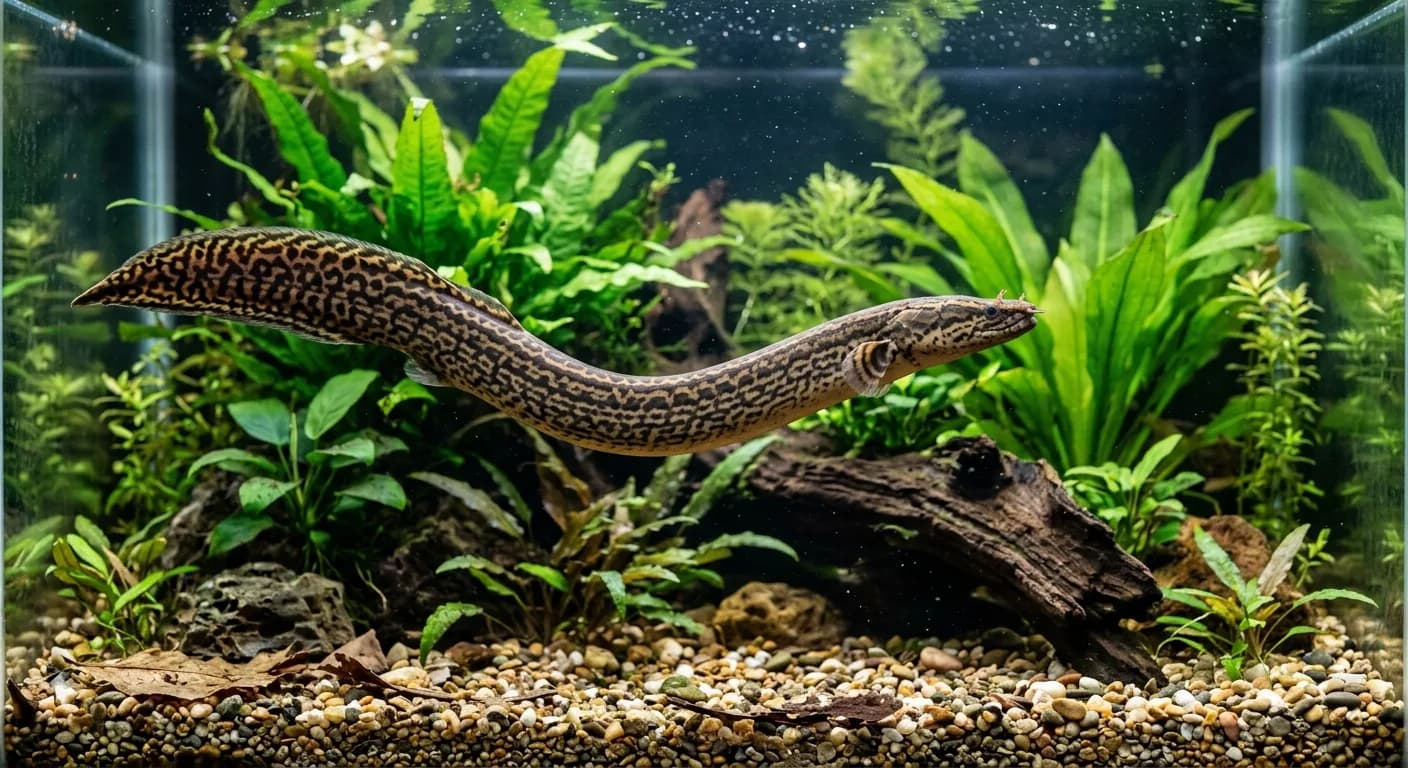
Tire Track Eel
Mastacembelus armatus
Overview
The tire track eel gets its name from the dark, zigzag pattern that runs from its head to its tail, resembling a tire track pressed into mud. Mastacembelus armatus is native to fast-flowing rivers across South and Southeast Asia, which tells you two things immediately: it needs good water flow, and it needs a tank it cannot escape from. This is one of the most common eels in the hobby, partly because it is reasonably hardy once settled, and partly because its nocturnal personality makes it interesting to watch once lights go out. In a planted tank with the lights dimmed after 10pm, a tire track eel will emerge from its cave, extend its long nose into the substrate hunting for worms and insect larvae, and work the entire bottom of the tank over a few hours. During the day, it is largely invisible. This is not a fish you keep for daytime viewing. It is a fish you keep because you know it is there, and because watching the tank at night reveals a whole second set of behaviors. Size is the primary commitment. Juveniles sold at 4-8 inches will reach 30-36 inches over 3-5 years. A 75-gallon tank is adequate for a single adult. A pair needs 120 gallons or more. They are escape artists with an ability to find gaps in tank lids that seem impossible.
Tank Setup
Start with 75 gallons for one adult, 120 gallons for a pair. Sand or smooth gravel substrate at least 2 inches deep lets the eel exhibit its natural burrowing behavior. In the wild, tire track eels spend daylight hours buried in river substrate with only their snout and eyes visible, waiting for prey to pass. In a tank without deep substrate, provide PVC pipes, terracotta caves, and flat rocks arranged to create shaded hiding spots. The eel will choose one or two primary hides and retreat to them daily. Multiple hide options reduce territorial aggression if keeping two eels. Place rocks and driftwood to create visual barriers rather than open space. Strong water flow matters more than most owners realize. Tire track eels from fast-flowing Asian rivers need oxygen-rich water and do better with a filter output that creates moderate current. A canister filter rated for the tank volume handles both filtration and flow. Avoid undergravel filters, which interfere with the eel's burrowing. A tight-fitting lid with no gaps is necessary. Eels push against covers with surprising force and find any gap, including filter return tubes and heater cords. Silicone any openings.
Water Parameters
Temperature 73-82F, with 78F as the target. pH 6.5-7.5. Soft to moderately hard water. Ammonia and nitrite must be zero. Nitrate under 40 ppm. The eel's gill structure is adapted to highly oxygenated water, and nitrates above 40 ppm show up as lethargy and loss of appetite within days. Weekly water changes of 25-30% are the baseline. The eel tolerates a range of conditions once established but is sensitive during the initial acclimation period after transport. Drip acclimate for 1-2 hours rather than floating bag acclimation. Sudden temperature changes trigger stress that can last weeks. Monitor ammonia closely during substrate disturbances. Stirring sand during gravel vacuuming releases pockets of anaerobic gas and ammonia that can knock out an eel fast.
Diet & Feeding
Carnivore with a preference for worms and insect larvae. Hikari Sinking Wafers are a good daily staple, especially for juvenile eels learning to accept prepared foods. Drop the wafers near the eel's hide at the same time each evening and leave the lights dimmed. The eel will emerge to feed once the room is dark and quiet. Supplement twice weekly with frozen bloodworms, blackworms, mysis shrimp, and chopped earthworms. Earthworms are excellent and tire track eels go crazy for them. Rinse earthworms thoroughly and cut them into appropriate lengths for the eel's size. Juveniles need daily feeding. Adults do well on food every other day. The eel finds food primarily by smell, using its tubular nose to probe substrate and water column. It has poor eyesight and will not compete effectively with fast-swimming surface feeders. Feed near the eel's hide, not in the open water. Some owners report their eels refusing all prepared food and eating only live or frozen worms. Patience is the fix for this. A hungry eel will eventually take sinking pellets.
Behavior & Temperament
Tire track eels are nocturnal and secretive. During the day they stay in their cave or buried in substrate, emerging only after lights go out. They are not aggressive toward fish too large to eat, and they are not territorial with their own species in large enough tanks. Two adults can coexist peacefully in a 120-gallon or larger tank with enough visual barriers that each can claim a separate cave system. The eel's primary interaction with tankmates is neutral. It ignores Oscars, large catfish, and other heavy fish. It does not compete for food aggressively because it feeds after dark when other fish are less active. This makes it an excellent addition to a large South Asian or Amazonian community tank where the centerpiece fish are too big to be eaten. The one behavioral note: the eel will sometimes dig at substrate and displace plants. Rooted plants with fragile root systems are not ideal. Anubias, java fern, and mosses attached to hardscape do better.
Compatible Tankmates
Large, peaceful fish that do not require a heated lid. Oscars, flowerhorn cichlids, and other large cichlids in the 10-inch-plus range are compatible as long as the tank is large enough for both. Silver dollars, tinfoil barbs, pictus catfish, iridescent sharks, and other large community fish work well. The eel is bottom-dwelling and nocturnal, so it occupies a different niche than most schooling fish. Clown loaches, zebra loaches, and kuhli loaches are compatible as other bottom dwellers. Avoid anything small enough to be eaten. Shrimp of any kind are food. Dwarf puffers are too aggressive and nippy for a tank with a slow-moving eel. Guppies, neon tetras, bettas, and other small fish will disappear. Corydoras catfish are safe from predation but may compete for bottom food and stress the eel at feeding time.
Common Health Issues
Tire track eels are reasonably hardy but have several specific vulnerabilities. Skin flukes are the most common parasite. They attach to the skin and gills and cause flashing, excess mucus production, and labored breathing. Treat with praziquantel or formalin bath. Internal parasites occasionally show up as weight loss despite normal feeding, especially in wild-caught specimens. Medicated food with praziquantel or metronidazole handles most internal parasites. Velvet is a gold-dust parasite that appears in stressed eels, usually triggered by poor water quality or sudden temperature drops. It requires a darkness treatment combined with increased aeration. The most serious health risk is injury from tank decorations. Eels burrow and push through substrate, and sharp rock edges can cut the thin skin. Inspect all rocks and driftwood in the tank. Smooth everything with fine sandpaper before adding it. Wounds on eels are prone to secondary bacterial infections. Minor cuts heal if water quality is perfect. Severe injuries require isolation in a hospital tank with kanamycin.
Breeding
Breeding tire track eels in captivity is rare. They are egg-layers that scatter adhesive eggs across substrate and plants. Sexing is difficult. Males have a slightly more pointed dorsal fin and develop more intense coloration as they mature, but the differences are subtle. A breeding tank should have flat rocks or slate near the bottom, which the fish use as a spawning site. Triggering breeding is not well-documented in home aquariums. Temperature drops followed by a gradual increase have been reported as a trigger. The fry are difficult to raise. They require live food exclusively for the first few weeks: baby brine shrimp, microworms, and daphnia. They are tiny, translucent, and hide immediately after hatching. Separation by size is necessary as they grow because cannibalism among siblings is common. Given the difficulty, most tire track eels in the hobby are wild-caught from Southeast Asian and Indian river systems. Captive breeding occurs at commercial farms, but home aquarium breeding remains uncommon.
Tankmates to Avoid
These species don't mix well with Tire Track Eel. Tap a name for the full breakdown.
Frequently Asked Questions
Quick Stats
What You Need for Tire Track Eel
Gear that works well for this species, based on what experienced keepers actually use.
Rated for tanks up to 70 gallons with 185 GPH flow rate. Provides strong biological filtration and moderate current appropriate for a 75-gallon tire track eel setup. Basket-style media trays are easy to maintain without disturbing the eel's substrate.
Fully submersible adjustable heater with dual-color LED display. Reliable 78F setting for the tire track eel's preferred temperature. Shatterproof construction and automatic shutoff protect against the temperature spikes that stress nocturnal bottom-dwellers.
Sinking carnivore wafer formulated for bottom-feeding fish and eels. Holds together in water without disintegrating, letting the eel graze over hours. High in protein and essential nutrients for a carnivore that feeds by probing substrate.
Tests all key parameters for a large carnivore tank: ammonia, nitrite, nitrate, pH, high-range pH, and KH. Essential for monitoring water quality in a tank where substrate disturbances can release pockets of ammonia. Liquid reagents give the accuracy needed for sensitive eel species.