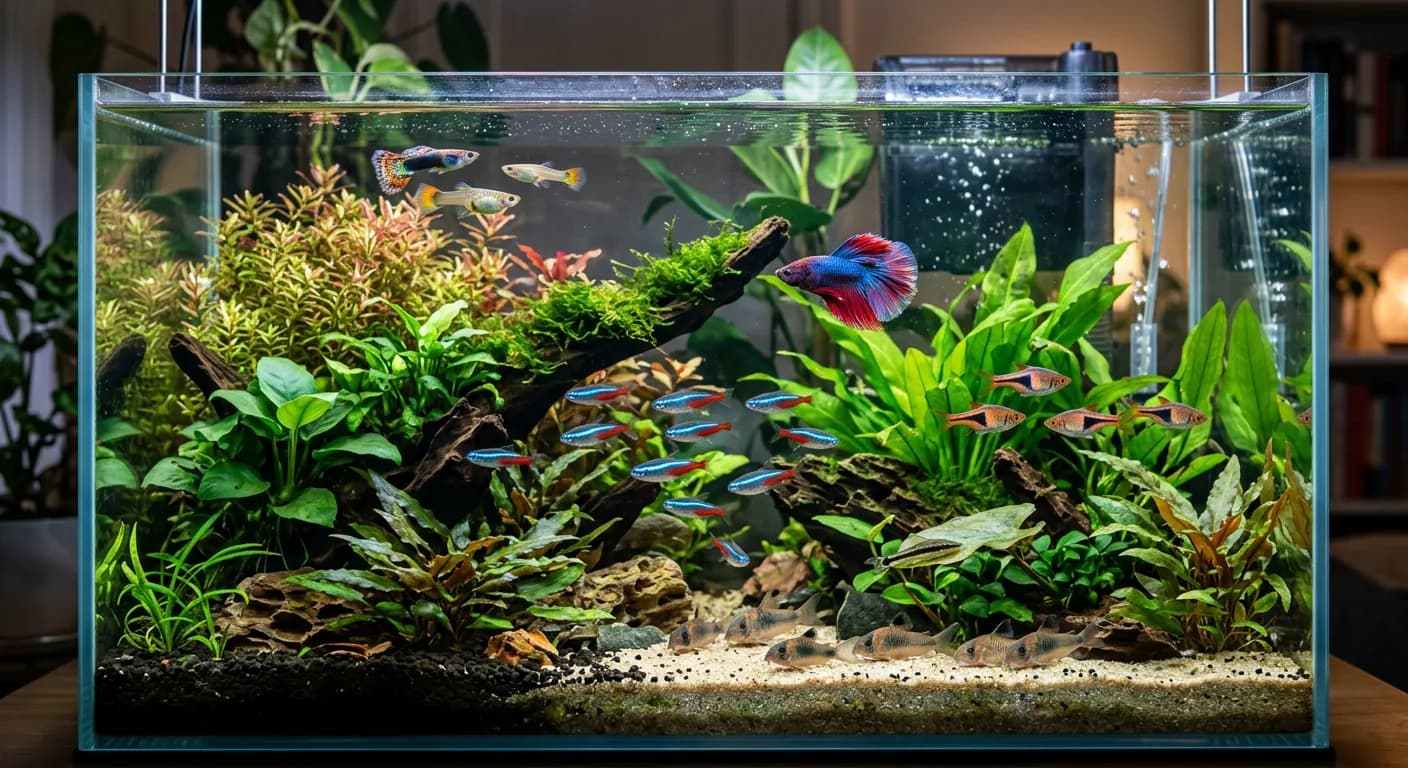
How Many Fish Can I Put in My Tank?
"One inch of fish per gallon." You have heard this rule. It is wrong. A 10-inch oscar does not belong in a 10 gallon tank. A 1-inch neon tetra produces a fraction of the waste a 1-inch goldfish does. And a 20 gallon tall has less surface area for gas exchange than a 20 gallon long, even though they hold the same water volume. Stocking is more nuanced than a simple formula, but it is not complicated either. Here is what actually determines how many fish your tank can hold, with real-world stocking plans for every common tank size.
01
Why the One-Inch-Per-Gallon Rule Is Wrong
The one-inch-per-gallon rule was invented as a rough guideline for small, slender-bodied community fish like tetras and guppies. For those fish, it works okay as a starting point. But people apply it to everything, and that is where it falls apart.
Body mass scales exponentially with length. A fish that is 6 inches long is not 6 times the mass of a 1-inch fish. It is closer to 200 times the mass. Mass means more food consumption, more waste output, and more oxygen demand. A single 6-inch fish produces far more bioload than six 1-inch fish.
The rule ignores behavior entirely. A 3-inch male betta occupies the entire tank psychologically. He patrols every inch and will harass tankmates in a space he considers too small. Six 3-inch tiger barbs in an 18 gallon tank is technically within the rule but is a recipe for aggression because they need room to school and establish a pecking order.
It also ignores filtration capacity. A tank with an oversized canister filter and heavy biological media can handle more fish than the same tank running a tiny internal filter. Filtration is the biggest variable in stocking capacity, and the rule does not account for it at all.
Use it as a loose sanity check for small community fish if you want. But never use it as your actual stocking calculator.
02
What Determines Stocking Capacity
Four things matter: filtration, surface area, species bioload, and behavior.
Filtration is the biggest factor. Your filter's biological media houses the bacteria that process ammonia and nitrite. A filter rated for 30 gallons on a 20 gallon tank gives you more bacteria capacity and more stocking headroom than a filter barely rated for 20 gallons. Over-filtering is always better than under-filtering. You cannot have too much biological filtration.
Surface area determines gas exchange. Oxygen enters the water and CO2 leaves through the water surface. A long, shallow tank (like a 20 gallon long: 30" x 12" x 12") has more surface area than a tall, narrow tank (like a 20 gallon tall: 24" x 12" x 16") and supports more fish even though both hold 20 gallons. Always choose long over tall for better stocking capacity.
Species bioload varies hugely. Goldfish are waste machines. A single fancy goldfish produces more ammonia than a school of 10 neon tetras. Messy eaters, large-bodied fish, and fish with high metabolisms (like puffers) punch way above their size in bioload. Small, efficient eaters like rasboras and corydoras have relatively low bioload for their size.
Behavior sets the real ceiling. Territorial fish need physical space regardless of filtration. A pair of German blue rams needs at least a 20 gallon even though their bioload could theoretically work in a 10. Schooling fish need room to swim in groups. Active swimmers like danios need horizontal swimming space that small tanks cannot provide.
03
Realistic Stocking for 5 and 10 Gallon Tanks
A 5 gallon tank is a single-species tank. Do not try to build a community in 5 gallons. Your realistic options:
Option A: 1 betta. Full stop. A betta will use every inch of a 5 gallon and thrive. You can add 3-5 nerite snails or a few cherry shrimp if the betta is not aggressive toward them (personality varies).
Option B: A colony of 8-10 cherry shrimp. Neocaridina shrimp breed readily and a 5 gallon planted tank makes an excellent shrimp colony. Add some java moss and watch them go.
Option C: A single pea puffer. These little guys have massive personality but are aggressive, messy eaters that should be kept alone in a small tank. They need live or frozen food (snails, bloodworms).
A 10 gallon opens up more options but is still limited:
Option A: 1 betta + 6 corydoras habrosus (pygmy cories). The cories stay on the bottom, the betta occupies the mid-to-top. Works well if the betta is not overly aggressive.
Option B: 8-10 celestial pearl danios + 6 pygmy corydoras. A gorgeous nano community. Both species stay small (under 1 inch) and have minimal bioload.
Option C: 6-8 endler's livebearers (males only, unless you want babies) + 3-5 amano shrimp. Colorful, active, and low bioload.
Option D: A species tank of 8-10 chili rasboras. Tiny, peaceful, and stunning in a planted tank with dark substrate.
Avoid neon tetras in a 10 gallon. They need a school of 6+ and are active swimmers that benefit from the extra horizontal space of a 20 long.
04
Stocking Plans for 20 and 29 Gallon Tanks
The 20 gallon long is the sweet spot for beginners. Enough water volume for stability, enough space for a real community, and small enough to maintain easily. Here are proven community combos:
20 Gallon Long Community A (classic): 8 neon tetras (mid-water schooling) 6 bronze or panda corydoras (bottom) 1 honey gourami (centerpiece) 3-5 amano shrimp (cleanup crew)
20 Gallon Long Community B (colorful): 8 harlequin rasboras (mid-water schooling) 6 kuhli loaches (bottom, nocturnal) 6 cherry shrimp (cleanup) 1 nerite snail per 5 gallons (algae control)
20 Gallon Long Community C (betta community): 1 male betta (centerpiece) 8 ember tetras (small, peaceful, mid-water) 6 corydoras habrosus (bottom) 3-5 amano shrimp
A 29 gallon gives you the same footprint as a 20 long but more height and volume. You can keep the same communities above with slightly larger schools, or add a second schooling species:
29 Gallon Community: 10 cardinal tetras (mid-water) 8 harlequin rasboras (mid-water) 8 bronze corydoras (bottom) 1 pearl gourami or 2 honey gouramis (centerpiece)
This is a full tank. You could push it slightly with strong filtration (AquaClear 50 or Seachem Tidal 55), but resist the urge to add "just one more" species. Every new addition increases bioload and social complexity.
05
Stocking a 55 Gallon Tank
A 55 gallon (48" x 13" x 21") is where things get exciting. The length supports active swimmers, the volume handles real bioload, and you can keep species that would be cramped in anything smaller.
55 Gallon Community A (South American theme): 12-15 cardinal tetras 10 rummy-nose tetras 8-10 bronze or sterbai corydoras 1 pair of German blue rams 1 bristlenose pleco 6-8 amano shrimp
55 Gallon Community B (peaceful and planted): 12 harlequin rasboras 10 ember tetras 8 kuhli loaches 2 pearl gouramis 1 bristlenose pleco 10+ cherry shrimp colony
55 Gallon Community C (active and colorful): 12-15 guppies (all male for color without breeding) 10 neon tetras 8 panda corydoras 6 otocinclus 2 honey gouramis
A 55 gallon with a canister filter (Fluval 307 or similar) rated for 70+ gallons gives you solid headroom. You can keep larger schools, which makes schooling fish look dramatically better. A school of 15 cardinal tetras in a planted 55 is a completely different experience than 6 cardinals in a 20.
Avoid common mistakes at this size: do not mix fish with incompatible temperature needs (goldfish with tropical fish), do not keep a single oscar (they need 75+ gallons), and do not fill it entirely with aggressive cichlids unless you know what you are doing with African cichlid stocking ratios.
06
Signs You Are Overstocked
Your tank tells you when it has too many fish. Learn to read the signs before you lose fish.
Frequent ammonia or nitrite readings above 0 in a cycled tank means your biological filtration cannot keep up with the waste output. If your tank has been cycled for months and you are still seeing ammonia, you either have too many fish or your filter is undersized.
Nitrate climbing above 40 ppm within a few days of a water change means your bioload is high relative to your water change schedule. Either increase water change frequency, increase the percentage changed, or reduce your fish count.
Fish gasping at the surface indicates low dissolved oxygen. Overstocked tanks run out of oxygen faster, especially at warmer temperatures (warm water holds less oxygen). More surface agitation from the filter output helps, but if you are seeing this regularly, you have too many fish.
Increased aggression is often a space issue disguised as a personality issue. Fish that were peaceful become aggressive when they do not have enough territory. Tetras that normally school tightly start nipping fins. Cichlids that were tolerant become murderous. Removing the "aggressive" fish usually reveals another fish that becomes the new bully because the root cause is overcrowding.
Algae explosions can signal overstocking because more fish means more waste, which means more nitrate and phosphate feeding algae growth. If you are battling algae despite reasonable light levels and a clean tank, check your stocking level.
Film on the water surface (protein film) that returns within hours of cleaning indicates too much organic waste. This is common in overstocked tanks without adequate surface agitation.
07
Community Tank Planning Tips
Think in layers. A well-planned community has fish occupying different zones: top dwellers (hatchetfish, guppies), mid-water swimmers (tetras, rasboras, gouramis), and bottom dwellers (corydoras, kuhli loaches, plecos). This reduces competition for space and makes the tank look active at every level.
Pick one centerpiece fish. A single honey gourami, pearl gourami, or betta gives the tank a focal point. Do not put three different centerpiece species in a 20 gallon. They will compete for territory and dominance.
Schooling fish need schools. Six is the minimum for most schooling species. Below that number, they become stressed, lose color, and behave erratically. If you cannot fit a school of 6, do not get that species. A school of 10+ looks dramatically better than 6 and the additional bioload per fish is minimal.
Research adult size, not purchase size. That 1-inch pleco at the store might be a common pleco that grows to 18 inches. That cute little bala shark gets to 14 inches and needs a 125+ gallon tank. Buy based on adult size, not baby size.
Use AqAdvisor.com as a starting point. Enter your tank size, filter, and proposed fish list. It calculates estimated bioload percentage and flags compatibility issues. It is not perfect (the bioload estimates are conservative and it does not account for plants), but it catches obvious problems like putting incompatible species together or massively overstocking.
Leave room to grow. Stock to 70-80% of your filter's theoretical capacity. This gives your biological filtration a buffer for days when you feed a bit extra or skip a water change. Running at 100% capacity means any small disruption causes problems.
Table of Contents
Related Content
Popular Fish Species
Essential Gear
Best Filter for a 20 Gallon Tank
Aquaneat 3-Pack Biosponge Filter
Best Aquarium Heater for Fish Tanks
Hitop Adjustable Aquarium Heater