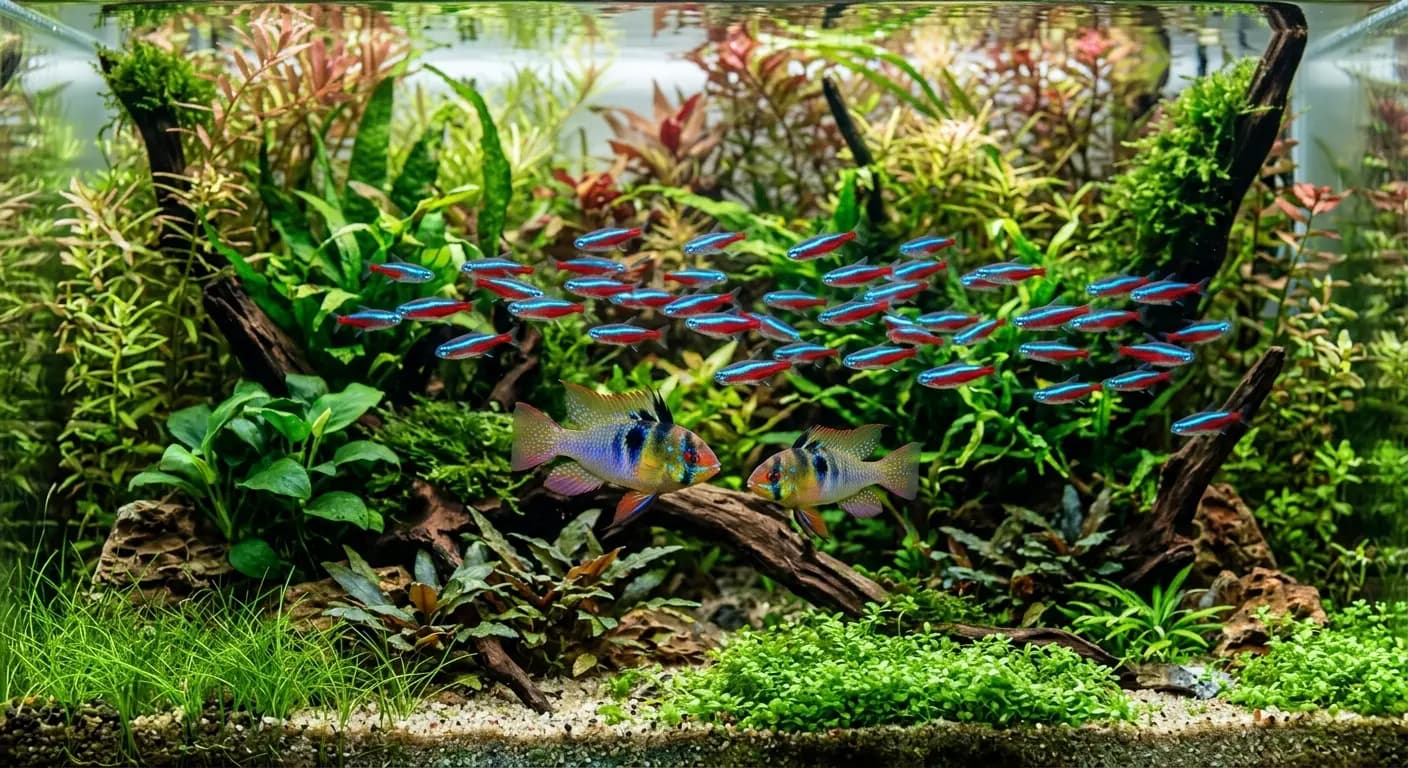
Best Fish for a 40 Gallon Tank (40 Breeder Stocking Guide)
The 40 gallon breeder punches above its volume. At 36x18x16 inches, it has more floor space than a 55 gallon despite holding less water, which makes it excellent for bottom-dwelling species, breeding projects, and planted tanks. The wide 18-inch front-to-back depth gives you room to create distinct visual layers: foreground plants, open swimming area, and dense background planting. Fish that need territory on the bottom of the tank, like dwarf cichlids and rainbow fish, suddenly have room to establish themselves properly. This guide covers the species that actually benefit from the 40 breeder's dimensions.
01
Why the 40 Breeder Is Special
The 40 breeder became popular with the reef hobby but crossed over to freshwater for good reason. Most "40 gallon" tanks are 36 inches long by 13 inches deep, similar footprint to a 29 gallon but longer. The 40 breeder is different: 36 inches long by 18 inches deep. That 18-inch depth changes everything about how the tank looks and what you can keep.
More floor territory. Bottom-dwelling fish that need to claim a territory (German blue rams, dwarf cichlids, kuhli loach colonies) get meaningful space. A pair of German blue rams in a 40 breeder can each claim a corner without constant conflict.
Better planted tank depth. A foreground carpet, midground plants, and tall background plants can all be at different distances from the glass simultaneously. The result is a sense of depth that a 13-inch-deep tank can't create.
More stable water chemistry. At 40 gallons, temperature and pH fluctuations between maintenance days are minimal. This matters for sensitive species like German blue rams and discus (though 40 gallons is on the small side for discus).
The practical trade-off: A 40 breeder is shorter at 16 inches tall than a 29 gallon (18 inches) or a 55 gallon (21 inches). Tall-bodied fish like angelfish technically fit, but they look more natural in taller tanks. The 40 breeder is better for fish that use the horizontal space rather than the vertical space.
02
Centerpiece and Semi-Aggressive Fish
German Blue Rams (1-2 Pairs)
German blue rams are the signature species for a 40 breeder. This small cichlid (about 3 inches) has electric blue spangling on a yellow-gold body with a distinctive black spot on the side. A bonded pair in a well-planted 40 breeder is one of the most photogenic setups in freshwater fishkeeping.
They're demanding on water quality: warm (78-84F), soft, and slightly acidic (pH 5.5-7.0). Zero tolerance for ammonia or nitrite. Tank-raised specimens from quality breeders are more forgiving than wild-caught fish, but rams still aren't beginner species.
One pair in a 40 breeder gives you adequate territory to reduce pair aggression while keeping the tank balanced. Two pairs need careful monitoring. Rams will defend territory against other rams, and the 40 breeder has enough space for two pairs to coexist but not so much that conflict is impossible.
Electric Blue Acara (1-2)
Electric blue acaras are the easier alternative to German blue rams. They're larger (up to 7 inches), hardy across a wider water parameter range (pH 6.5-7.5, temperature 72-82F), and genuinely electric blue coloring that holds up beautifully under good lighting. They're cichlids and will claim territory but are far less aggressive than most cichlids their size.
A single EBA in a community tank or a mated pair in a species-focused setup both work in a 40 breeder. They'll eat small fish (under 2 inches) and rearrange substrate, but won't terrorize other fish the way larger cichlids would.
Bolivian Ram (1-2 Pairs)
If German blue rams seem too demanding, Bolivian rams offer similar behavior and appearance with significantly more tolerance for typical aquarium water parameters (pH 6.5-7.5, temperature 72-79F). They're slightly larger and less colorful than German blue rams, but still a beautiful fish. Bolivians are good gateway cichlids. They'll teach you pair dynamics and territory management without the strict water parameter requirements.
03
Schooling Fish
Rainbowfish (6-8)
Rainbowfish are underused in the hobby and particularly well-suited to a 40 breeder. Most species reach 3-4 inches with a laterally compressed, arched body shape and colors that change depending on lighting and mood. Under a good light, males display to each other and shift from silver to iridescent blue, orange, or yellow.
Boesemani rainbowfish are the most popular: deep blue-green head and bright yellow-orange back half, separated by a silvery transition zone. Males are 4 inches; females slightly smaller and less colorful. A group of 6-8 boesemani in a 40 breeder with a good light looks stunning.
They prefer hard, slightly alkaline water (pH 7.0-8.0, temperature 74-82F), which is opposite of what German blue rams want. Keep this in mind when planning your full stock list. Rainbowfish pair better with electric blue acaras than German blue rams.
Denison Barbs (5-6)
Denison barbs (also called roseline sharks) are large barbs at 4-6 inches with a torpedo shape, red stripe on the nose, and a bold black-and-yellow tail. They're active, schooling fish that need the swimming room a 40 breeder provides. In a smaller tank, they're too big and too energetic. In a 40 breeder, a group of 5-6 creates constant movement.
They prefer temperatures from 72-77F and pH 6.5-7.5. They're also more expensive than common schooling fish. Expect to pay more per fish than you would for tetras or rasboras. But a school of 5 Denison barbs moving in formation is a sight worth paying for.
Congo Tetras (6-8)
Congo tetras are the show tetras. Males reach 3 inches with iridescent blue, gold, and orange coloration and extended fin edges. In a 40 breeder, a group of 6-8 males and females creates a colorful, fast-moving mid-water display. They prefer slightly soft, slightly acidic water (pH 6.0-7.5, temperature 75-81F) and need a large group to feel confident.
Fluval Bug Bites Tropical Fish Food
Works for cichlids, barbs, rainbowfish, and tetras alike. Insect-based protein with small pellet size that mid-water fish grab before it sinks.
04
Bottom Dwellers
Bronze Corydoras or Sterbai Corydoras (8-10)
A 40 breeder's floor space supports a larger cory school than smaller tanks. Eight to ten bronze corydoras form genuine foraging parties and use the full bottom of the tank. Sterbai corydoras are the better choice if you're running German blue rams. Sterbai handle the warmer temperatures (75-84F) that rams require, while most other cory species struggle above 78F.
All corydoras need fine sand substrate. The 18-inch depth of the 40 breeder means more sand to buy and maintain, but it also means more foraging territory and better behavioral expression from your cories.
Kuhli Loaches (6-8)
A 40 breeder is the ideal tank for a larger kuhli loach colony. Eight kuhli loaches in a tank with fine sand, driftwood, and caves will actually be seen regularly. The colony feels more confident in larger groups and in tanks with more hiding options. They pair well with corydoras (different feeding niches) and don't compete for territory.
Bristlenose Pleco (1-2)
One or two bristlenose plecos handle algae for a 40 breeder. The wider footprint means more glass and hardscape surface for them to work. At 4-5 inches, two bristlenose don't stress the bioload significantly if you're running good filtration.
05
Complete Stocking Plans
The Planted Ram Tank 1 pair German blue rams + 8 cardinal tetras + 8 sterbai corydoras + 5 amano shrimp
Warm (80-82F), soft water, heavily planted. Cardinals and sterbai both handle the warm temperature that rams require. Amano shrimp keep plant leaves clean. The rams provide drama and personality, the cardinals provide color, and the cories add constant bottom movement. This is a high-care but high-reward setup.
The 40 Breeder Community 1 electric blue acara + 8 harlequin rasboras + 8 bronze corydoras + 3 nerite snails
More forgiving water parameters than the ram tank (pH 6.8-7.5, temperature 74-78F). The EBA is the focal point without requiring warm, soft water. Harlequins school reliably and look good with most backgrounds. Cories cover the bottom. A good mid-experience build with high visual payoff.
The Rainbowfish Tank 6 boesemani rainbowfish + 5 Denison barbs + 6 bronze corydoras + 1 bristlenose pleco
Harder water build (pH 7.0-7.8, temperature 74-78F). Boesemani provide the color show and Denison barbs add fast-moving torpedo shapes. Cories clean up below, bristlenose handles algae. No centerpiece fish. The rainbowfish are the show.
The Planted Breeding Project 1 pair electric blue acaras + 8 Congo tetras + 6 sterbai corydoras + 5 otocinclus
Built around a cichlid pair that may spawn. Soft, slightly acidic water (pH 6.5-7.2, temperature 76-80F). Congo tetras add large-bodied schooling color. Sterbai and otocinclus handle bottom and plant maintenance. If the EBAs spawn, the tetras and cories are fast enough to avoid trouble.
06
Equipment for a 40 Breeder
Filtration
A 40 breeder needs more filtration than the tank volume alone suggests, because the wide footprint means water doesn't circulate as efficiently as in a narrower, taller tank. A filter rated for 60-80 gallons (like the Fluval 307 canister filter) is appropriate for a fully stocked 40 breeder. Canister filters are particularly well-suited to this tank since they don't take up any in-tank or hang-on-back space, leaving the full viewing area unobstructed.
For planted tanks or shrimp tanks where strong flow is a problem, a sponge filter plus a smaller canister handles filtration without blasting your plants or livestock.
Heating
A 150-200W heater handles a 40 breeder. The wider footprint means slightly more heat loss than a taller tank of similar volume. Place the heater near the filter intake or output for even distribution. For German blue rams requiring 80-84F, use an adjustable heater and verify the actual temperature with a separate thermometer. Don't trust the dial.
Lighting
The 36-inch length of a 40 breeder is a standard size for full-spectrum LED aquarium lights. A good 36-inch light in the 6500-7000K range supports low to medium-light plants. If you're going high-tech planted with CO2, step up to a higher-output model. The 18-inch depth means your light needs to penetrate further to reach foreground plants, which matters more in planted builds than in fish-only setups.
Fluval 307 Canister Filter
Rated for tanks up to 70 gallons. External canister keeps the 40 breeder's clean aesthetic intact. Priming button makes setup easier than older canister designs.
Pool Filter Sand
The best affordable substrate for a 40 breeder stocked with corydoras, kuhli loaches, or cichlids that dig. Fine grain won't damage barbels, available in bulk.