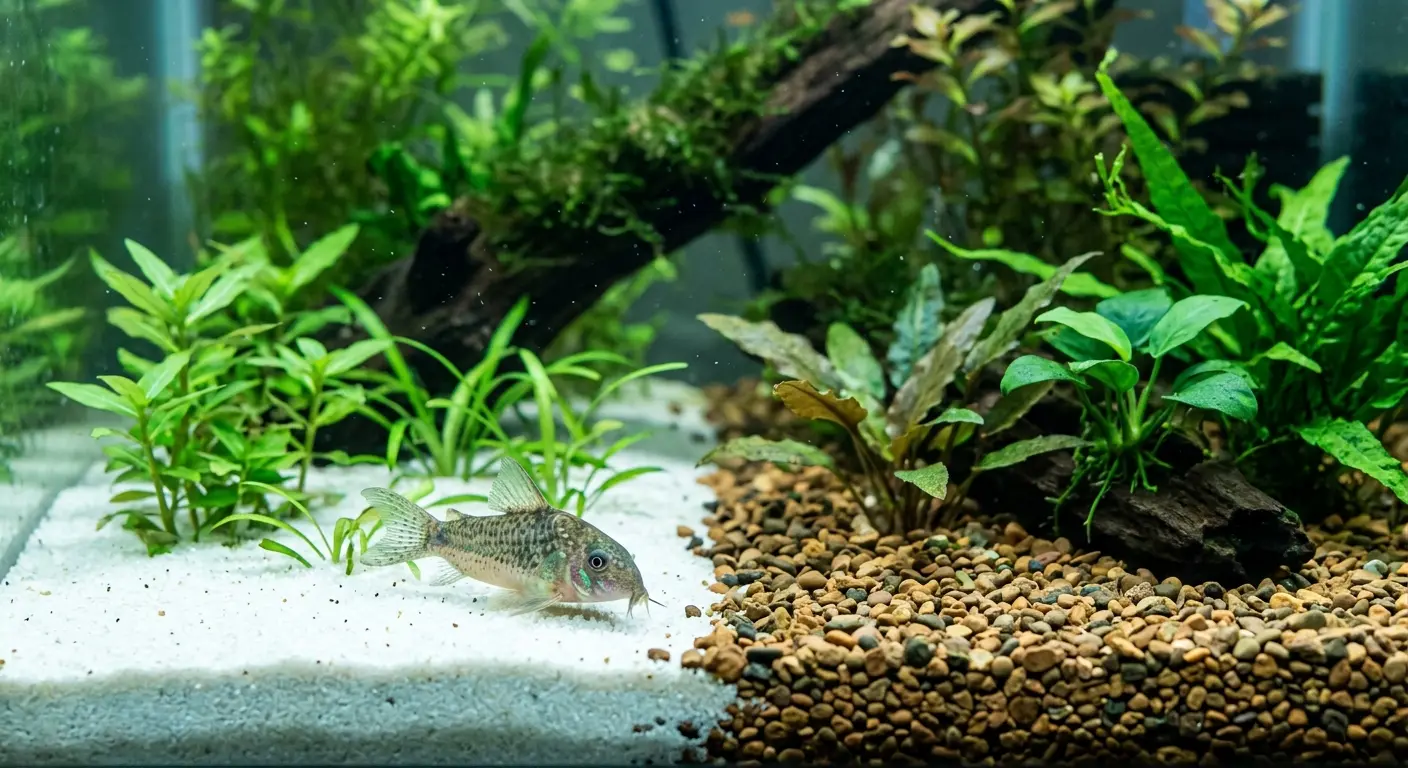
Sand vs Gravel: Which Substrate Is Right for Your Aquarium?
For most freshwater tanks, substrate choice comes down to what fish you are keeping. Corydoras, loaches, and burrowing species need sand, not because they prefer it aesthetically, but because gravel damages their barbels when they sift through it for food. Beyond that specific constraint, gravel and sand perform similarly in a cycled tank. The debates about which one is better for beneficial bacteria, water clarity, or plant growth are mostly overblown. Pick the one that fits your fish and your maintenance habits.
01
The Real Difference Between Sand and Gravel
Beneficial bacteria colonizes every surface in your tank: filter media, tank walls, decorations, and substrate. The substrate contributes to your overall biological filtration capacity, but it is not the primary site for bacterial colonization. Your filter media handles the heavy lifting. Swapping substrate types does not significantly change your tank's ability to process ammonia, which is the claim that generates the most substrate debates.
What substrate type does affect:
Waste behavior. In a gravel tank, uneaten food and fish waste sinks down between the stones and sits out of sight. It still decompose and affect water quality, but you do not see it. In a sand tank, waste sits on the surface where you can vacuum it more directly, though it is also more visible and can make a tank look dirtier than it is.
Plant rooting. Plants anchor more easily in gravel than in sand. Roots in sand can get uprooted by fish activity or water flow. Gravel's heavier particle size holds root balls in place. That said, heavy root-tab fertilization and the right plants (anubias, java fern, crypts) work fine in sand.
Fish behavior. Bottom-dwelling fish that sift substrate (corydoras, kuhli loaches, dojo loaches, peacock spiny eels, rope fish) need fine sand. Gravel particles scrape and damage the delicate barbels these fish use to search for food. Damaged barbels lead to bacterial infections, and chronic substrate stress shortens lifespans.
02
Sand: Who Should Use It
Sand is mandatory for some fish and optional for everyone else.
Required for: Any species that sifts substrate as part of natural feeding behavior. Corydoras, kuhli loaches, dojo loaches, yoyo loaches, peacock spiny eels, rope fish, and sand-sifting cichlids like Geophagus all need fine sand. These fish push their snouts into the substrate dozens of times per day. On gravel, the repeated abrasion wears down their barbels within months. The barbel damage often goes unnoticed until the fish develops a secondary infection.
Recommended for: Shrimp tanks. Cherry shrimp, amano shrimp, and other freshwater shrimp graze biofilm from every surface in the tank. Fine sand gives them more surface area to explore and does not trap shed exoskeletons the way gravel can. Blue velvet shrimp and other neocaridina varieties look better against light-colored sand than against dark gravel.
Works for: Betta tanks, planted tanks (with the right plants and root tabs), and community tanks where aesthetics favor the look. Natural-colored fine sand like CaribSea Super Naturals gives a clean, natural appearance.
The practical downsides of sand are that it can get kicked up by strong filter flow (use a spray bar or prefilter sponge to diffuse the return), and deep sand beds over 3 inches can develop anaerobic pockets if not disturbed regularly. Keep sand beds at 1-2 inches and run a mystery snail or nerite snail to stir the surface.
CaribSea Super Naturals Crystal River Sand
Fine-grain natural sand that stays where you put it, will not cloud the tank after the initial rinse, and works for corydoras, shrimp, and planted tanks.
03
Gravel: When It Works Better
Gravel is the default for most freshwater tanks for practical reasons, not just because it is traditional.
Plant anchoring. Sword plants, vallisneria, and stem plants root better in gravel than in sand. The larger particle size grips root balls and holds stems upright. Plants in sand get uprooted by digging fish or strong water flow more often than plants in gravel.
Waste management. Gravel tanks hide waste between stones, which means the tank looks cleaner between vacuuming sessions. The tradeoff is that the waste is harder to remove because you have to push the siphon down between stones rather than skimming the surface.
Cichlid and goldfish tanks. Larger, digging fish do not benefit from sand and can make it worse. They continuously relocate it around the tank. Medium-grain gravel stays in place better when large fish dig.
Lower cost. Plain aquarium gravel is cheaper per pound than most quality aquarium sand. For large tanks where substrate cost adds up, gravel wins on budget.
Gravel has one real downside for bottom-dwelling fish: particle size. If you want to keep corydoras in a gravel tank, use very fine gravel (1-2mm) rather than standard aquarium gravel (3-5mm). The finer particle size reduces barbel abrasion significantly. It is not as good as sand, but it is better than standard gravel for species that sift.
04
Planted Tanks: What Matters
For serious planted tanks, the sand vs gravel debate is mostly irrelevant because the best planted substrate is neither. It is a nutrient-rich soil-based substrate.
Substrates like CaribSea Eco-Complete, Fluval Stratum, and similar products contain iron, minerals, and other nutrients that plants consume through their roots. Plain gravel and plain sand contain no plant nutrition. You can compensate with root tabs (fertilizer capsules pushed into the substrate near plant roots), but a nutrient-rich substrate gives you a head start and reduces how often you need to fertilize.
For low-tech planted tanks (no CO2 injection, moderate light), Eco-Complete or Stratum under most plants produces noticeably faster growth and healthier root development than plain gravel, even with root tabs. For high-tech planted tanks with CO2 and strong lighting, a capped nutrient substrate (nutrients underneath, sand or fine gravel on top) or a dedicated aquasoil is the standard approach.
If you want plants and you have corydoras or loaches, the common solution is a capped substrate: 1-2 inches of Eco-Complete or similar on the bottom, topped with 1 inch of fine sand. The sand layer protects fish barbels while the substrate underneath provides nutrients to plant roots.
CaribSea Eco-Complete Planted Substrate
Iron-rich substrate that skips the root tab dependency for most planted tanks. Works under a sand cap or as a standalone substrate in tanks without substrate-sifting fish.
05
The Short Answer by Fish Type
If you are choosing substrate and want the quick version:
Always use sand: Corydoras (all species), kuhli loaches, dojo loaches, yoyo loaches, peacock spiny eels, rope fish, bichirs, any Geophagus cichlid, sand-sifting gobies.
Sand strongly preferred: Cherry shrimp, amano shrimp, most neocaridina shrimp, freshwater puffers that hunt in substrate.
Either works well: Bettas, tetras, rasboras, danios, guppies, livebearers, rainbowfish, honey gouramis, dwarf gouramis.
Gravel works better: Plants that root aggressively (sword plants, vallisneria), large cichlids that dig, goldfish, most larger community fish.
Use nutrient substrate: Any planted tank where plant growth is a priority, regardless of fish type. Cap with sand if keeping corydoras or loaches.
Table of Contents
Related Content
Essential Gear
Best Filter for a 20 Gallon Tank
Aquaneat 3-Pack Biosponge Filter
Best Aquarium Light for Freshwater Tanks
Hygger Auto On Off LED Aquarium Light