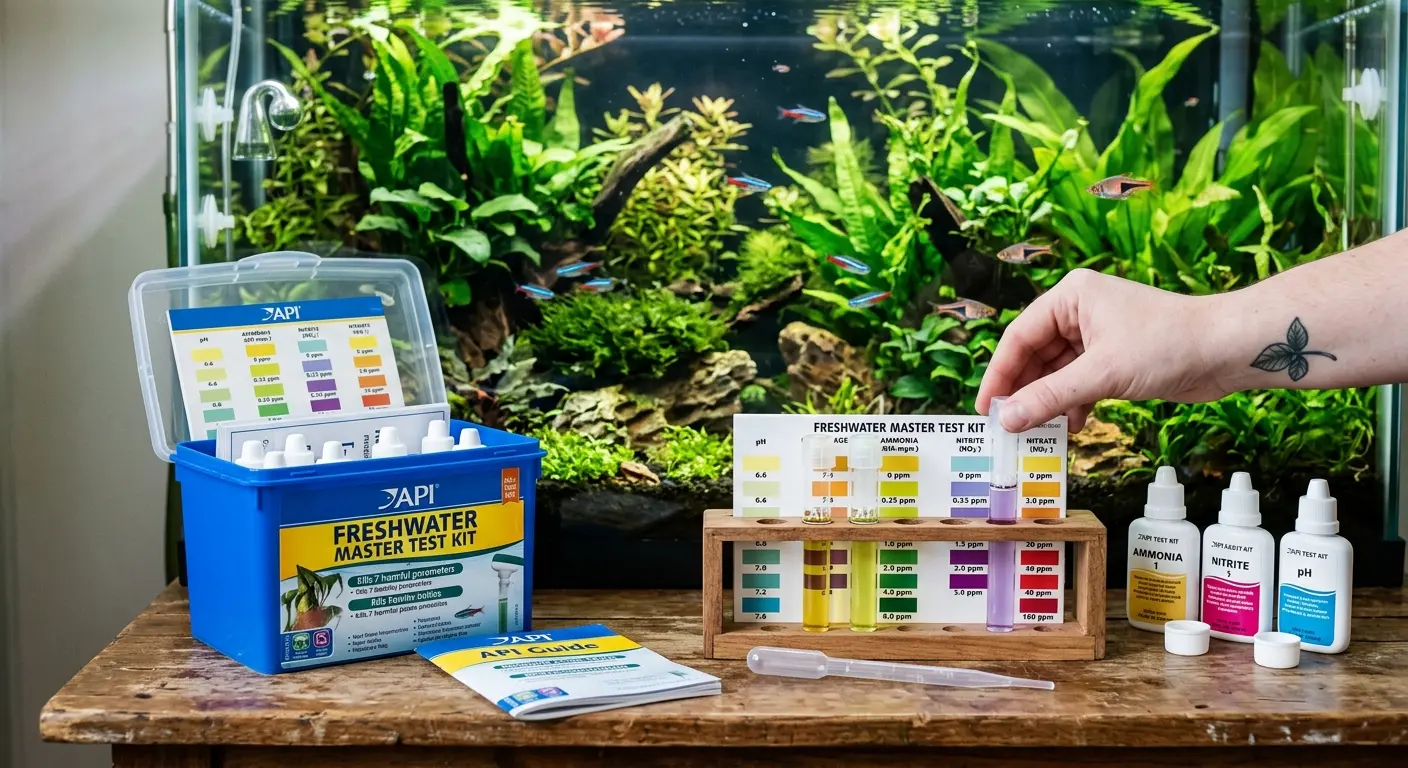
How to Lower Nitrates in Your Aquarium
Nitrates are the end product of the [nitrogen cycle](/guides/how-to-cycle-tank). Unlike ammonia and nitrite, which spike and crash during cycling, nitrates accumulate steadily in every established tank. They do not go away on their own. Your tank has nitrates. The question is whether the level is high enough to cause problems and what to do about it.
01
What Nitrate Level Is Too High?
Most freshwater community fish tolerate nitrates up to 40 ppm without visible stress. Below 20 ppm is better and what most experienced keepers aim for. Above 40 ppm, you start to see immune suppression, reduced disease resistance, fin damage in sensitive species, and behavioral changes. Above 80 ppm is genuinely harmful for most fish and lethal for shrimp and sensitive species like discus and cardinal tetras.
Shrimp and invertebrates are the most sensitive. Cherry shrimp, amano shrimp, and other freshwater shrimp can show stress at 20 ppm and deaths above 40 ppm. If you are keeping shrimp and having unexplained die-offs, test nitrates first.
Goldfish and cichlids are more tolerant than most species but still suffer at sustained high levels. The "goldfish are hardy" reputation comes from their ability to survive bad conditions temporarily, not from any preference for them.
Planted tanks often run near 0 ppm nitrates because plants consume nitrates directly. This is not a problem. It means the system is working correctly.
02
Water Changes: The Only Method That Reliably Works
Water changes are the primary tool for lowering nitrates, and they are more reliable than any other method. If your nitrates are high, a water change is the first response. Not a product, not a filter upgrade.
How much to change depends on how high your nitrates are:
- Nitrates at 40-80 ppm: A 25-30% water change drops them proportionally. One good water change and weekly 20-25% changes going forward will keep levels manageable.
- Nitrates above 80 ppm: Do multiple smaller water changes rather than one large one. A single 50% water change when nitrates are at 100 ppm halves them to 50 ppm. A second 25% change the next day drops them further without shocking the fish with a sudden chemistry shift.
- Emergency (above 160 ppm): Multiple changes over 24-48 hours. Do not do a single 90% change. The osmotic shock from sudden water chemistry changes stresses fish more than temporarily high nitrates.
The math is simple: a 25% water change replaces 25% of the water with nitrate-free tap water, so it reduces nitrates by 25%. A tank at 80 ppm becomes 60 ppm after a 25% change, 45 ppm after a second 25% change.
Tap water can contain nitrates. If your tap water tests above 10-20 ppm nitrates, water changes become less effective because you are adding nitrates with each change. Contact your water utility or test your tap water if you are struggling to lower nitrates despite regular changes.
Python No Spill Clean and Fill Water Changer
Connects directly to a faucet for siphoning and refilling without carrying buckets. Makes the weekly water change fast enough that you actually do it consistently.
03
Live Plants: Long-Term Nitrate Control
Live plants consume nitrates as fertilizer. A heavily planted tank can keep nitrates near zero without water changes. That is how the walstad method and heavily planted tanks stay stable. A lightly planted tank reduces how fast nitrates climb, which means you need less frequent water changes to stay in range.
Plants that grow fast consume the most nitrates. Fast-growing stem plants like hornwort, water sprite, amazon frogbit, and duckweed are the most effective nitrate consumers. Slow-growing plants like anubias and java fern consume nitrates at a much slower rate.
Floating plants are particularly efficient because they grow quickly and have direct access to CO2 from the air rather than depending on dissolved CO2 in the water. Duckweed, frogbit, and red root floaters can visibly reduce nitrates in a week if the tank has good light.
The catch: plants need nutrients to grow. If your water column is very low in nutrients other than nitrates, plant growth slows and nitrate consumption drops. A balanced planted tank with some root tabs and occasional liquid fertilizer for trace elements grows faster and pulls nitrates more consistently than a tank where plants are slowly starving.
04
Reduce the Source: Feeding and Stocking
Nitrates come from fish waste and uneaten food breaking down. Reducing the input reduces how fast nitrates accumulate.
Feeding. Feed only what fish consume in 2-3 minutes once or twice daily. Uneaten food decays into ammonia, which converts to nitrite, which converts to nitrate. One overfeeding session creates the same nitrate load as a week of normal feeding. Remove any uneaten food after 5 minutes.
Stocking. More fish means more waste means faster nitrate accumulation. An overstocked tank is constantly fighting nitrates regardless of how often you change water. If you are doing 40%+ water changes weekly and still seeing high nitrates, the stocking level is likely the problem, not the maintenance schedule.
Cleaning. Detritus (waste, dead plant matter, uneaten food) that accumulates in substrate and corners of the tank continuously breaks down and contributes to nitrates. Regular gravel vacuuming during water changes removes the source rather than just the symptom.
05
What Doesn't Work as Well as Advertised
Nitrate-removing filter media. Products marketed as nitrate reducers (certain resins, zeolite for nitrates, specific filter pads) work briefly and need frequent replacement or regeneration. They treat the symptom without addressing the cause and are expensive to maintain. They are useful as a temporary fix in emergency situations, not as a long-term strategy.
Nitrate-removing bacteria products. Products that claim to add denitrifying bacteria to your filter media have limited evidence behind them in freshwater aquariums. Denitrifying bacteria operate in very low oxygen environments, deep in filter media or in deep sand beds, and are difficult to establish with bottled products. The filtration setup would need to support them, and most standard filters don't.
Algae. Algae consumes nitrates, but controlled algae growth as a nitrate management strategy is more trouble than it is worth. The amount of algae you would need to make a dent in nitrates would turn the tank into a green mess.
The honest answer is that water changes, live plants, and controlling inputs are the methods that work consistently. Everything else is supplemental at best.
Table of Contents
Related Content
Popular Fish Species
Essential Gear
Best Aquarium Test Kit for Freshwater Tanks
API Freshwater Master Test Kit
Best Aquarium Gravel Vacuum
Python No Spill Clean and Fill (25 ft)
Frequently Asked Questions
Sources & Further Reading
- National Primary Drinking Water Regulations — EPA
EPA maximum contaminant level for nitrate in drinking water: 10 mg/L (10 ppm). Reference point for toxicity thresholds in aquatic contexts.
- Nitrate — Wikipedia
Chemistry and biological effects of nitrate, including aquatic organism toxicity and the role of nitrate in the nitrogen cycle.
- FishBase — Global Species Database
Species-level water quality data used to verify nitrate sensitivity thresholds for shrimp and sensitive species cited in this guide.