Best Aquarium Gravel Vacuum
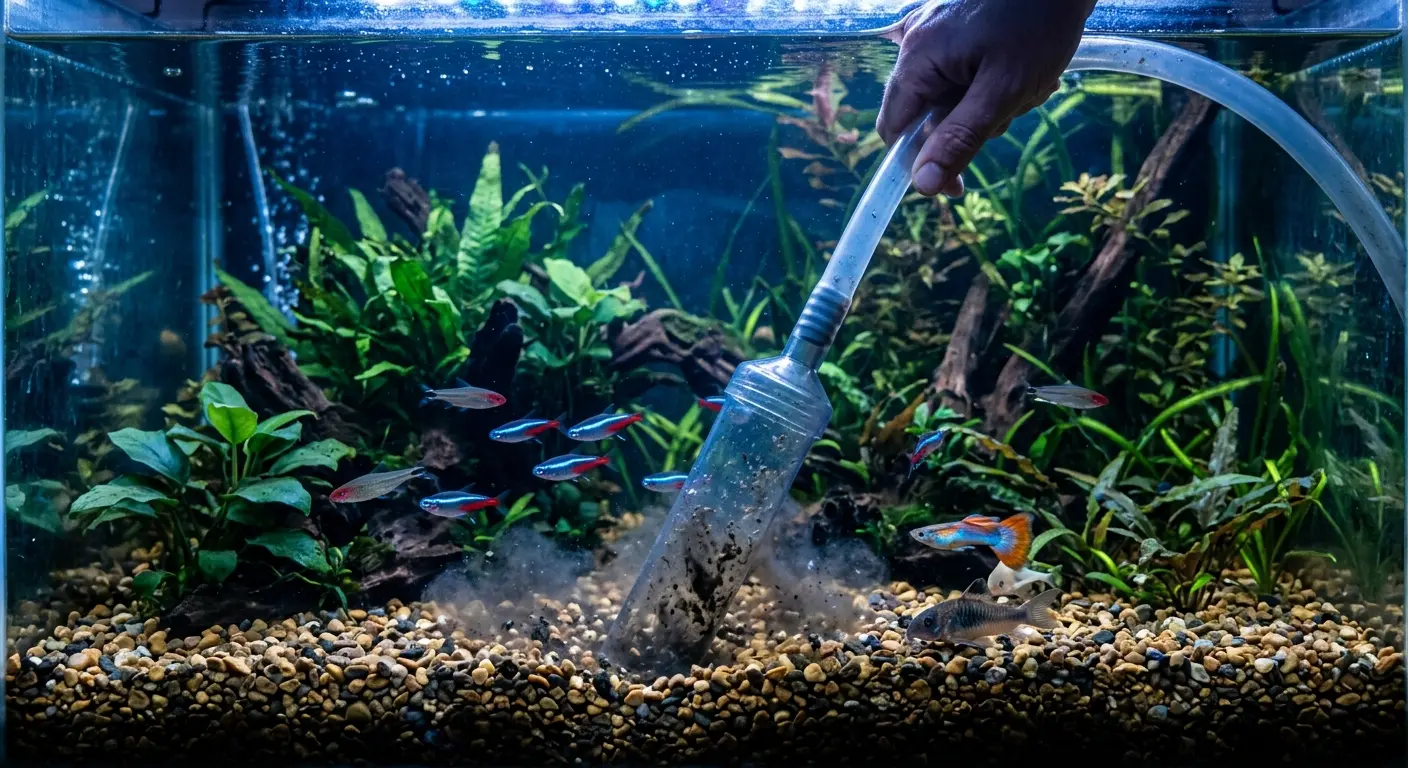
A gravel vacuum is the tool that makes consistent water changes actually happen. Without one, debris compacts in the substrate where it decays and drives up nitrates between water changes. With a good one, you pull water and waste simultaneously, and the job takes minutes instead of a production. The choice comes down to tank size: below 30 gallons, a basic siphon vacuum does the job at almost no cost. Above 40 gallons, the Python No Spill system pays for itself in time saved within a few months.
Our Picks
Python No Spill Clean and Fill (25 ft)
Best OverallThe Python connects to your sink faucet with a water-powered vacuum that drains the tank through a gravel tube directly to the drain — no buckets, no lifting, no back strain. When the water change is done, you reverse the flow to refill through the same tube. For tanks over 30 gallons or anyone doing regular 25-30% weekly changes, this eliminates the most tedious part of tank maintenance. The 25-foot hose reaches most tank-to-sink setups in standard rooms.
Pros
- • No buckets — drains and refills directly to your sink
- • 25-foot hose reaches across most rooms
- • Water-powered vacuum needs no electricity
- • Saves significant time on tanks 30 gallons and up
Cons
- • Requires a faucet with the right threads — may need an adapter for some faucet types
- • You add dechlorinator directly to the tank as it refills (Prime works well for this)
- • Higher upfront cost than a basic siphon
- • 25 feet may not reach in every room setup — 50-foot extensions available
Lee's Ultra GravelVac Self-Start
Budget PickThe Lee's Ultra GravelVac is the standard budget siphon that has been in the hobby for decades. The self-start feature means you shake the tube rather than siphon-starting with your mouth. It has a wide gravel tube that pulls substrate debris effectively without sucking up gravel, and the hose is long enough for most tanks under 30 gallons. For small tanks, a quarantine setup, or anyone who does not want to deal with faucet adapters, this is the practical choice.
Pros
- • Self-starting — no mouth siphon needed
- • Effective gravel tube pulls debris without removing substrate
- • Inexpensive; easy to keep as a backup
- • No faucet connection required — works anywhere with a bucket
Cons
- • Requires a bucket for collecting water — manual disposal
- • Takes longer than the Python on tanks over 20 gallons
- • Hose length limits reach in taller or longer tanks
Gravel Vacuum vs. Python: How to Choose
The decision is mostly about tank size and how much you value your time.
For tanks under 30 gallons, a standard siphon vacuum is entirely adequate. A 10 or 20 gallon water change fills one bucket. The job takes 5 minutes. The Python's convenience does not justify the cost at this scale.
For tanks 30-55 gallons, this is the crossover zone. A 30% water change on a 40 gallon tank is 12 gallons — two full buckets, carried from tank to drain. If you do this weekly, the Python pays off fast. If you do it monthly, the Lee's still works fine.
For tanks 55 gallons and up, get the Python. A 25% change on a 75 gallon tank is nearly 19 gallons. That is multiple heavy bucket trips every week. The Python converts this into a 15-minute hose-and-faucet operation.
One Python technique worth knowing: add dechlorinator (Seachem Prime works well) directly to the tank just before you refill. Prime detoxifies chlorine and chloramines on contact, so you do not need to pre-treat the water as long as it is added while fresh water is still entering. The alternative is a drip inline dechlorinator inline on the Python hose.
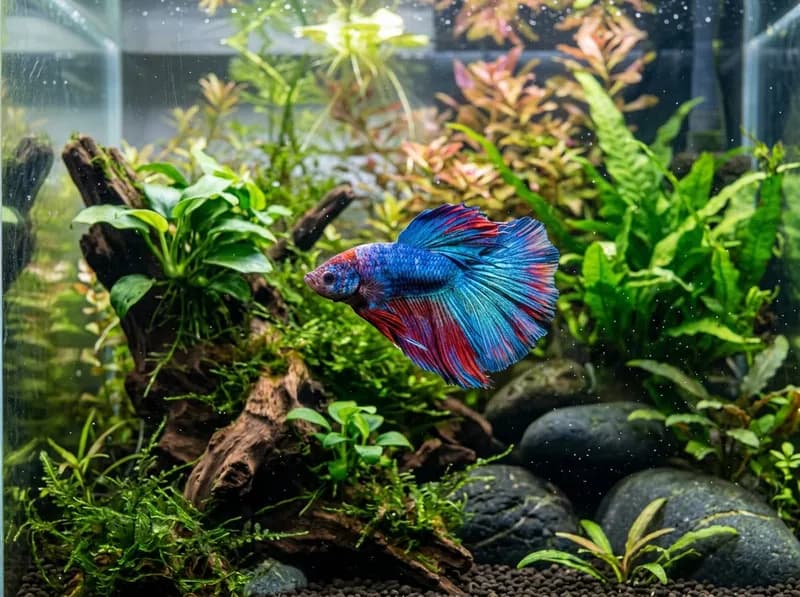
For planted tanks, vacuuming technique matters. Lightly graze the surface of plant areas rather than pushing the tube deep into the substrate — you want to remove surface debris without disturbing the substrate bacteria layer that feeds plant roots. Bare areas between plants can be vacuumed normally.