How to Do Water Changes (The Right Way)
Water changes are the single most effective thing you can do to keep fish healthy. Nothing else comes close. Not fancy filters, not UV sterilizers, not miracle additives. Fresh, clean water on a consistent schedule prevents 90% of the problems fishkeepers post about in forums. Yet most beginners either skip them entirely, do them wrong, or do them so aggressively they stress out their fish. Here is exactly how to do water changes properly, how often, how much, and what equipment makes the job painless instead of miserable.
01
Why Water Changes Matter
Your fish eat, poop, and breathe in the same water 24/7. The filter handles ammonia and nitrite through the nitrogen cycle, converting them into nitrate. But nitrate just accumulates. Nothing in a typical aquarium removes it except water changes and live plants.
Nitrate above 40 ppm starts stressing most tropical fish. Above 80 ppm and you are looking at stunted growth, weakened immune systems, and fish that die from diseases they would have shrugged off in clean water. Long-term high nitrate is called "old tank syndrome" and it kills slowly enough that many keepers never connect the dots.
Beyond nitrate, dissolved organic compounds build up over time. These are the things that make old tank water slightly yellow when you hold a glass of it up to white paper. They lower pH gradually, reduce oxygen levels, and create conditions where bacteria and parasites thrive.
Water changes also replenish minerals and trace elements that fish and plants need. Tap water contains calcium, magnesium, and other minerals that get used up over time. Topping off evaporation does not replace these because only the water evaporates, leaving the minerals behind in increasingly concentrated form.
02
How Often and How Much
For most community tanks: 25-30% weekly. That is the baseline. Write it on your calendar, set a phone reminder, whatever it takes to make it a habit.
Heavily stocked tanks or tanks with messy fish (goldfish, oscars, large cichlids) may need 40-50% weekly or even twice-weekly changes. Lightly stocked planted tanks with fast-growing plants can sometimes stretch to every 10-14 days, but weekly is still safer.
Betta tanks under 5 gallons need 25-30% twice per week because the small volume concentrates waste faster. A betta in a filtered 10 gallon can follow the standard weekly schedule.
The key metric is nitrate. Test your water the day before a water change. If nitrate is under 20 ppm, your schedule is working. If it is creeping above 40 ppm, increase the frequency or volume. If it is consistently under 10 ppm, you might have room to do slightly less, but honestly just keep doing weekly changes. Consistency beats optimization.
New tanks that just finished cycling often have a nitrate spike. Do a large 50-70% change to bring it down before adding fish, then shift to the weekly 25-30% routine.
03
Equipment You Need
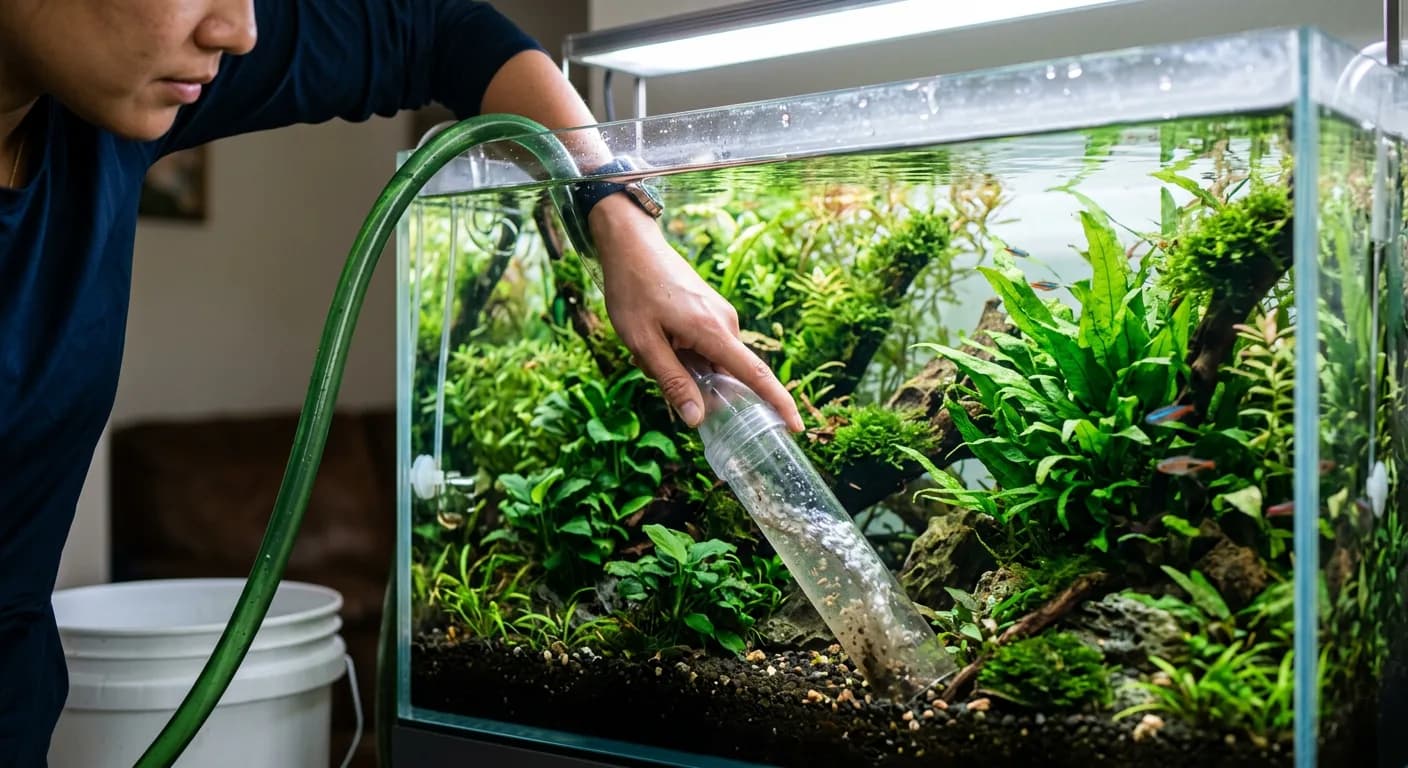
A gravel vacuum (also called a siphon) is non-negotiable. This is a wide tube connected to flexible tubing that lets you suck debris out of the substrate while draining water. The Python No Spill Clean and Fill is the gold standard if your tank is near a sink. It hooks directly to the faucet, so no buckets at all. The 25-foot version is a worthwhile investment if you have a 20+ gallon tank.
If you go the bucket route, get a dedicated 5 gallon bucket from a hardware store. Write "FISH ONLY" on it in permanent marker. Never use it for anything involving soap, chemicals, or cleaning products. Soap residue is extremely toxic to fish and nearly impossible to fully rinse out.
A water conditioner is essential. Seachem Prime is the standard recommendation because it handles chlorine, chloramine, and temporarily binds ammonia and nitrite. A 500 mL bottle treats 5,000 gallons and is very economical. That is years of water changes for most hobbyists.
A thermometer (you should already have one on your tank) helps you temperature-match new water. A turkey baster is useful for spot-cleaning waste from tight spaces without doing a full gravel vac. Keep a towel nearby because you will drip. Always.
Python No Spill Clean and Fill (25 ft)
Hooks directly to the faucet so you drain and refill without lifting a single bucket. If you have a tank within 25 feet of a sink, this is the one purchase that makes water changes feel effortless.
04
Step-by-Step: Doing the Water Change
Turn off the heater. Exposed heaters can crack when water drops below the heating element. If you have a fully submersible heater and the water level is not dropping below it, you can leave it on, but unplugging takes two seconds and removes the risk.
Start the siphon. With a Python, turn on the faucet and flip the valve. With a manual gravel vac, either use the self-starting pump on the end or do the quick-start method: submerge the whole thing, cover the hose end with your thumb, pull it out of the tank and below the water line, then release. Gravity does the rest.
Work the gravel vacuum through the substrate in sections. Push it down into the gravel about an inch, let it suck up debris, then move to the next spot. You do not need to clean the entire substrate every time. Do one-third to one-half per change and rotate areas each week. Sand requires a lighter touch. Hold the vacuum just above the sand surface and let it pick up debris without sucking up the sand itself.
Drain 25-30% of the water. For a 20 gallon tank, that is 5-6 gallons. You will learn to eyeball it after a few times.
Refill with temperature-matched water. Run your hand under the tap and adjust until it feels the same as the tank water. You do not need to hit 78.0 degrees exactly. Within 2-3 degrees is fine. Dose Prime into the tank before refilling, or add it to each bucket of new water. Turn the heater back on once refilled.
05
Temperature Matching and Dechlorinating
Temperature shock is real and it kills fish. Dumping water that is 10 degrees colder or warmer than the tank water can send fish into shock, trigger ich outbreaks, or cause immediate death in sensitive species like discus or cardinal tetras.
The target is within 2 degrees Fahrenheit of your tank water. If your tank runs at 78, anywhere from 76-80 on the incoming water is fine. Use your hand to gauge the tap temperature. After a few water changes you will know exactly where to set your faucet handles.
If you are using buckets, fill them and check with a thermometer if you are unsure. Let the bucket sit for 10-15 minutes and the temperature will stabilize. In winter, tap water straight from the pipe can be 50-55 degrees in cold climates, so always check.
For dechlorinating: add Seachem Prime (or your chosen conditioner) before or during refilling. If using a Python that fills directly from the tap, dose Prime into the tank before you start refilling. The conditioner works within seconds and neutralizes chlorine and chloramine on contact.
Do not skip the conditioner. Ever. Chlorine kills beneficial bacteria in your filter and burns fish gills. Chloramine (chlorine bonded to ammonia, used in many municipal water systems) is even worse because it does not gas off on its own like free chlorine does. You cannot just let water sit overnight to make chloramine safe.
06
Common Mistakes That Hurt Your Fish
Changing too much water at once is surprisingly harmful in established tanks. If you have been neglecting water changes and nitrate is above 80 ppm, a sudden 80% change shocks the fish with drastically different water chemistry. In tanks with chronic high nitrate, bring it down gradually: 20% changes daily for a week rather than one massive change.
Not treating the new water with conditioner is the most dangerous mistake. Chlorine burns fish gills and kills the bacteria in your filter, potentially crashing your cycle. This one kills fish directly and quickly.
Cleaning the filter and doing a water change on the same day removes too much beneficial bacteria at once. Stagger them. Do the water change on Saturday and rinse the filter media on Wednesday, or something similar. When you do clean filter media, rinse it in old tank water, never under the tap.
Disturbing the substrate too aggressively stirs up pockets of hydrogen sulfide in deep sand beds. That rotten egg smell is toxic to fish. If you have sand deeper than 2 inches, disturb only the top layer. Deep sand beds work by creating anaerobic zones that process nitrate, but those zones produce hydrogen sulfide as a byproduct. Gentle surface cleaning is the move.
Skipping water changes because the water "looks clean" is a trap. Dissolved waste is invisible. Your water can look crystal clear with nitrate at 100 ppm. Test your water. Numbers do not lie.
07
Making Water Changes Less Painful
A Python water changer turns a 30-minute bucket-hauling chore into a 10-minute hands-off process. If you have a 20+ gallon tank and a faucet within 25 feet, buy one. The people who quit the hobby often cite water changes as the reason. Make it easy on yourself.
Set a consistent day and time. Sunday morning while coffee brews. Wednesday after dinner. Whatever sticks. Building it into your routine means it happens automatically instead of getting postponed indefinitely.
Keep your supplies in one place. Bucket, Prime, towel, and gravel vac stored together next to the tank or in a nearby closet. Reducing friction matters more than you think.
For multiple tanks, a Python pays for itself in sanity. Without one, changing water on four tanks means hauling twenty buckets. With one, you just move the hose between tanks.
Track your schedule in a simple notebook or phone note. Date, amount changed, any observations (water looked cloudy, fish acting weird, nitrate reading). This log becomes incredibly valuable when something goes wrong because you can look back and spot patterns instead of guessing.
Table of Contents
Related Content
Popular Fish Species
Essential Gear
Best Filter for a 20 Gallon Tank
Aquaneat 3-Pack Biosponge Filter
Best Aquarium Heater for Fish Tanks
Hitop Adjustable Aquarium Heater
Frequently Asked Questions
Sources & Further Reading
- Osmoregulation — Wikipedia
How fish regulate internal salt and water balance, and why rapid water chemistry changes cause osmotic stress.
- FishBase — Global Species Database
Species-specific water parameter data used to verify safe parameter ranges and acclimation thresholds cited in this guide.