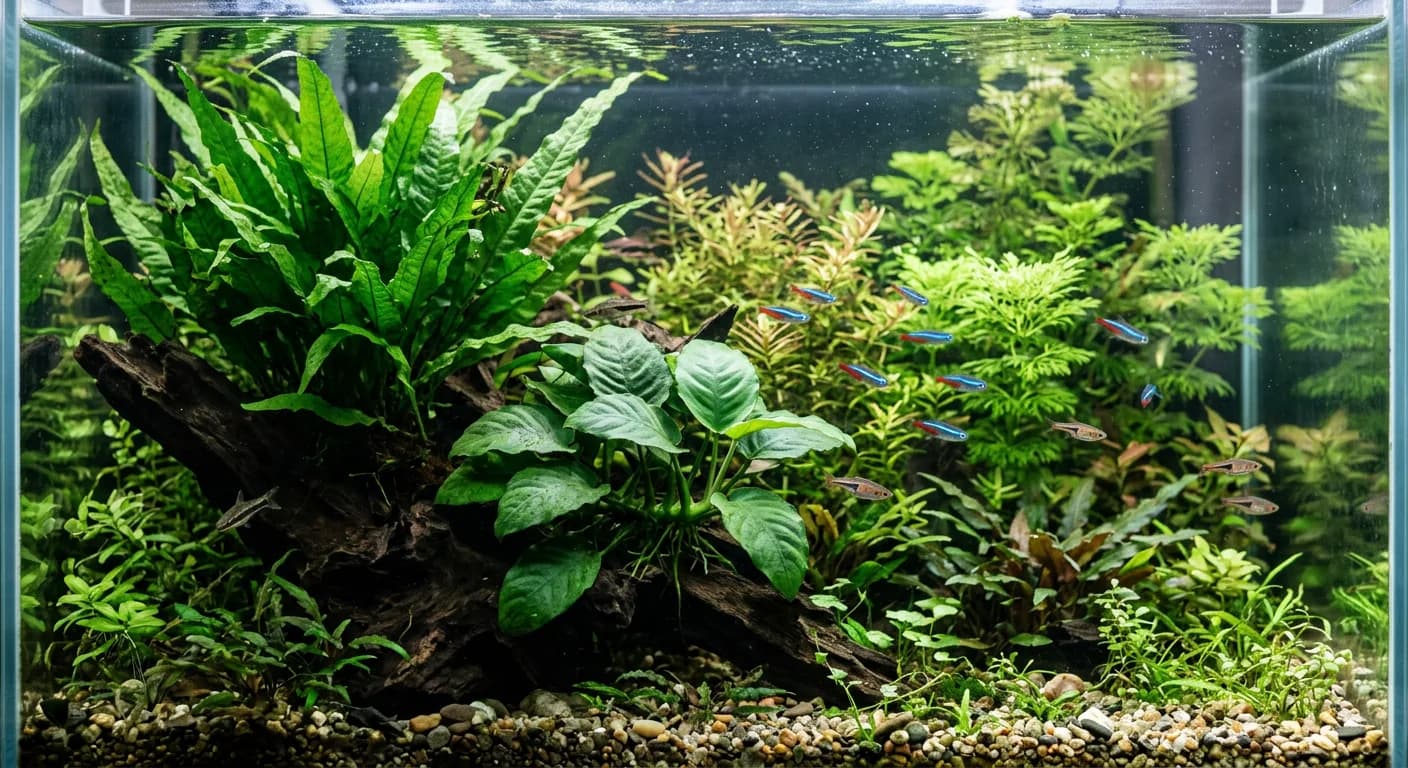
Planted Tank Setup: A No-Nonsense Guide for Beginners
A planted tank looks incredible, improves water quality, and gives your fish a more natural environment. But most beginners either overthink it or jump straight to expensive CO2 setups and rare plants they cannot keep alive. You do not need any of that. A low-tech planted tank with hardy plants, decent substrate, and a basic light can look stunning with minimal effort. This guide covers everything from substrate selection to planting techniques, so you can skip the trial-and-error phase that kills most people's first attempt at aquatic plants.
01
Low-Tech vs High-Tech: Start Simple
Planted tanks fall into two camps: low-tech and high-tech. Low-tech means no pressurized CO2 injection, moderate lighting, and plants that grow slowly but steadily with minimal intervention. High-tech means pressurized CO2, high-intensity lighting, and fast-growing plants that need frequent trimming and precise dosing schedules.
Start low-tech. Seriously. A low-tech planted tank costs less to set up, requires less daily maintenance, and is far more forgiving of mistakes. You can grow gorgeous tanks with nothing but a decent light, some root tabs, and plants that basically refuse to die.
High-tech tanks look amazing in YouTube videos, but those creators are doing daily trimming, calibrating CO2 drop checkers, and running fertilizer dosing pumps on schedules. That is a hobby within a hobby. If you skip straight to high-tech without understanding plant basics, you will end up with an algae farm despite significant equipment investment.
Once your low-tech tank has been running for 6-12 months and you understand how your plants grow, what nutrients they need, and how light affects them, then consider upgrading to CO2 if you want faster growth and access to more demanding plant species.
02
Choosing the Right Substrate for Plants
Substrate matters more for plants than for fish. Plants with root systems need something they can anchor into and pull nutrients from. You have three main options.
Fluval Stratum is a lightweight volcanic soil that lowers pH slightly and is packed with nutrients out of the bag. It is excellent for plants but crumbles over time and can be messy if disturbed. You need 2 bags for a 20 gallon with a 2 inch depth at moderate cost.
Seachem Flourite is a porous clay gravel that lasts forever but contains fewer nutrients than Stratum. It is heavier, does not break down, and looks natural. Rinse it thoroughly or your tank will be cloudy for a week. Reasonably priced per bag.
Inert gravel or sand with root tabs is the budget option. Use whatever gravel you already have and push Seachem Flourish Root Tabs into the substrate every 4-6 inches. The tabs dissolve slowly and feed plant roots directly. This approach is very economical with affordable tab packs and works surprisingly well for most beginner plants.
For a first planted tank, Flourite or the root tab method are the most practical choices. Stratum is great but gets annoying to work with when you need to replant or rearrange things.
03
Lighting: How Much You Need
Light is what makes or breaks a planted tank. Too little and your plants melt. Too much and algae takes over. The sweet spot for low-tech tanks is 20-40 PAR (photosynthetically active radiation) at the substrate level.
If PAR numbers mean nothing to you, here is the simple version: get a light marketed for planted tanks and run it for 6-8 hours per day. That is it. Do not leave it on for 12+ hours thinking more light equals more growth. More light without CO2 equals more algae. Always.
Budget options that work well: the Nicrew ClassicLED Plus (very affordable) handles low-demand plants in tanks up to 20 gallons. The Hygger 24/7 (budget-friendly) has a built-in timer and sunrise/sunset mode.
Premium options: the Fluval Plant 3.0 (higher-end investment depending on size) is the gold standard for planted tanks. Full spectrum, programmable, and enough power for medium-demand plants without CO2. The Chihiros C2 (mid-range pricing) is another solid choice.
Put your light on a timer. Do not rely on remembering to turn it on and off. Inconsistent lighting stresses plants and promotes algae. A basic outlet timer from any hardware store is very inexpensive and solves this permanently.
04
Best Beginner Plants That Survive
Start with plants that are genuinely hard to kill. These six species grow in low light, do not need CO2, and tolerate a wide range of water conditions.
Java Fern attaches to rocks and driftwood. Do not bury the rhizome (the thick horizontal stem) in the substrate or it will rot. Tie it to hardscape with fishing line or glue it with cyanoacrylate super glue. Grows slowly but steadily and looks great once established.
Anubias is similar to java fern. Attach it to hardscape, never bury the rhizome. Grows even slower than java fern but has thick, dark green leaves that are basically indestructible. Anubias nana is the most popular variety.
Java Moss grows on anything. Stuff it into cracks in driftwood, tie it to rocks, or let it float. It spreads on its own and creates a natural look. Shrimp love hiding in it.
Amazon Sword is a background plant that gets big, up to 20 inches in a standard tank. Plant it in the substrate with root tabs nearby. Heavy root feeder, so it does best in nutrient-rich substrate or with regular root tab supplementation.
Cryptocoryne (various species) are mid-ground plants that grow from the substrate. They often "melt" when first planted, dropping all their leaves. Do not throw them away. They grow back from the root within 2-3 weeks. Crypts are one of the most reliable low-light plants once established.
Water Wisteria grows fast, absorbs excess nutrients, and fills in background space quickly. Plant it in the substrate or let it float. Floating water wisteria also provides shade that helps control algae.
05
Planting Techniques: Getting Plants in the Tank
There are two categories of aquarium plants and they go in completely differently.
Rhizome plants (java fern, anubias, bucephalandra) must be attached to hardscape like rocks or driftwood. Never bury the rhizome in substrate. The easiest method is cyanoacrylate super glue, the regular gel kind from any dollar store. Take the plant out of water, put a small dab of super glue on the rhizome, press it against a rock or piece of driftwood, hold for 10 seconds. The glue cures in water and is completely fish-safe once set. You can also tie plants with cotton thread (it dissolves after a few weeks once roots have gripped) or fishing line (permanent but less visible).
Rooted plants (amazon sword, crypts, vallisneria, stem plants) go directly into the substrate. Use aquascaping tweezers or your fingers to push the roots about an inch deep. With fine substrates like sand, the plant might float back up. Push it in again, deeper this time, or use a small rock to weigh down the base until roots establish, usually 1-2 weeks.
Stem plants (water wisteria, hornwort, rotala) can be planted in substrate or left floating. If planting, push 2-3 nodes deep into the substrate. Remove any leaves that would be buried since they will rot.
When you first set up, plant densely. Bare substrate with good lighting is an invitation for algae. Aim for at least 60-70% of the substrate covered by plants from day one. Buy extra floaters like water wisteria or hornwort to fill gaps while slower plants establish.
06
Fertilization: What Your Plants Need
Plants need macronutrients (nitrogen, phosphorus, potassium) and micronutrients (iron, manganese, boron, and others). In a tank with fish, the fish produce ammonia which bacteria convert to nitrate, covering most of the nitrogen your plants need. But that still leaves gaps.
Liquid fertilizers handle water column feeders like java fern, anubias, and floating plants. Seachem Flourish Comprehensive is the standard all-in-one, dosed 1-2 times per week. Easy Green by Aquarium Co-op is another popular option that includes macros and micros in one bottle. For a low-tech tank, one of these is usually all you need.
Root tabs feed plants that pull nutrients through their roots, like amazon swords, crypts, and vallisneria. Push a Seachem Flourish Tab or API Root Tab about an inch into the substrate near the plant's roots. Replace every 3-4 months. Without these, heavy root feeders will slowly yellow and die even with perfect lighting.
CO2 injection is only necessary if you are running high light and growing demanding plant species like carpeting plants (dwarf baby tears, monte carlo) or red plants. For a low-tech tank with the beginner plants listed above, you do not need CO2. If you want to dip your toes in, Seachem Flourish Excel is a liquid carbon supplement that gives a mild boost without any equipment, but it is not a true replacement for pressurized CO2.
Start with liquid ferts and root tabs. Add CO2 only after you have maxed out what low-tech can do and want to push further.
07
Common Mistakes That Kill Planted Tanks
Burying rhizomes is the number one plant killer for beginners. Java fern and anubias rhizomes rot when buried in substrate. Every single aquarium forum has daily posts from people wondering why their java fern is turning brown. The rhizome sits on top of or attached to hardscape. The roots can grow into substrate, but the rhizome itself stays exposed.
Too much light without CO2 creates algae, not plant growth. Plants can only photosynthesize as fast as their most limited resource allows. In a tank with strong light but no CO2 injection, the plants cannot use all that light, but algae can. The result is green water, hair algae, or black beard algae coating your leaves. Keep light at 6-8 hours per day in a low-tech tank.
Not enough plants at startup leaves bare substrate exposed to light with no competition for nutrients. Algae fills the gap. Plant heavily from day one, even if it means buying cheap fast-growing stems as temporary fillers.
Ignoring nutrient deficiencies causes slow decline. Yellowing leaves usually mean nitrogen or iron deficiency. Holes in leaves (pin holes) often indicate potassium deficiency. Small, stunted new growth can signal a lack of CO2 or micronutrients. Pay attention to what your plants look like and adjust dosing accordingly.
Moving plants constantly stresses them. Pick a layout, plant it, and leave it alone for at least a month. Crypts in particular will melt every time you uproot them. Let your plants settle in before deciding something needs to move.
08
Maintenance: Keeping Your Planted Tank Healthy
Planted tanks need less maintenance than bare tanks in some ways and more in others. The plants absorb nitrate, so your water stays cleaner between changes. But you still need to do 20-25% water changes weekly to replenish minerals and remove waste.
Trim plants when they get overgrown. Stem plants can be cut at any point along the stem and replanted. The cut top grows new roots, and the rooted bottom usually sprouts new side shoots. Java fern and anubias grow slowly enough that you rarely need to trim them, but remove any brown or dying leaves by cutting them at the base.
Remove dead leaves promptly. Rotting plant material breaks down into ammonia just like uneaten fish food. A few dead leaves are normal, especially in the first few weeks as plants adjust to your tank. Consistent dieback after that suggests a lighting or nutrient problem.
Clean your filter monthly but never replace all the media at once. Rinse the sponge in old tank water, not tap water. The chlorine in tap water kills beneficial bacteria.
Dose fertilizers consistently. Set a reminder on your phone if you need to. Skipping liquid ferts for a few weeks will not crash your tank, but your plants will start showing deficiency symptoms, and algae is always waiting to take advantage of any gap.
Table of Contents
Related Content
Popular Fish Species
Essential Gear
Best Filter for a 20 Gallon Tank
Aquaneat 3-Pack Biosponge Filter
Frequently Asked Questions
Sources & Further Reading
- Aquatic Plant — Wikipedia
Overview of aquatic plant biology including submersed vs. emersed growth forms and nutrient uptake mechanisms.
- FishBase — Global Species Database
Species compatibility data used to verify which fish work in planted setups without uprooting plants.