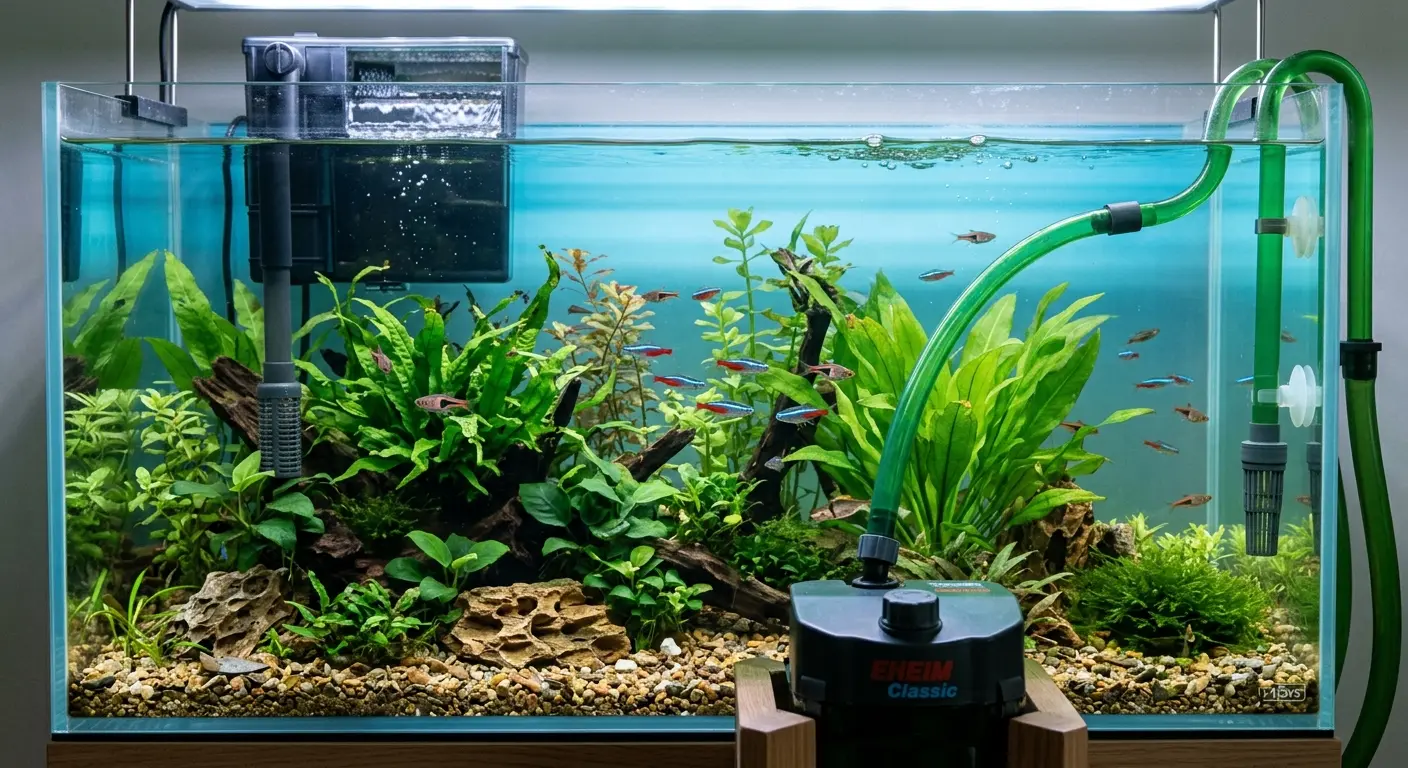
HOB Filter vs Canister Filter: Which One Is Right for Your Tank?
Most freshwater tanks do not need a canister filter. That is not a knock against canisters (they are excellent filters), but the choice gets oversold as more consequential than it usually is. A good hang-on-back filter handles the average community tank without breaking a sweat, and a canister does not automatically produce better water quality. What it does is give you more media volume, quieter operation, and less surface agitation. Whether those things matter depends entirely on what you are keeping and how your tank is set up.
01
How Each Filter Type Works
A hang-on-back filter hangs off the rim of the tank. It draws water from the tank through an intake tube, passes it through a media chamber inside the hanging body, and pours it back into the tank over a waterfall-style return. The waterfall creates surface agitation, which is good for gas exchange in most tanks but strips CO2 in planted setups running pressurized CO2 injection.
A canister filter sits below the tank, usually inside the stand. It pulls water down from the tank through an intake tube, pushes it through a sealed pressurized chamber packed with media, and returns it through a separate output tube. Because the chamber is sealed and the return is typically a spray bar or lily pipe at the water line, surface agitation is minimal.
The practical difference between them comes down to four things: media volume, maintenance effort, noise, and surface agitation. Everything else follows from those.
02
HOB Filters: What They Do Well
HOB filters are the right call for most freshwater tanks, and not just because they are cheaper.
Maintenance is simpler. To clean an HOB, you lift the media basket out of the hanging body, rinse the foam or sponge in old tank water, and put it back. The whole process takes five minutes. With a canister, you disconnect the intake and return lines, carry the sealed body to a sink, open it, clean the trays, reassemble, reprime, and reconnect. That is fifteen to thirty minutes for an experienced keeper and longer the first few times you do it. That friction leads people to clean canisters less often than they should, which defeats the purpose.
Priming is automatic or easy. Most modern HOBs self-prime when you plug them in after a water change. Canisters can airlock if you are not careful about the restart process.
They handle most stocking levels. A 20-gallon community tank with tetras, corydoras, and a gourami does not produce enough waste to justify a canister. An AquaClear 30 or Seachem Tidal 35 processes that tank's water four to six times per hour and keeps nitrates low between weekly water changes.
Replacement media is cheap and widely available. Generic foam blocks and carbon fit most HOBs, and you can cut your own.
HOBs do have real limits. The media chamber is smaller than a canister's, so heavily stocked tanks or messy fish can push the boundaries of what they handle. The waterfall return adds noise, not a lot, but audible in a quiet room. And they hang off the back of the tank, which means the tank needs several inches of clearance from the wall.
AquaClear 30 Power Filter
Best media volume in its price range, with separate foam, carbon, and BioMax that you replace independently without losing your bacteria colony.
03
Canister Filters: When They Make Sense
A canister earns its price in specific situations. Outside those situations, the added complexity and cost do not pay off.
Planted tanks with CO2. This is the strongest case for a canister. Pressurized CO2 injection works by dissolving CO2 into the water column. Surface agitation off-gasses CO2 before the plants can use it. A canister with a lily pipe return keeps the surface calm and keeps CO2 levels stable. This matters more as tank size increases.
Tanks over 55 gallons. Large tanks generate more waste than most HOBs handle comfortably. Running two HOBs works, but a single canister rated for the tank size is cleaner and easier to manage long-term.
Messy or high-waste fish. Oscars, large cichlids, goldfish, and similar species produce a lot of ammonia. A canister's larger media volume means more biological filtration surface area and more capacity between cleanings.
Quiet installations. Canisters are nearly silent. If the tank is in a bedroom or a room where you notice filter noise, a canister eliminates the problem.
Under-stand placement. If you want a clean look with nothing hanging off the tank, a canister hidden inside the stand achieves that. HOBs are always visible.
The honest downside of canisters is the maintenance gap. When they work, they are excellent. When they develop an air bubble, a slow leak at a connection, or a failing impeller, diagnosing the problem is harder than with an HOB because everything is sealed and out of sight. For new keepers, the visibility of an HOB is a feature, not a flaw.
Fluval 207 Performance Canister Filter
Rated for up to 45 gallons, runs silent, and includes intake and output hardware. The right size for a 29-40 gallon planted tank or community setup with messy fish.
04
Running Both Filters Together
Some setups benefit from pairing an HOB with a canister, or an HOB with a sponge filter. The canister handles biological and chemical filtration with its large media volume. The HOB handles mechanical filtration, pulling suspended particles and debris from the water column more aggressively than most canisters do.
This combination works well for heavily stocked tanks, tanks with messy fish, and planted tanks where you want the canister's quiet return but also want the mechanical efficiency of an HOB. It also builds in redundancy: if one filter fails, the other keeps the bacterial colony alive while you fix the problem.
For shrimp tanks and breeding setups, the preferred pairing is a canister or HOB alongside a sponge filter. The sponge handles biological filtration safely (no suction risk for juveniles or shrimplets), and shrimp graze biofilm from the sponge surface between meals.
05
The Decision, Simplified
Use a HOB if: - Your tank is 55 gallons or under with standard community fish - You want straightforward maintenance - You are newer to the hobby and want a filter you can actually see and diagnose - You are not running pressurized CO2
Use a canister if: - You are running pressurized CO2 in a planted tank - Your tank is 55 gallons or larger - You are keeping fish with high bioload (oscars, goldfish, large cichlids) - Noise is a concern - You want the filter hidden under the stand
There is no wrong answer between a well-matched HOB and a well-matched canister. The filter that gets cleaned on schedule beats the technically superior filter that sits dirty for six weeks because cleaning it is annoying.
Table of Contents
Related Content
Popular Fish Species
Essential Gear
Best Filter for a 20 Gallon Tank
Aquaneat 3-Pack Biosponge Filter
Best Filter for a 55 Gallon Tank
Fluval 307 Performance Canister Filter
Best Sponge Filter for Aquariums
AQUANEAT Double Bio Sponge Filter