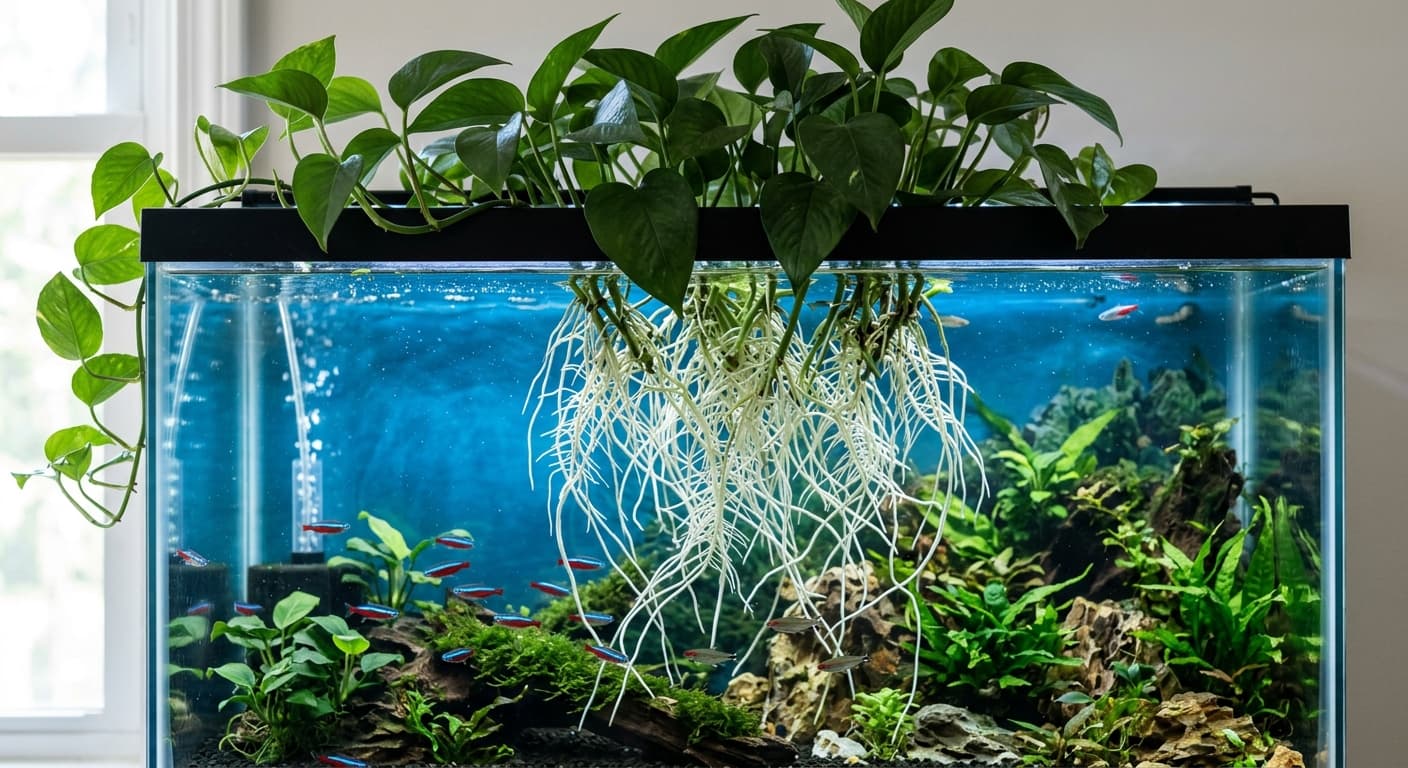
How to Grow Pothos in Your Aquarium (The Easy Way)
Pothos is one of the best plants you can add to a freshwater tank. The roots hang in the water, absorb nitrates directly from the water column, and the plant grows fast enough to actually make a dent. It requires zero aquarium substrate, no CO2, and almost no light besides whatever hits the tank. Here is how to do it right.
01
Why Pothos Works in an Aquarium
Pothos pulls nitrates and ammonia from the water column through its roots. The mechanism is straightforward: terrestrial plants convert dissolved nitrates into plant tissue, which then grows above the waterline where you can trim it and throw it out. The roots do the filtering work; the leaves are just what the plant does with all that nitrogen.
This makes pothos function like an above-water filter plant. It competes directly with algae for nutrients while adding zero waste to the tank. Unlike a sponge filter, it actually removes nitrates from the system rather than just processing them.
Because pothos grows above the surface, it does not shade out or crowd submerged plants. You can run pothos alongside java fern, anubias, or stem plants without them competing for light or space. They occupy different layers entirely.
The aesthetic side is worth mentioning too. Trailing vines over the tank edge look good in a way that most filtration equipment does not. Some keepers train the vines along a shelf or across the top of the tank. It looks intentional rather than thrown together.
02
Which Pothos Variety to Use
Golden pothos (Epipremnum aureum) is the most common variety and the fastest grower. You can find cuttings at most grocery stores, hardware stores, or from any plant person you know. It is the default choice.
Marble queen pothos grows slower due to its variegation. More white in the leaves means less chlorophyll, which means less photosynthesis, which means slower uptake. It works fine for nitrate reduction but you will not see the same growth speed as golden.
Neon pothos grows at roughly the same pace as golden. The bright yellow-green color can look striking over a planted tank.
For water quality purposes, variety does not matter much. What matters is growth rate, and golden pothos wins on that front. If you already have a marble queen sitting on your windowsill, use it. If you are buying specifically for the tank, get golden.
03
Two Methods: Hang-Over vs. Emerged Planting
Both methods work. The hang-over method is simpler and what most people use.
Hang-over method: Cut a stem with 2 to 3 nodes. Remove any leaves that would end up sitting at or below the waterline as they will rot and add ammonia back to the tank. Drape the stem over the tank edge so the bottom portion, including at least one node, hangs into the water. The node is where roots will emerge. Secure the stem with a clip, rubber band around the trim, or just tuck it behind equipment. The plant hangs, roots dangle down into the water, and that is it.
Emerged basket method: Some keepers float a small mesh basket or plastic container with holes on the water surface. The cutting sits in the basket with roots reaching through into the water below. This keeps the plant horizontal at the surface rather than draping over the side. It works well for open-top tanks where there is no ledge to hang from. The setup takes more effort to rig, and the basket can look untidy, but the plant itself performs the same.
Hang-over is the move for most setups. Less hardware, easier to adjust, easier to trim.
04
How to Get Cuttings Started
Cut just below a node. Nodes are the small brown bumps where leaves attach to the stem. Roots emerge from nodes, not from blank stem sections. If you cut mid-stem without a node, nothing will grow.
Remove any leaves that will sit at or below the waterline. A leaf submerged in tank water will start to rot within a week. Rotting plant matter raises ammonia and adds phosphates, which defeats the whole purpose. Strip leaves cleanly, do not leave stubs.
You can pre-root the cutting in a cup of dechlorinated water before adding it to the tank. This gives the plant a head start and lets you see whether the cutting is viable before committing it to the tank. Set the cup near a window. Roots appear in 1 to 2 weeks as thin white threads emerging from the node.
Healthy roots look white or cream-colored and have a fine, hairlike texture. They will spread and multiply as the plant establishes. Rotten roots look brown and soft. If you squeeze a rotten root it will feel mushy rather than firm. Trim rotten sections back to healthy tissue with clean scissors.
05
How Many Plants Do You Need?
One established pothos plant per 10 gallons is a reasonable starting point. Established means actively growing with a developed root system, not a fresh cutting that just went in last week.
More plants will do more work, but there are diminishing returns. At some point you are managing a jungle instead of a tank.
A single plant will not replace water changes. That is not a realistic goal, and you should not expect it. What pothos does is slow the buildup. In a lightly stocked 20-gallon tank with two well-established pothos, you might shift from weekly water changes to every 10 to 12 days before nitrates hit your target threshold. That is the realistic win.
Heavily stocked tanks with messy eaters (cichlids, goldfish, large plecos) will overwhelm any reasonable amount of pothos. The plant helps, but it cannot compensate for a bioload it was never designed to handle.
06
What to Expect in the First 6 Weeks
Weeks 1 and 2: You will see small white roots emerging from the submerged node. No noticeable water quality change at this point. The plant is establishing, not filtering yet.
Weeks 3 and 4: Root mass is spreading. The plant is pulling nutrients now but not at full speed. Test your nitrates and keep a baseline number to compare against later.
Weeks 5 and 6: This is when measurable nitrate reduction shows up for most people. How much depends on tank volume, stocking level, and how established the roots are.
Some leaf yellowing in the first few weeks is normal. The plant is transitioning from growing in soil or dry air to hanging over water. Once it adjusts and new growth appears, yellowing usually stops. New leaves are the sign the plant has settled in. If yellowing continues past week 4 with no new growth, the problem is almost always light.
07
Troubleshooting: Yellow Leaves, Root Rot, Slow Growth
Yellow leaves: The most common cause in a tank setup is low light. Pothos does not need much, but it needs something. A tank sitting in a dim corner with no window access and no grow light will produce a struggling plant. Move it to a brighter spot or add a small clip-on grow light above the leaves. Direct sun is not necessary. Indirect light from a window a few feet away is enough.
Root rot: Brown, mushy roots usually come from stagnant water around the root zone. If the roots are packed tight against the tank wall with no flow, they can start to rot at the base. Try repositioning so roots hang more freely into moving water near a filter return. Trim any rotted sections back to healthy tissue. The plant will regrow from healthy nodes.
Slow growth: The number one cause is insufficient light, same as yellowing. Second most common is a tank with very low nitrates to begin with. A pristine, understocked tank with regular water changes may not have enough dissolved nutrients to push aggressive growth. That is not a problem to solve; it means your tank is clean.
Do not fertilize unless the plant looks severely deficient (no new growth for months, persistent yellowing despite good light). The water column provides enough nutrients in most tanks. Adding fertilizer to already-adequate water just feeds algae.
Table of Contents
Related Content
Popular Fish Species
Essential Gear
Best Filter for a 20 Gallon Tank
Aquaneat 3-Pack Biosponge Filter
Best Aquarium Heater for Fish Tanks
Hitop Adjustable Aquarium Heater
Frequently Asked Questions
Sources & Further Reading
- The Krib: Aquatic Plants FAQ
Long-running hobbyist reference documenting emergent plant usage in aquariums, including terrestrial plants with submerged roots as nitrate sinks.
- Aquatic Plant Central: Emergent and Riparian Plants Forum
Community discussion and documented keeper experience with above-tank plants including pothos, covering root behavior, nitrate reduction, and long-term results.
- Purdue Extension: Nitrogen Cycling in Aquaponics Systems
University extension resource covering how terrestrial plants convert dissolved nitrates into plant tissue in water-based systems, the same mechanism pothos uses in a home aquarium.