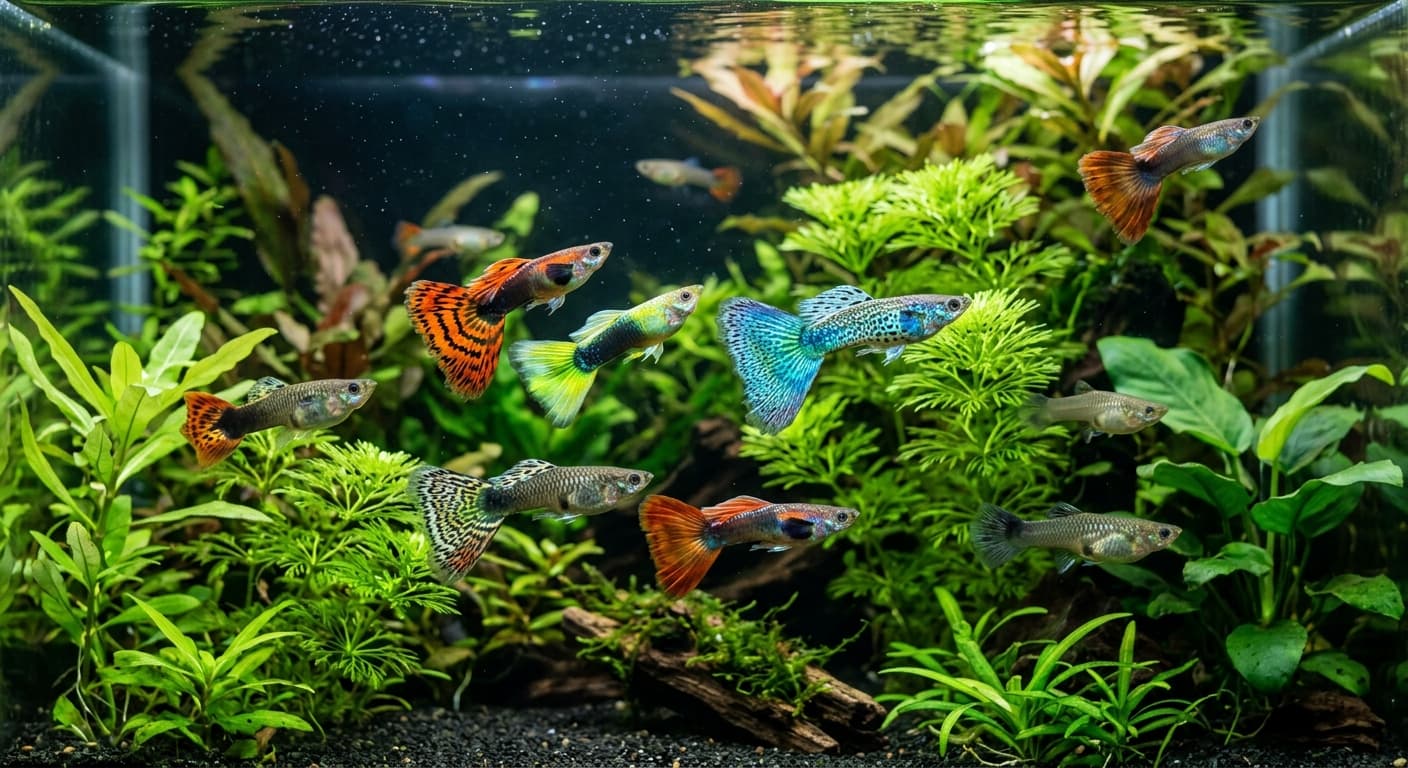
Guppy Care Guide: Setup, Feeding, and Breeding
Guppies are the most widely kept freshwater fish in the hobby. Males are strikingly colorful, both sexes are peaceful and active, and they breed so readily that a trio of fish can become a colony of 50 within a few months. That last point is a feature if you want it and a management problem if you do not. This guide covers tank setup, feeding for the best coloration, and how to handle breeding intentionally rather than just discovering babies in your filter.
01
Tank Setup
Guppies are adaptable fish that do well in a range of setups, but they have preferences that affect health and longevity.
Tank size: 10 gallons minimum for a small group. A 10-gallon tank supports 6-8 guppies with regular water changes and moderate filtration. A 20-gallon long is more comfortable for a breeding colony and gives you space to manage fry.
Filtration: Guppies are active fish and produce moderate waste. A hang-on-back filter rated for the tank size, or a good sponge filter in smaller tanks, handles the bioload. If you plan to breed, add a sponge filter cover over any HOB intake. Guppy fry are small enough to get sucked into standard intakes.
Temperature: 74-82°F. Guppies do best in the warmer end of tropical range. At 78-80°F, their metabolism and immune systems function optimally and fry development is faster. Below 70°F they become sluggish, colors fade, and disease resistance drops.
Plants and cover: Guppies appreciate plants, particularly floating plants that provide shade and refuge for fry. Java moss, hornwort, and floating water wisteria work well. Dense plant growth also gives females places to escape when males are harassing them.
Substrate: Guppies are not bottom-dwellers and are indifferent to substrate type. Use whatever you prefer aesthetically. They spend most time in the middle and upper water column.
02
Water Parameters
Guppies are genuinely hardy and tolerate a range of water conditions better than most tropical fish.
pH: 7.0-8.0. Guppies prefer slightly alkaline water and do well in hard tap water that would stress soft-water species. If your tap water runs 7.4-7.8, it is probably fine without adjustment.
Hardness: Moderate to hard water (GH 8-12 dGH) suits them well. They were developed from fish in Caribbean and South American coastal rivers with high mineral content. Very soft water leads to more disease susceptibility and shorter lifespans in guppies over time.
Temperature: 74-82°F. This is the most important parameter. Guppies kept consistently below 70°F get sick frequently.
Ammonia and nitrite: 0 ppm. Like all fish, guppies need a cycled tank before being added.
Nitrates: Below 40 ppm with weekly water changes. Guppies are more nitrate-tolerant than shrimp or discus, but high nitrate over time leads to fin problems and early death. Weekly 25-30% water changes keep levels manageable.
Guppies from most fish stores are tank-raised through many generations and adapted to typical tap water in most cities. Unlike wild-caught soft-water fish, they usually do not need parameter adjustment if your tap water falls anywhere in the normal range.
03
Feeding for Health and Color
Guppies are omnivores and accept virtually any food, but diet quality shows directly in male coloration and overall vitality.
Staple food: A high-quality small-pellet or flake food as the daily base. Omega One Color Mini Pellets and similar color-enhancing formulas improve male fin coloration visibly over several weeks. The enhancement comes from astaxanthin and other carotenoids in the food, not artificial dyes.
Variety: Rotate in frozen or freeze-dried foods 2-3 times per week. Daphnia, baby brine shrimp, and micro worms are all accepted and provide protein that improves breeding condition and immune function. Guppies are particularly fond of daphnia, and it also acts as a mild digestive aid.
Fry feeding: Guppy fry need very fine food their first 2-3 weeks. Crushed flake food or micro pellets work, but specialized fry foods provide better nutrition for growth rates. Fry need to eat 4-5 times per day for fastest growth. Their stomachs are tiny and they cannot hold much at once.
Feeding schedule: Adults do well on twice-daily feedings of a small pinch each time. Only feed what they consume in 2 minutes. Guppies are enthusiastic eaters and will beg for food even when they do not need it. Overfed guppies in poor water conditions develop bloating and internal problems.
Male color: Color in males develops fully between 3-6 months of age. Young males (under 3 months) may look pale compared to adults. Diet, water quality, and genetics all influence final coloration. Stress and poor water quality fade colors even in fish with strong genetics.
Omega One Color Mini Pellets
Small pellet size suits guppies, and astaxanthin-rich formula enhances male fin coloration noticeably over 4-6 weeks.
04
Breeding: What to Expect
Guppies breed without any special intervention. Understanding the biology prevents surprises.
Guppies are livebearers: females give birth to fully-formed, free-swimming fry rather than laying eggs. A female can store sperm from a single mating for up to 6 months, producing multiple batches of fry from one encounter. At 78-80°F, females give birth approximately every 4-6 weeks. Litter size ranges from 20-80 fry depending on female size and age.
Fry are born large enough to accept crushed flake food immediately. In a community tank with adult guppies, most fry get eaten within hours unless there is dense plant cover. Java moss, hornwort, and floating plants provide enough refuge for some fry to survive even without intervention.
If you want to raise fry intentionally: Set up a separate grow-out container. A 5-gallon tank or large plastic tub with a sponge filter works. Transfer pregnant females (look for the dark gravid spot near the anal fin getting larger and the belly becoming very angular right before birth) to the separate container. Remove the female immediately after she gives birth or she may eat the fry. The fry can be raised in the grow-out tank until large enough not to be eaten by adults (about 0.5 inches).
If you do not want to breed: Keep only males. Male-only tanks are peaceful, colorful, and do not produce fry. Alternatively, keep a heavily planted tank and accept that some fry survive and the population grows slowly.
Sex ratio: Mixed groups should have more females than males. A ratio of 2-3 females per male reduces harassment. Males constantly pursue females, and a single female in a tank full of males will be stressed to death. If you have equal numbers, watch the females for clamped fins, hiding, and loss of appetite, which indicate excessive stress.
05
Common Problems
Fin rot and fin clamping are the most common guppy health issues and almost always indicate water quality problems. Test ammonia, nitrite, and nitrate before anything else. See the fin rot guide for treatment steps.
Wasting disease (fish tuberculosis): A guppy that becomes progressively thinner despite eating, develops a bent spine, and eventually stops eating may have fish tuberculosis (Mycobacterium marinum). There is no reliable treatment. Affected fish should be removed from the tank. The bacteria can infect humans through open skin wounds. Wear gloves when working in a tank that may be infected.
Guppy disease (Tetrahymena): A ciliate parasite specific to guppies that causes white patches, rapid breathing, and sudden death in batches. Treat the whole tank with an antiparasitic medication. The parasite spreads quickly through water transfer.
Male aggression: Males sometimes nip each other's fins. In small tanks with few females, this can become severe. Add more females, add more plants for line-of-sight breaks, or move the most aggressive male.
Population explosion: The most common guppy problem that is not a disease. If you mix sexes without a plan for fry, you will have many more guppies than your tank can support within a few months. Overcrowding leads to water quality problems, disease, and stress. Plan for fry before adding a mixed group: either have a grow-out tank ready, a buyer for fry (local fish stores sometimes take them), or keep males only.
Spawning Mop Kit
Give females a place to drop fry away from other adults. Fine strands mimic plant cover and let shrimplets and fry hide immediately after birth.
Table of Contents
Related Content
Popular Fish Species
Essential Gear
Best Filter for a 20 Gallon Tank
Aquaneat 3-Pack Biosponge Filter
Best Aquarium Heater for Fish Tanks
Hitop Adjustable Aquarium Heater
Best Aquarium Test Kit for Freshwater Tanks
API Freshwater Master Test Kit
Frequently Asked Questions
Sources & Further Reading
- Poecilia reticulata (Guppy) — FishBase
Species data for guppies including natural distribution, water parameters, and biological characteristics.
- Livebearer — Wikipedia
Overview of livebearer reproduction biology relevant to guppy breeding and fry development.