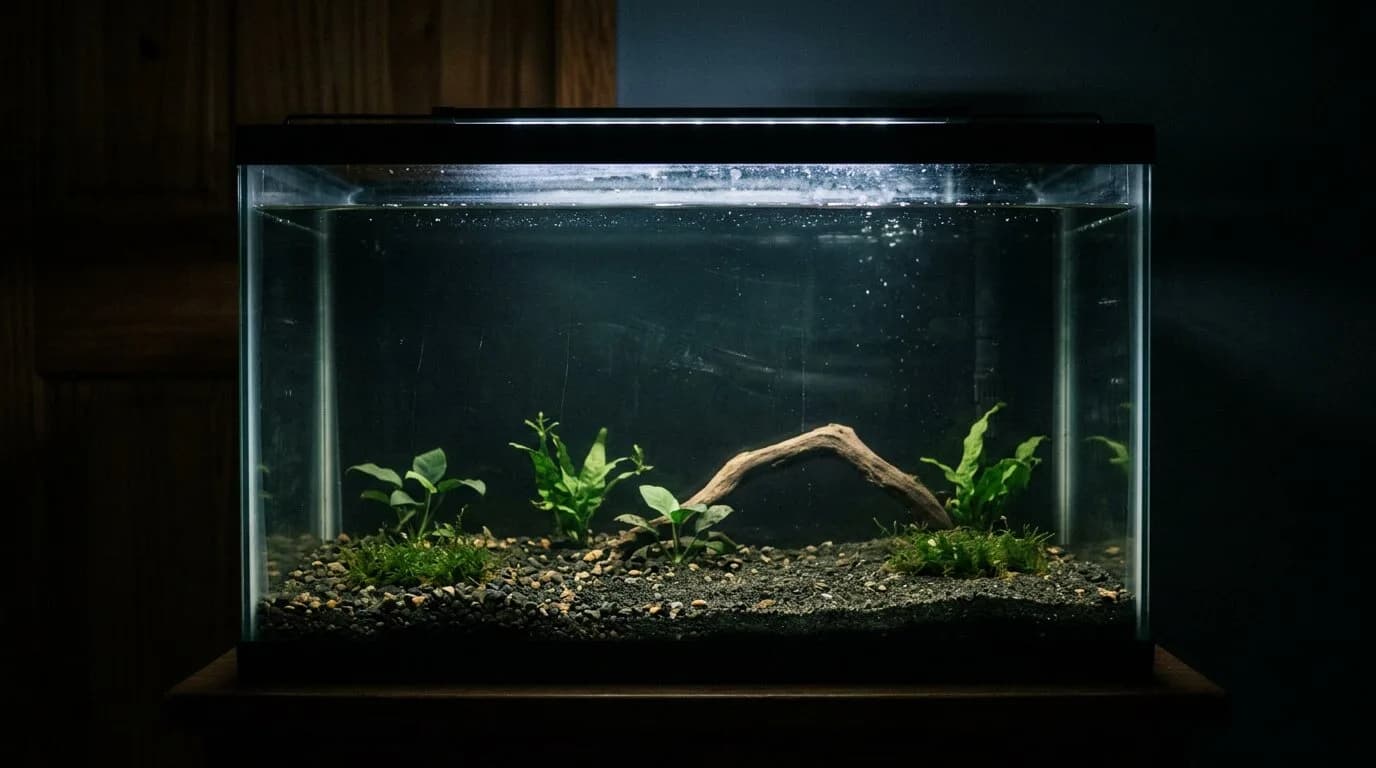
How to Cycle a Fish Tank (Skip This and Your Fish Die)
Cycling is the single most skipped step in fishkeeping, and it is the reason most new fish die within the first month. The concept is straightforward: you are growing a colony of beneficial bacteria that convert toxic ammonia (from fish waste and uneaten food) into nitrite, and then into nitrate, which is far less harmful. Without these bacteria, [ammonia builds up to lethal levels](/guides/how-to-lower-ammonia) within days. This process takes 4-6 weeks when done properly, and there are no real shortcuts. Here is exactly how to do it.
01
What Cycling Means
Every fish produces ammonia through its gills and waste. Ammonia at concentrations above 0.25 ppm is toxic. It burns gills, damages organs, and kills fish. In nature, bacteria in soil and water break down ammonia constantly. In your tank, those bacteria do not exist yet. You have to grow them.
The nitrogen cycle works in two stages. First, Nitrosomonas bacteria convert ammonia (NH3) into nitrite (NO2). Nitrite is also toxic to fish. Then, Nitrospira bacteria convert nitrite into nitrate (NO3). Nitrate is only harmful at high concentrations (above 40 ppm) and is removed through water changes and plant absorption.
A "cycled" tank has enough of both bacteria colonies to process ammonia as fast as your fish produce it. You will know the cycle is complete when ammonia reads 0 ppm, nitrite reads 0 ppm, and nitrate is present (5-20 ppm is typical). This means the full chain is working.
02
Fishless Cycling: Step by Step
Fishless cycling is the humane and reliable method. You add an ammonia source to an empty tank and let the bacteria grow without any fish at risk.
- Set up the tank completely: filter running, heater set to 80-82 degrees (warmer water speeds up bacterial growth), dechlorinated water filled to the top. The filter must be running 24/7 from this point forward.
- Add ammonia to bring the concentration to 2-4 ppm. Use pure ammonia (Dr. Tim's Ammonium Chloride is the easiest option, available on Amazon). Avoid any ammonia with surfactants or fragrances. You can also use a raw shrimp from the grocery store dropped in the tank, but liquid ammonia gives you more control.
- Test daily with the API Freshwater Master Test Kit. For the first 1-2 weeks, ammonia will stay high and nitrite will be at 0. This is normal. The first bacteria colony is still growing.
- Around week 2-3, you will see ammonia start to drop and nitrite start to rise. This is a great sign. The first stage of the cycle is working. Keep dosing ammonia back to 2 ppm whenever it drops below 1 ppm.
- Around week 3-5, nitrite will spike high (sometimes off the chart on your test kit) and then start to fall. Nitrate will start appearing. You are almost there.
- The cycle is complete when you can dose 2 ppm of ammonia and both ammonia and nitrite read 0 ppm within 24 hours, with nitrate present. Do a large 50-70% water change to bring nitrate down below 20 ppm, then add your fish.
03
Fish-In Cycling
Fish-in cycling means adding fish to an uncycled tank and managing the toxic ammonia through frequent water changes while the bacteria grow. It works, but it stresses the fish and requires daily commitment for 4-6 weeks.
If you are doing fish-in cycling (maybe the fish are already in the tank), here is how to minimize harm:
Stock lightly. One or two hardy fish maximum. Good choices are a single betta, a few danios, or white cloud mountain minnows.
Test water daily for ammonia and nitrite. If either reads above 0.25 ppm, do a 25-50% water change immediately.
Use Seachem Prime as your water conditioner. It temporarily detoxifies ammonia and nitrite for 24-48 hours, buying you time between water changes.
Add bottled bacteria like Fritz TurboStart 700 or Seachem Stability. These will not eliminate the need for water changes, but they seed the tank with beneficial bacteria to speed up the process.
Feed sparingly. Every bit of food that goes in becomes ammonia. Feed once a day, only what the fish can eat in 30 seconds.
Expect the cycle to take 4-8 weeks with fish-in. The process is the same biological chain, just slower because you are keeping ammonia levels low through water changes.
04
How to Know When Cycling Is Done
The cycle is done when three things are true at the same time:
- Ammonia reads 0 ppm
- Nitrite reads 0 ppm
- Nitrate is present (any reading above 0)
For fishless cycling, the definitive test is dosing 2 ppm ammonia and checking 24 hours later. If both ammonia and nitrite are 0, you are done. If either still shows a reading, give it more time.
For fish-in cycling, the cycle is complete when you consistently get 0 ammonia, 0 nitrite readings for a full week without needing a water change to achieve those numbers.
Do not trust your nose or the water clarity. Crystal clear water can be full of ammonia. Cloudy water is often just a bacterial bloom during cycling and clears on its own. Only test results tell the truth.
API Freshwater Master Test Kit
Tests ammonia, nitrite, nitrate, and pH: everything you need to track the cycle. The liquid reagent kit is more accurate than strip tests and cheaper per test over time.
05
Timeline: What to Expect
Week 1: Ammonia stays high. Nothing seems to happen. This is normal.
Week 2: Ammonia may start to dip slightly. You might see a slight cloudiness (bacterial bloom). Keep dosing.
Week 3: Ammonia drops noticeably, nitrite starts climbing. The first bacteria colony is established.
Week 4: Nitrite spikes hard, sometimes reading off the test chart. Ammonia processes quickly. Almost there.
Week 5-6: Nitrite drops to 0, nitrate appears. Do your 24-hour ammonia test to confirm. You are cycled.
Some tanks cycle in 3 weeks. Some take 8. Temperature, ammonia dosing consistency, and filter media surface area all affect speed. Higher temperatures (80-84 degrees), established filter media from another tank, and bottled bacteria can all cut the time. But there is no guaranteed way to skip the wait entirely.
06
Common Cycling Mistakes
Washing filter media in tap water. Chlorine in tap water kills the bacteria you are trying to grow. Always rinse media in old tank water during water changes.
Using ammonia with surfactants. Shake the ammonia bottle. If it foams, it has soap in it. Only use pure ammonia or Dr. Tim's Ammonium Chloride.
Dosing too much ammonia. Going above 4-5 ppm can actually stall the cycle because it overwhelms the growing bacteria. Stick to 2-4 ppm.
Turning off the filter at night. The bacteria live in your filter media and need constant water flow to survive. If you turn off the filter for more than a few hours, you can crash your bacteria colony.
Adding too many fish at once after cycling. Your bacteria colony is sized to handle the ammonia you were dosing. If you add 20 fish on day one, the spike will overwhelm it. Add 2-3 fish at a time, waiting a week between batches.
Panicking at the nitrite spike. Nitrite going sky-high is actually the sign that you are halfway done. Do not do a massive water change during fishless cycling because of high nitrite. It is supposed to happen.
Table of Contents
Related Content
Popular Fish Species
Essential Gear
Best Filter for a 20 Gallon Tank
Aquaneat 3-Pack Biosponge Filter
Frequently Asked Questions
Sources & Further Reading
- Nitrogen Cycle — Wikipedia
Overview of nitrogen cycling including nitrification and denitrification processes relevant to aquarium biology.
- Nitrifying Bacteria — Wikipedia
Biology of Nitrosomonas and Nitrospira, the bacteria responsible for converting ammonia to nitrite and nitrite to nitrate.
- FishBase — Global Species Database
Species-specific water parameter data used to verify ammonia and nitrite tolerance thresholds cited in this guide.