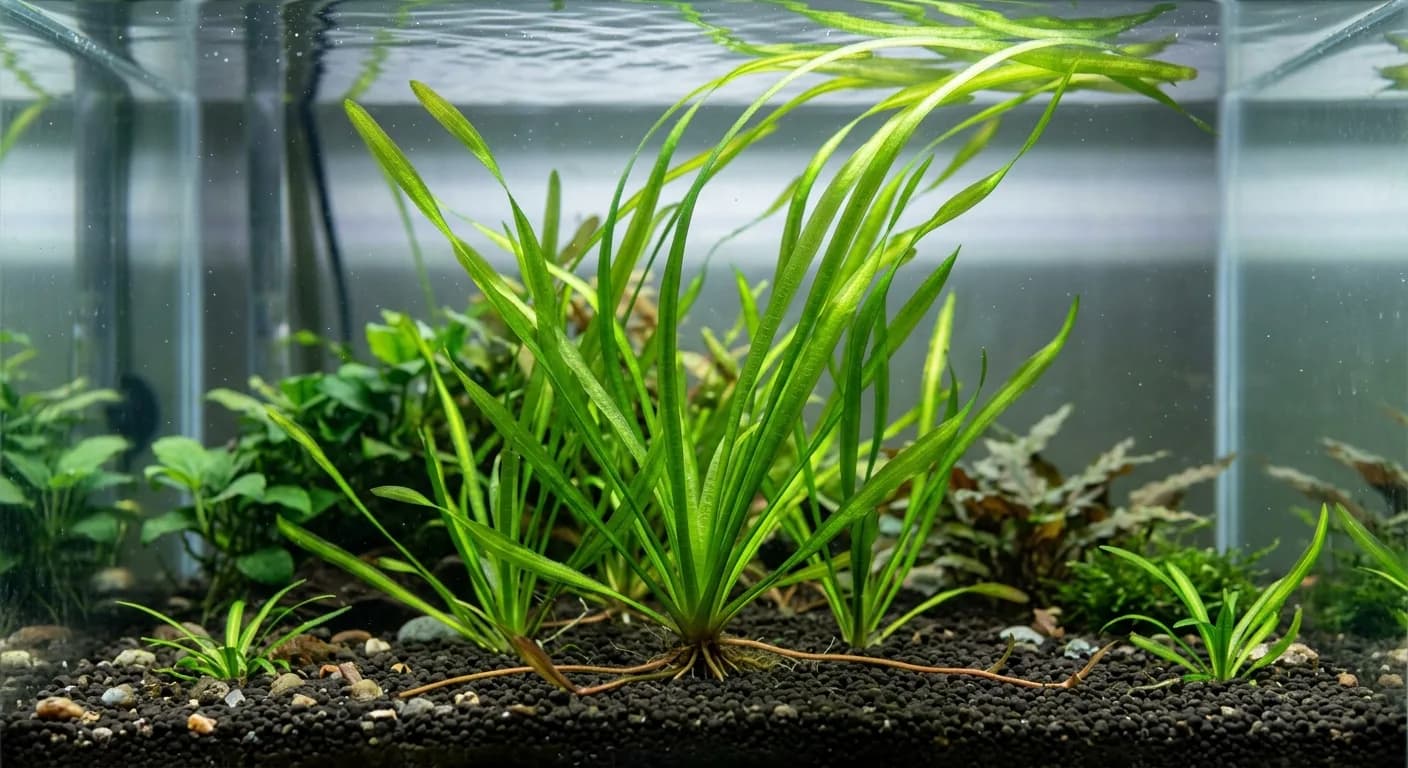
Jungle Val
Vallisneria americana
Difficulty
2 / 5
Light
medium
CO₂
none
Growth
fast
Placement
background
Max Height
24-36 inches
Tank Min
20 gal
Temp
68–82°F
Overview
Jungle Val is one of the few easy plants that genuinely prefers hard alkaline tap water, which makes it a gift for keepers in limestone regions fighting every other species. Long ribbon leaves wave in the current and can reach 24 to 36 inches, so this is a true background plant that wants a tank at least 20 gallons to look right. Once established it spreads aggressively through runners, sending daughter plants 2 to 4 inches away from the mother every few weeks. That growth rate is the upside and the maintenance task rolled together. Val tolerates 68 to 82F, adapts to low or medium light, and does not need CO2 to do well. The hard part is getting it past the first month without melting back during acclimation.
Planting
Plant each rosette so the roots are buried in substrate and the crown, where the leaves emerge, sits just at the substrate line. Burying the crown will rot the plant. Space individual plants 3 to 4 inches apart to give runners room to spread without crowding. A tall substrate bed of 2 to 3 inches works best because the roots go deep. Root tabs pushed near each plant at setup help establishment noticeably, especially in inert gravel. Expect the outer leaves to yellow and die back in the first 2 to 3 weeks as the plant transitions to your water. Do not pull it. New growth pushes from the center once the roots anchor.
Water Parameters
Temperature range is 68 to 82F with 75F being a comfortable middle. Val thrives in pH 6.8 to 8.0, and unlike most popular aquarium plants it actively benefits from harder water with GH 6 to 15 and KH 4 to 12. This species uses bicarbonate from alkaline water as a carbon source, which is why it grows well without CO2 injection. Moderate flow is fine. Weekly water changes of 25 to 30 percent keep conditions stable. Iron is the nutrient to watch. Pale or yellowing new leaves are almost always an iron or potassium issue, fixed by dosing a trace element fertilizer at the label rate weekly.
Care & Maintenance
The main ongoing task is managing runners and trimming tall leaves. Every 4 to 6 weeks, pull excess daughter plants to keep density manageable or let them fill in if you want a jungle look. Trim tall blades at the water surface rather than cutting at the base, because cutting at the base removes too much healthy tissue at once and stresses the mother plant. Use sharp scissors for clean cuts that do not shred the leaf edges. Root tabs every 3 to 4 months near the densest clusters keep growth steady in inert substrate. Remove dead or yellowing outer leaves by snapping them at the base with your fingers during water changes.
Propagation
Jungle Val reproduces almost entirely through runners in aquarium conditions. A healthy mother plant sends out a horizontal runner just below the substrate surface, and a new daughter plant emerges 2 to 4 inches away with its own roots and leaves. After 4 to 8 weeks, each daughter is established enough to separate. Trace the runner with your fingers, cut it cleanly with scissors about an inch from the daughter, and lift the young plant out with its roots intact. Replant it anywhere in the tank at the same depth, crown at substrate level. One vigorous mother plant can produce 5 to 10 daughters per year, which is why Val colonizes a tank quickly once settled.
Common Problems
The biggest failure mode specific to Val is liquid carbon melt. Seachem Excel and similar liquid CO2 products contain glutaraldehyde, and Vallisneria is notoriously sensitive to it. Dosing Excel in a tank with Val causes the leaves to turn translucent and disintegrate within days. If you are running Val, skip liquid CO2 entirely. This is not optional. The second common issue is transition melt during the first few weeks after planting. Outer leaves yellow and die back as the plant adjusts. Fix: do not pull the plant, trim dead material, leave the roots undisturbed, wait 3 to 4 weeks for new growth. Pale new leaves later on are iron deficiency, solved by a trace fertilizer.
What You Need for Jungle Val
Gear that works well for this species, based on what experienced keepers actually use.
Seachem Flourish Tabswater-care
Jungle Val is a heavy root feeder that spreads by runners. Root tabs keep the long blades green to the tips.
Fluval Plant and Shrimp StratumSubstrate
A nutrient substrate supports the fast runner growth Val is known for.
Fluval Plant 3.0 LED LightLight
A tall background plant that grows fast under medium light.