Java Moss
Taxiphyllum barbieri
Difficulty
1 / 5
Light
low
CO₂
none
Growth
medium
Placement
midground, foreground
Max Height
1-4 inches
Tank Min
5 gal
Temp
65–82°F
Overview
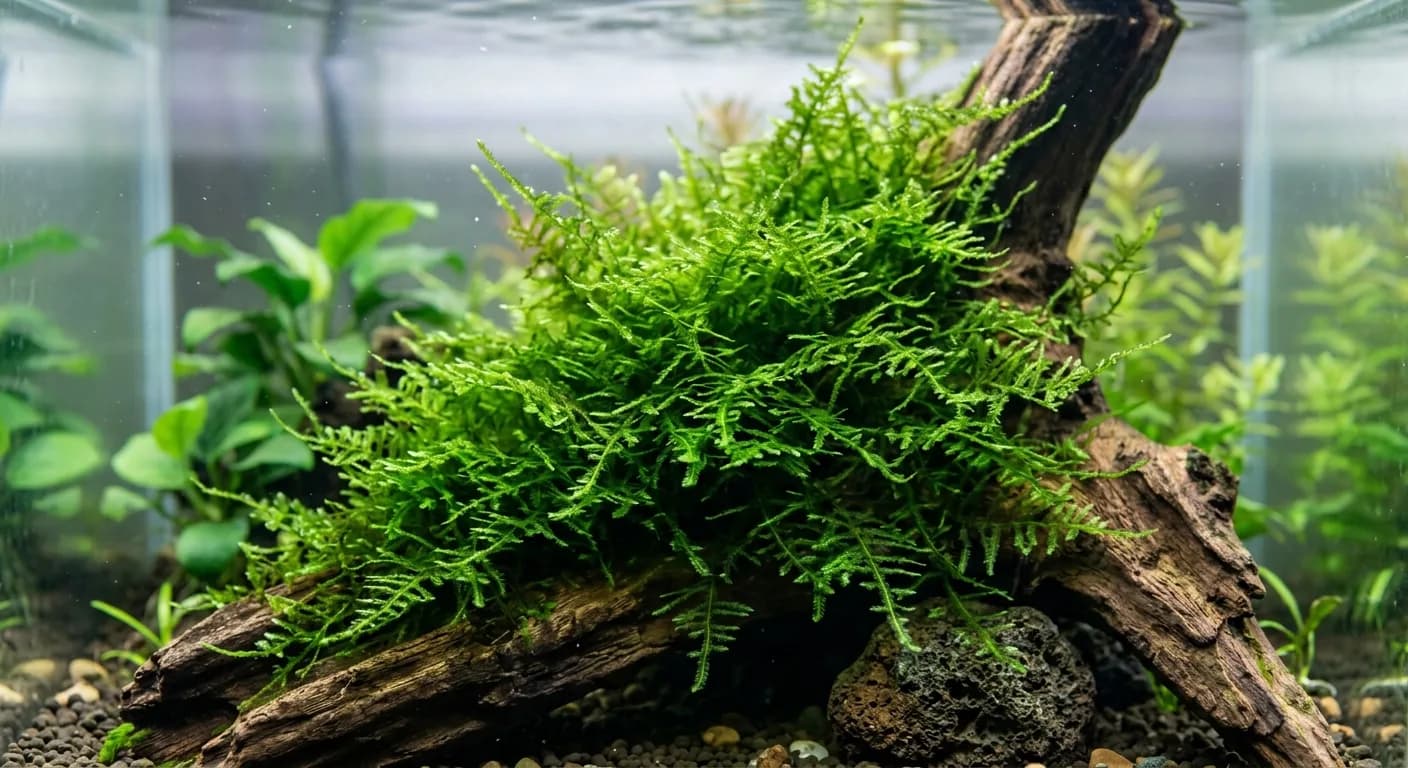
Java Moss is the plant I recommend most often when someone sets up their first low-tech tank. It grows on driftwood, rocks, and substrate without any special requirements. The dense, feathery fronds create excellent cover for shrimp fry, shrimp eggs, and small fish. I have seen it used in breeder tanks where the spawn survival rate jumps noticeably just from adding a clump. It tolerates a wide pH range from 5.5 to 8.0 and temperature swings between 65F and 82F without melting back. You do not need root tabs or nutrient-rich substrate. Attach it somewhere and let it grow. That is the whole care strategy in most tanks.
Planting
Attach Java Moss to driftwood, lava rock, or mesh panels using cotton thread, fishing line, or super glue gel. I prefer super glue gel because it sets quickly underwater and the moss stays in place within 48 hours. Cotton thread works well too but decomposes over 3 to 4 months, by which point the moss has usually rooted itself. Do not bury the main mass in substrate. That causes inner sections to rot. Tie it to vertical or horizontal surfaces so water flows through the fronds. A 5-gallon tank needs about a palm-sized clump. A 10-gallon or larger tank benefits from multiple attachment points spread across hardscape.
Water Parameters
Java Moss tolerates tap water with a pH between 5.5 and 8.0 without issue. Hard or soft water both work fine. I keep it at 75F as a mid-range target. Temperatures above 85F long-term will cause the plant to melt back, so monitor summer heat in unconditioned rooms. Weekly 30 percent water changes keep the fronds clean in low-flow areas. No CO2 injection needed. Low light at 1 to 2 watts per gallon suffices. Fertilizer is optional. If you dose liquid plant food, use half strength. Excess nutrients in the water column tend to encourage algae on the moss rather than benefiting the plant itself.
Care & Maintenance
Trimming every 6 to 8 weeks with sharp scissors prevents inner browning. Use curved scissors to reach into the clump and remove oldest growth at the center. If you skip trimming, the interior dies off and you lose the dense texture. Rinse trimmed moss in old tank water before reattaching fragments. Never let trimmings float free in the display tank. They sink and settle where you do not want them. In high-flow tanks, the moss stays cleaner because water moves through it. In low-flow setups, manually swish the clump during water changes to dislodge trapped debris. The plant grows at medium speed, roughly doubling its mass in 2 to 3 months under decent conditions.
Propagation
Break off any healthy section with at least 5 to 8 fronds attached. That fragment grows roots and spreads within 3 to 4 weeks when tied to a surface. No special treatment needed. I store spare fragments in a jar with tank water and low light until I need them. Successful propagation relies on keeping the new piece submerged at all times and ensuring water movement reaches it. Fragments left on bare glass sometimes drift but usually attach within days if water flow is present. The method works at any size tank. One established clump can yield 10 to 15 new attachment points within a year.
Common Problems
Algae coating the fronds is the most common issue. Causes include excess light, excess nutrients, and poor water flow. Fix it by moving the moss to higher-flow areas, reducing light duration to 6 hours daily, and cutting back on fertilizer. Mechanical removal with a soft toothbrush works for spot cleaning. Inner die-off happens when dense growth blocks light from reaching center sections. The fix is simple: cut out dead interior portions with scissors and trim the outer growth to open up air circulation. Meltback after shipping or temperature spikes above 85F requires removing affected parts and waiting for regrowth from remaining healthy tissue. This takes 4 to 6 weeks. Do not add Excel or H2O2 near the moss in concentrated doses because it burns the fronds.
What You Need for Java Moss
Gear that works well for this species, based on what experienced keepers actually use.
Aquarium Co-Op Easy Green All-in-One Fertilizerwater-care
Moss feeds from the water column. A little all-in-one liquid fertilizer keeps it green and growing instead of browning out in the center.
NICREW ClassicLED Aquarium LightLight
Java Moss grows under almost any light, but a modest LED keeps it dense rather than stringy.