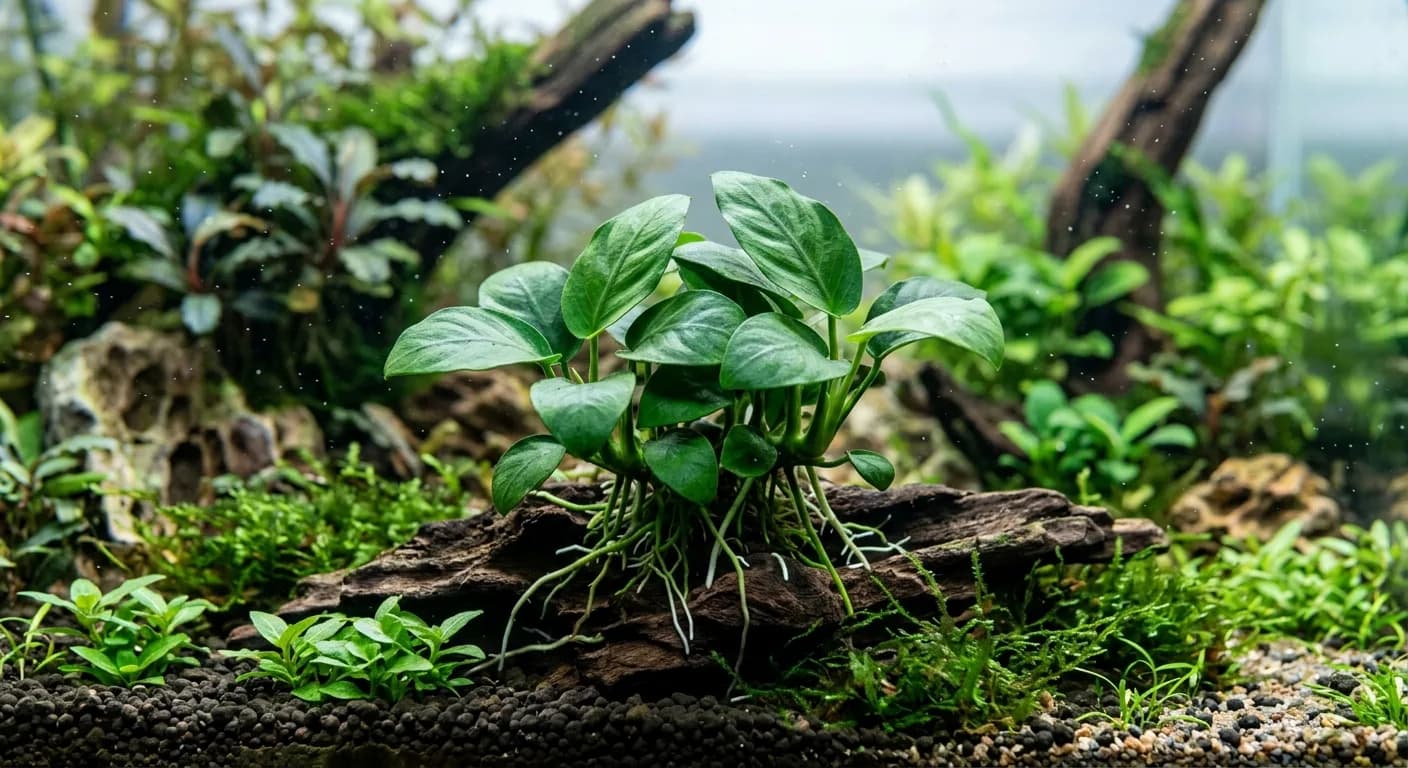
Anubias Nana
Anubias barteri var. nana
Difficulty
1 / 5
Light
low
CO₂
none
Growth
slow
Placement
midground
Max Height
4-6 inches
Tank Min
5 gal
Temp
72–82°F
Overview
Anubias Nana is the first plant I tell anyone to buy when they start a low-tech tank. It grows slowly, tolerates almost any water condition within the tropical range, and asks for nothing beyond a place to anchor its rhizome. The thick, dark green leaves resist nibbling from fish that chew softer plants, and the whole thing stays compact at 4 to 6 inches, which keeps it honest as a midground feature. Growth is slow enough that you will see roughly one new leaf every 3 to 5 weeks under a typical low-light LED. That pace sounds frustrating until you realize it also means no weekly trimming and no algae outbreaks from fast-growing biomass crashing. A decent specimen survives a betta tank, a shrimp tank, or a 29 gallon community for years.
Planting
Do not bury the rhizome. This is the single rule that matters. If you push the rhizome into substrate, it rots within a few weeks and the whole plant collapses. Instead, wedge it between rocks, tie it to driftwood with cotton thread or black sewing thread, or attach it with a small dot of cyanoacrylate gel super glue. Gel glue sets underwater in about 30 seconds and the plant will not know the difference. Roots will find their own grip on the wood or rock within 4 to 6 weeks. There is a long-running debate about whether you can ever plant the rhizome directly: the safe answer is you can wedge it into substrate with the rhizome sitting above the gravel line, but attaching to hardscape is the reliable method.
Water Parameters
Anubias Nana handles temperatures between 72 and 82F without complaint and tolerates pH from 6.0 to 7.5. Hardness is a non-issue. It grows in soft water and hard water alike, which is why it shows up in so many different setups. Flow matters more than most people realize. The leaves need moderate water movement to stay clean, because debris settling on the broad surfaces encourages black beard algae. Weekly water changes of 25 to 30 percent are plenty. No CO2 required. Do not add liquid CO2 products like Seachem Excel in overdoses near this plant, because concentrated spot-dosing can burn the leaves. If you dose liquid plant food, half strength weekly is more than enough for such a slow grower.
Care & Maintenance
The real maintenance job with Anubias Nana is keeping the leaves clean. Once every 2 weeks during water changes, wipe each leaf gently between your fingers to knock off biofilm and settling debris. That one habit prevents 90 percent of algae problems on this species. Trim old yellow or hole-riddled leaves at the base of the leaf stem, not at the rhizome itself. Use sharp scissors and cut cleanly. Check the rhizome every month for any soft or brown spots. Firm and green means healthy. Soft and brown means rot starting, and you need to cut away the affected section immediately. Root tabs are unnecessary because this plant does not feed heavily from substrate anyway.
Propagation
Rhizome division is the only practical propagation method for aquarists. Wait until your plant has at least 6 leaves and a rhizome section 3 to 4 inches long. Remove the plant from its attachment. Identify a natural point where the rhizome branches or shows a visible growth node between clusters of leaves. Using a clean sharp blade, cut through the rhizome cleanly. Each division needs at least 3 leaves and 1 inch of rhizome with roots attached. Reattach both pieces to separate hardscape with glue or thread. New growth from the cut face appears in 4 to 8 weeks. Do not divide a weak plant or a plant that has recently melted. Give it a full cycle of healthy growth first.
Common Problems
Rhizome rot is the number one killer of this plant and it is always caused by burying the rhizome. Symptoms are soft brown rhizome tissue and leaves falling off at the base. Fix: lift the plant, cut away all soft tissue until you hit firm green, reattach what is left to hardscape above substrate, and wait. Black beard algae on older leaves is the second common issue. Cause is usually a combination of slow growth, high organic buildup, and steady light. Fix: increase flow across the plant, wipe leaves weekly, and spot treat with diluted hydrogen peroxide on a removed leaf if needed. Melting of new shipments is normal for 2 to 3 weeks as the plant transitions from emersed to submersed growth. Do not panic. Leave the rhizome in place.
What You Need for Anubias Nana
Gear that works well for this species, based on what experienced keepers actually use.
Aquarium Co-Op Easy Green All-in-One Fertilizerwater-care
Anubias attaches to hardscape rather than rooting in substrate, so it feeds from the water column. An all-in-one liquid fertilizer keeps the leaves dark green.
NICREW ClassicLED Aquarium LightLight
Low light on purpose. Too much light grows algae on Anubias's slow leaves, so a modest LED is the right fit.