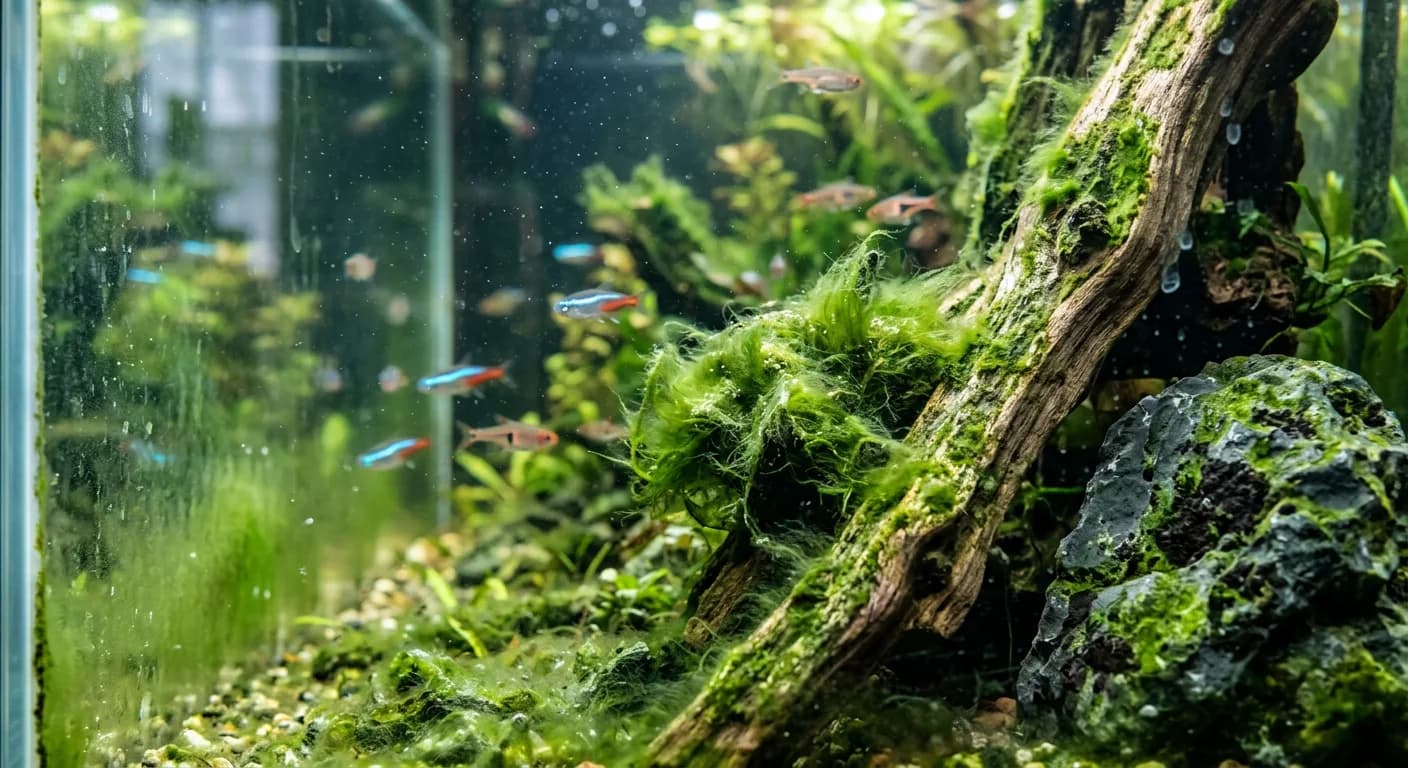
How to Get Rid of Algae in Your Fish Tank
Every fish tank gets algae. That's normal. A thin green film between cleanings is not a crisis. But when plants are coated in black fuzz, green hair is taking over driftwood, or water looks like pea soup, you have a problem that won't fix itself. The fix depends entirely on what type of algae you have. Generic advice like 'do more water changes' doesn't cut it. Here's how to identify what you're dealing with and eliminate it.
01
Identifying Your Algae
Not all algae is the same. Treating the wrong type wastes time and money. Here are the six types you'll encounter.
Green Spot Algae (GSA): hard, flat green dots on glass, slow-growing plant leaves, decorations. Won't wipe off with a soft cloth. Needs a razor blade on glass or a nerite snail.
Green Dust Algae (GDA): soft green film coating glass evenly. Wipes off easily but comes back within days. Looks like someone smeared green paint inside your tank.
Hair or String Algae: long, wispy green strands on plants, hardscape, filter intakes. Pulls out by hand or twirl around a toothbrush. Feels soft and stringy.
Black Beard Algae (BBA): dark grey to black tufts on leaf edges, driftwood, filter outlets. Tough, doesn't pull off easily. One of the most stubborn types. Feels fuzzy and stiff.
Brown Diatoms: dusty brown coating on glass, substrate, plants. Common in new tanks (first 1-3 months) and low-light tanks. Wipes off easily, usually resolves as tank matures.
Blue-Green Algae (BGA): technically cyanobacteria, not algae. Slimy sheets of blue-green or dark green that peel off in layers and smells terrible. If your algae smells swampy, it's probably BGA.
02
Why Algae Takes Over
Algae needs light, water, and nutrients. You can't remove water or nutrients from a fish tank, so the levers are light duration, light intensity, and nutrient balance.
Too much light is the most common cause. Running lights 10-12+ hours per day or using too powerful a light gives algae more energy than plants can compete with. In tanks without live plants, it's even worse.
Nutrient imbalance matters more than total levels. High nitrate alone doesn't cause algae, but high nitrate with zero phosphate and strong light does. Plants need balanced nutrition. When one nutrient is missing, they stall and algae fills the gap.
Poor CO2 in planted tanks creates the same problem. Plants in high-light setups without adequate CO2 can't photosynthesize fast enough. Algae, which has much lower CO2 demands, takes over.
Poor water circulation creates dead spots where nutrients accumulate. If algae consistently appears in one corner, check whether your filter output reaches that area.
Brown diatoms in new tanks are normal. They feed on silicates that leach from new substrate. They resolve on their own after 2-3 months. Don't panic about brown algae in a tank under 3 months old.
03
Fixing Green Spot and Green Dust Algae
Green Spot Algae on glass is cosmetic. Scrape it off with a razor during water changes and move on. If it's on plant leaves, that usually means low phosphate. Test phosphate levels. If they read 0, dose potassium phosphate to bring levels to 1-2 ppm. GSA on anubias is extremely common because anubias grows so slowly that algae has weeks to colonize each leaf.
Nerite snails are the single best solution for persistent green spot algae. They eat the hard spots nothing else touches. Two or three nerites in a 20 gallon tank will keep your glass nearly spotless. They can't breed in freshwater, so no snail explosion.
Green Dust Algae is trickier. The counterintuitive fix is to leave it alone for 3-4 weeks. GDA has a lifecycle, and if you keep wiping it off, you spread spores and restart the cycle. Let it grow undisturbed, then do a massive wipe-down followed by a large water change. This breaks the cycle. If GDA keeps coming back, reduce light duration by 1-2 hours.
04
Eliminating Hair Algae and Black Beard Algae
Hair algae thrives when there's excess light and available iron. First, reduce light to 6 hours per day. If you're dosing liquid iron separately, stop. Most all-in-one fertilizers contain enough iron.
Physical removal works well. Twirl a toothbrush or wooden skewer in the strands. They wrap around and pull right out. Do this every few days during initial outbreak.
Amano shrimp are the best biological control for hair algae. A crew of 5-10 amanos in a 20 gallon tank will noticeably reduce hair algae within 2 weeks. They eat it constantly and pull strands off plant leaves.
Black Beard Algae is harder. BBA usually signals fluctuating CO2 levels in planted tanks, but also appears in non-planted tanks with poor flow. The nuclear option is spot-treating with hydrogen peroxide. Turn off your filter, draw up 1-2 mL of 3% hydrogen peroxide in a syringe, squirt directly on BBA. Leave filter off for 5 minutes, then turn back on. BBA turns pink or white within 24-48 hours and dies. Fish and shrimp tolerate small amounts, but don't exceed 1 mL per gallon total.
For BBA on removable items, soak them in a 1:20 bleach-to-water solution for 2-3 minutes, rinse thoroughly, soak in dechlorinated water before returning.
Siamese algae eaters are the only fish that reliably eat BBA, but they grow to 6 inches and need a 30+ gallon tank.
05
Dealing With Brown Diatoms and Blue-Green Algae
Brown diatoms in a new tank are normal and temporary. They feed on silicates that leach from new substrate, glass, decorations. In most tanks, diatoms disappear entirely after 2-3 months as silicate levels drop. Wipe them off during water changes, but don't stress about them.
Otocinclus catfish devour diatoms. A group of 6 otos in a 20 gallon tank can clear diatoms within days. But only add otos to a tank at least 2-3 months old with established biofilm.
If brown diatoms persist past 3 months, check your water source. Some tap water has high silicates. RO units remove silicates but are overkill for most hobbyists.
Blue-Green Algae (cyanobacteria) needs a different approach. BGA usually appears when nitrate is very low (under 5 ppm) and water flow is poor. The fix is often to add nitrogen. Dose potassium nitrate to raise nitrate to 10-20 ppm and increase circulation.
If BGA persists after fixing nutrients and flow, a 3-day blackout works. Turn off the light completely, cover the tank, don't feed fish. BGA can't survive 72 hours without light, but plants can. After blackout, do a 50% water change and manually remove remaining sheets.
As a last resort, erythromycin (API E.M. Erythromycin) kills BGA within days because it's a bacterium, not algae. Follow package dosing. Won't harm biological filter at recommended dose.
06
Algae-Eating Crew
Not every 'algae eater' actually eats algae, and none of them solve problems caused by underlying issues. Fix the root cause first, then add cleanup crew.
Nerite snails are the best glass cleaners. They eat green spot algae, green film algae, diatoms, biofilm. Can't reproduce in freshwater, so population stays controlled. They do leave small white eggs on hardscape that never hatch, which bothers some people. Two to three per 20 gallons is plenty.
Amano shrimp are the top choice for hair algae and soft green algae. Work in groups, so get at least 5 for a 20 gallon tank. Peaceful, hardy, large enough that most community fish won't eat them. They don't eat BBA or green spot algae.
Otocinclus eat diatoms, soft green algae, biofilm. Small, peaceful, must be kept in groups of 6+. Sensitive to water quality, only for mature tanks (3+ months old). They starve easily, so supplement with blanched zucchini or algae wafers if needed.
Bristlenose plecos handle most algae types except BBA. Max out at 4-5 inches, produce a lot of waste. One per 20+ gallons is enough. Don't confuse them with common plecos, which grow to 18+ inches.
Mystery snails eat soft algae and decaying plant matter but aren't aggressive algae eaters. Good to have but won't solve an outbreak on their own.
07
Chemical Treatments
Chemical treatments are a last resort, not a first response. They treat symptoms without fixing causes, and algae comes back unless you address the underlying problem.
API AlgaeFix works on green water, hair algae, blanket weed. Follow dosing exactly. Overdosing kills shrimp and can crash oxygen levels as dead algae decomposes. Never use in tanks with shrimp or invertebrates. It is toxic to them even at recommended doses.
Seachem Flourish Excel (glutaraldehyde) is marketed as liquid carbon but also kills algae when spot-dosed. Use a syringe to apply 1 mL directly onto BBA or hair algae with filter off. Safer than hydrogen peroxide for regular use but still stresses sensitive plants like vallisneria and certain mosses.
UV sterilizers solve green water permanently. An inline or hang-on UV kills algae cells as water passes through. A 9W UV clears green water in a 20-40 gallon tank within 3-5 days. Doesn't help with algae on surfaces.
Never use copper-based treatments in tanks with shrimp or snails. Copper is lethal to invertebrates at concentrations safe for fish. Read ingredient lists before adding any treatment.
The best chemical treatment is prevention. Consistent lighting, balanced fertilization, regular water changes, and healthy plant mass outperform any bottle of algae killer.
08
Prevention
Preventing algae is easier than fighting it. These habits keep your tank clean without constant intervention.
Run your light on a timer for 6-8 hours per day. This is the single most impactful thing you can do. Algae can't grow in the dark. Reducing from 10 hours to 7 hours makes a noticeable difference within a week.
Don't overfeed. Uneaten food breaks down into nutrients that fuel algae. Feed only what fish eat in 2 minutes, once or twice per day. Food on the substrate after 5 minutes means too much.
Keep up with water changes. 20-25% weekly removes excess nutrients before they accumulate to algae-feeding levels. Skipping water changes for a few weeks is one of the fastest ways to trigger an algae bloom.
Maintain healthy plants. A heavily planted tank with fast-growing stem plants outcompetes algae for nutrients. Floating plants like frogbit, water lettuce, or water wisteria absorb excess nutrients and block light from algae below.
Clean your filter regularly but not obsessively. A clogged filter reduces flow and creates dead spots. Rinse filter media in old tank water every 3-4 weeks.
Avoid direct sunlight on your tank. Even 2-3 hours through a window can trigger algae. If your tank is near a window, close blinds during peak sun hours or relocate.
Table of Contents
Related Content
Popular Fish Species
Essential Gear
Best Filter for a 20 Gallon Tank
Aquaneat 3-Pack Biosponge Filter