What Fish Can Live With Bettas? (Complete Tankmate Guide)
The short answer is: it depends on your betta. Some bettas coexist peacefully with tankmates for years. Others murder a snail within 24 hours. Individual temperament matters more than any compatibility chart, and anyone who gives you a guaranteed list without that caveat is setting you up for dead fish. That said, some species are far safer bets than others, and tank size plays a massive role. This guide covers what works, what does not, and how to introduce tankmates without turning your tank into a war zone.
01
Why Most Betta Tankmate Advice Is Wrong
Every pet store employee and half the internet will tell you bettas are fine with neon tetras, guppies, or whatever they happen to sell. This advice ignores the single most important variable: your specific betta's personality.
Bettas range from completely docile to homicidally aggressive. A betta that flares at his own reflection for 20 minutes is not going to tolerate a tank full of colorful fish. A betta that barely reacts to a mirror and spends his time exploring might do fine with carefully chosen companions.
The other problem with generic advice is ignoring tank size. Putting a betta with 6 corydoras in a 5 gallon tank is a disaster regardless of temperament. The tank is too small, the bioload is too high, and there is no room for anyone to establish territory.
Before adding any tankmates, ask yourself two things. First, is your tank big enough? Anything under 10 gallons means your betta lives alone (with maybe a snail). Second, is your betta aggressive? If he flares at everything, builds bubble nests constantly, and patrols the glass when you walk by, he is telling you he wants his space. Respect that.
02
Tank Size Rules for Betta Communities
Tank size is not negotiable. These are minimums, not suggestions.
5 gallons: betta only. Maybe a nerite snail. That is it. A 5 gallon tank does not have the space or water volume for a community. Your betta can live a great life alone in a well-planted 5 gallon.
10 gallons: betta plus snails (nerite or mystery) and possibly cherry shrimp. The shrimp need heavy plant cover to survive because even peaceful bettas snack on exposed shrimp. Java moss, dense stem plants, and floating plants give shrimp enough hiding spots to maintain a population.
15 gallons: opens up options for small, peaceful fish like ember tetras or harlequin rasboras, but this is still tight. A school of 6 small fish plus a betta in 15 gallons works if the tank is well-planted and the betta is confirmed peaceful.
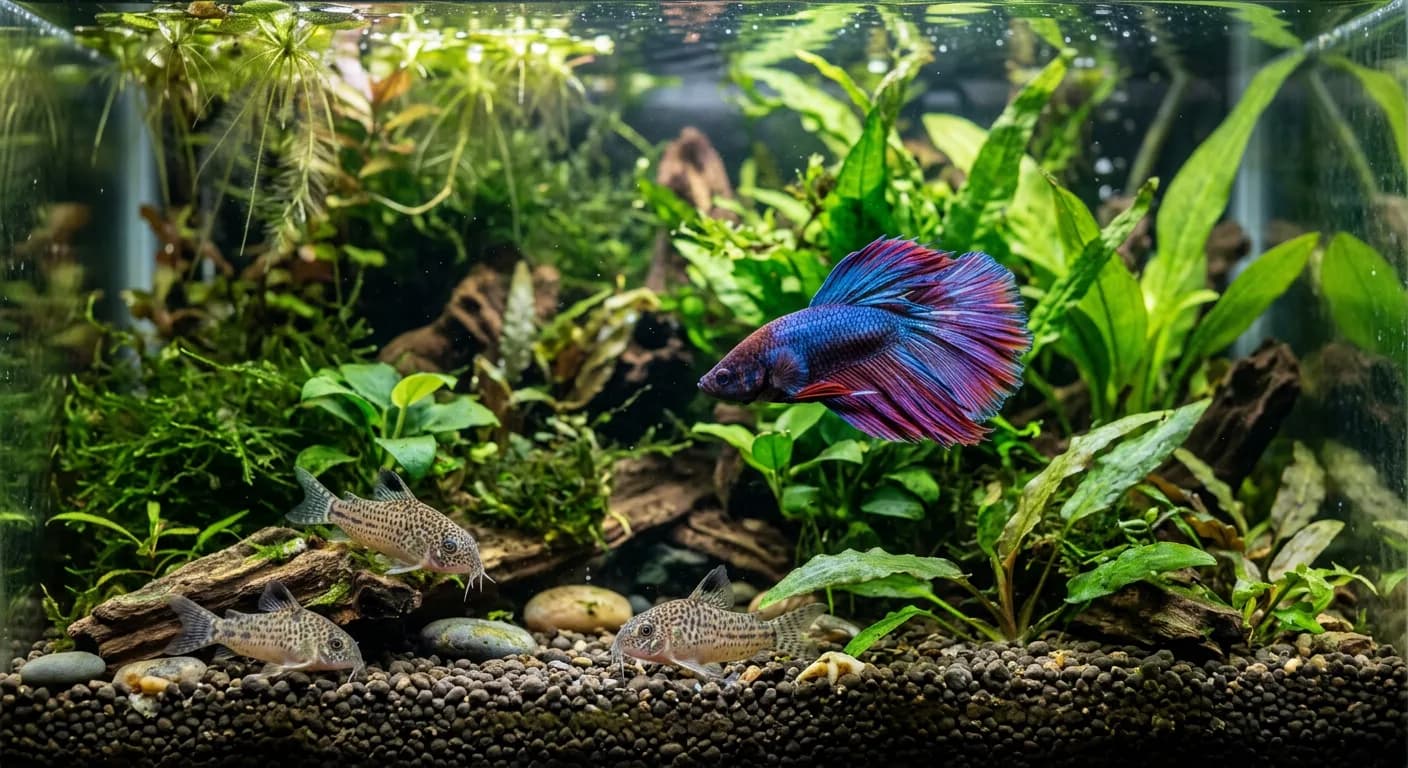
20 gallons: the real sweet spot for a betta community. Enough space for the betta to claim territory, enough room for a school of bottom dwellers and a school of mid-level fish, and enough water volume to buffer the bioload. This is where you can do a betta with 6 corydoras and 6-8 small tetras or rasboras.
Do not let anyone convince you that a betta sorority (multiple female bettas) works in anything under 40 gallons, and honestly, most of those end badly too. Female bettas are less aggressive than males on average, but they still fight, establish pecking orders, and stress each other out.
03
Safe Tankmates: The Reliable Picks
These species have the highest success rate with bettas across the hobby. They work because they are peaceful, do not resemble bettas, and mostly occupy different areas of the tank.
Nerite snails are the safest possible tankmate. They are too armored for a betta to harm, they keep the glass clean, and they mind their own business. Even aggressive bettas usually ignore nerites after a day of initial investigation. Two or three nerites in a 10+ gallon tank is a safe bet.
Mystery snails work similarly but are larger and more active. Some bettas nip at their antennae, which can stress the snail into staying retracted. If your betta persistently bothers a mystery snail, remove the snail. Most bettas lose interest after the first day.
Cherry shrimp are possible in a heavily planted tank. Your betta will eat baby shrimp and probably pick off any adult that wanders into the open. But in a tank with dense java moss, lots of stem plants, and floating cover, a cherry shrimp colony can sustain itself because enough babies survive in the plant cover. Accept that some will get eaten. That is the deal.
Corydoras catfish (bronze, peppered, or panda) stay on the bottom and look nothing like bettas. Keep them in groups of 6 or more in a 20 gallon tank. They are armored, peaceful, and occupy a completely different zone than the betta. They need sand or smooth gravel substrate since rough gravel damages their barbels.
Otocinclus are small, peaceful algae eaters that stick to surfaces. Keep 6 or more in a 20 gallon. They are completely non-threatening to bettas and are usually ignored entirely. They need a mature tank with established biofilm.
Kuhli loaches are bottom-dwelling noodles that hide in substrate and behind decorations. Keep 6 or more in a 20 gallon with sand substrate and plenty of hiding spots. They are nocturnal and rarely interact with bettas at all.
04
Risky but Possible: Proceed With Caution
These species can work with bettas, but you need a larger tank, a confirmed peaceful betta, and a backup plan.
Harlequin rasboras are one of the more commonly recommended betta tankmates and for good reason. They are peaceful, stay in a school, and occupy the middle of the water column. Keep 8-10 in a 20 gallon with the betta. Their coppery color is different enough from a betta's typical blue, red, or purple that most bettas do not see them as rivals. The risk is that a particularly aggressive betta may chase them anyway.
Ember tetras are tiny (under an inch), peaceful, and stick together in a loose school. They work in 15+ gallon tanks with bettas. Their small size means they are not threatening, but it also means a determined betta could injure them. Dense planting provides escape routes.
Neon tetras are a classic recommendation but honestly borderline. Their bright blue and red stripes can trigger some bettas. They also need cooler water (72-76F) than most bettas prefer (78-80F). If you run the tank at 76-78F, you are compromising for both species. They work best in a 20+ gallon tank where the betta has clearly established a territory away from the school.
African dwarf frogs are sometimes suggested, but they are slow, nearly blind, and compete poorly for food. They can coexist with bettas in calm tanks, but feeding time is stressful because the betta eats everything before the frog finds it. Not recommended unless you are willing to target-feed the frogs with tongs.
05
Never: Fish That Will Cause Problems
Some combinations fail almost every time. Do not try these.
Other male bettas. This should be obvious, but it still happens. Two male bettas in the same tank will fight until one or both are dead or severely injured. No amount of space, plants, or dividers makes this work long-term. Even in a 100 gallon tank, they will find each other.
Guppies have flowing, colorful tails that bettas frequently mistake for another betta. Male guppies in particular look like a rival from a betta's perspective. This pairing results in shredded guppy fins and dead guppies more often than not.
Gouramis are in the same family as bettas (Osphronemidae) and occupy the same space at the top of the tank. They are essentially competitors for territory. Dwarf gouramis and bettas will fight.
Tiger barbs are fin nippers by nature. They will shred a betta's long fins within hours. This goes for most barb species, though cherry barbs are the one exception that can sometimes work.
Angelfish get large (6+ inches), are semi-aggressive, and will bully or eat bettas. They also need different tank parameters and far more space.
Chinese algae eaters become aggressive as they mature and will latch onto slow-moving fish, including bettas, to eat their slime coat. Avoid.
Any fish with long, flowing fins (fancy guppies, fancy goldfish) triggers betta aggression because it mimics another betta. And any aggressive species (cichlids, large tetras like Buenos Aires or serpae) will either bully or be attacked by the betta.
06
How to Introduce Tankmates the Right Way
The introduction order matters more than most people realize. Always add the tankmates first and the betta last. This is the opposite of what most beginners do, and it makes a huge difference.
When a betta is placed in an empty tank, he claims the entire tank as his territory. Every inch of it. Adding new fish into his established territory is an invasion from his perspective. But when the betta is introduced into a tank that already has other fish, he has to find his space within an existing community. This dramatically reduces aggression.
If your betta is already in the tank and you want to add tankmates, rearrange the decorations and plants right before the introduction. Moving things around resets territorial claims and makes everything feel new to the betta.
Add tankmates with the lights off and leave them off for a few hours. Lower light reduces stress and aggression during the initial encounter. Drop the new fish in, turn off the light, and check back in 2-3 hours.
Watch closely for the first 48 hours. Some chasing and flaring in the first few hours is normal as everyone figures out the hierarchy. What you are looking for is sustained aggression: the betta relentlessly chasing one specific fish, cornering tankmates, or actually biting. Brief flares followed by everyone going about their business is fine. Non-stop pursuit is not.
Feed the betta right before the introduction. A full betta is a less aggressive betta. Hungry bettas are more likely to view new additions as either threats or food.
07
Signs Your Betta Is Not Tolerating Tankmates
Some aggression at first is expected. Persistent aggression after 48-72 hours means the arrangement is not working. Here is what to watch for.
Constant flaring means the betta sees the tankmates as rivals. Occasional flares are normal, but if your betta spends most of his time with gills extended and fins spread at the other fish, he is stressed and aggressive. This is exhausting for the betta and terrifying for the tankmates.
Relentless chasing is different from brief investigation. A betta that follows the same fish repeatedly, cornering it against glass or into plants, is trying to drive it away or kill it. The chased fish will show stress: clamped fins, hiding, loss of color, and refusal to eat.
Nipped fins on tankmates are a clear sign. If your tetras or rasboras suddenly have ragged, torn fins, your betta is attacking them. This escalates quickly from occasional nips to sustained damage.
The betta refusing to eat can indicate he is too stressed by the presence of other fish. A stressed betta may also lose color, become lethargic, or develop stress stripes (horizontal lines along his body).
Tankmates hiding constantly means they are afraid. Fish that stay behind the filter, in corners, or pressed against the glass are being bullied. Healthy fish explore the tank and move freely.
If you see any of these signs lasting more than 72 hours, separate the fish. Hoping it will "work itself out" usually ends with dead or severely stressed fish.
08
Your Backup Plan: Always Have One
Before you add a single tankmate, have a plan for what to do if it does not work. This is non-negotiable.
The simplest backup is a spare tank. A cycled 5 gallon with a heater and sponge filter gives you somewhere to move the betta (or the tankmates) immediately if aggression becomes a problem. Keep a sponge filter running in your main tank so it stays seeded with beneficial bacteria. When you need the backup tank, move the sponge filter over and you have an instantly cycled hospital or separation tank.
If a second tank is not possible, a tank divider works as a temporary solution. Clear dividers let fish see each other (which can still cause flaring), so opaque or mesh dividers are better. Dividers reduce swimming space for everyone, so this is not a long-term solution for anything under 20 gallons.
Another option is to have a friend or local fish store that will take fish back. Many local fish stores accept returns or surrenders. Ask before you buy. Big box pet stores vary by location on return policies.
Planning for failure is not pessimistic. It is responsible fishkeeping. Even experienced betta keepers sometimes get a betta that refuses to share space. The difference between a good fishkeeper and a bad one is what you do when the plan does not work. The good fishkeeper separates the fish. The bad one hopes for the best and loses fish.
Table of Contents
Related Content
Popular Fish Species
Essential Gear
Best Filter for a 20 Gallon Tank
Aquaneat 3-Pack Biosponge Filter