Aquarium Water Hardness: GH, KH, and Why They Matter
Water hardness trips up more fishkeepers than almost any other parameter, mostly because GH and KH get lumped together when they are actually measuring different things. GH (general hardness) measures dissolved minerals, primarily calcium and magnesium. KH (carbonate hardness) measures the water's ability to resist pH swings. You can have hard water with low KH, or soft water with moderate KH. Understanding the difference determines whether your fish thrive or struggle, and whether your pH stays stable or bounces around.
01
GH and KH Are Different Things
GH measures the total concentration of dissolved minerals in your water, mainly calcium (Ca²⁺) and magnesium (Mg²⁺). Fish from rivers and lakes with lots of dissolved minerals evolved to require those minerals for proper bone development, osmoregulation, and reproduction. Remove those minerals from the water and soft-water fish do fine; put hard-water fish in mineral-poor water and they struggle long term.
KH measures carbonate and bicarbonate ions specifically. These ions act as a chemical buffer, absorbing excess acids or bases before they can shift the pH. A tank with KH above 4 dKH holds its pH stable across the day. A tank with KH below 2 dKH can swing 1-2 pH points overnight as CO2 builds up from fish respiration and breaks down the carbonate buffer.
The two values do not move together automatically. Reverse osmosis water, for example, strips out nearly everything: both GH and KH end up near zero. Tap water in most cities has substantial KH because water treatment adds carbonates to prevent pipe corrosion. You can have city tap water with moderate GH (the minerals vary by source) but high KH (added by the treatment plant).
Reading your test results: GH and KH are usually reported in degrees (dGH or dKH) or ppm. One degree equals approximately 17.8 ppm. Soft water is typically below 4 dGH; hard water is above 12 dGH. For KH, below 3 dKH is considered unstable buffering; 4-8 dKH is the stable range for most community tanks.
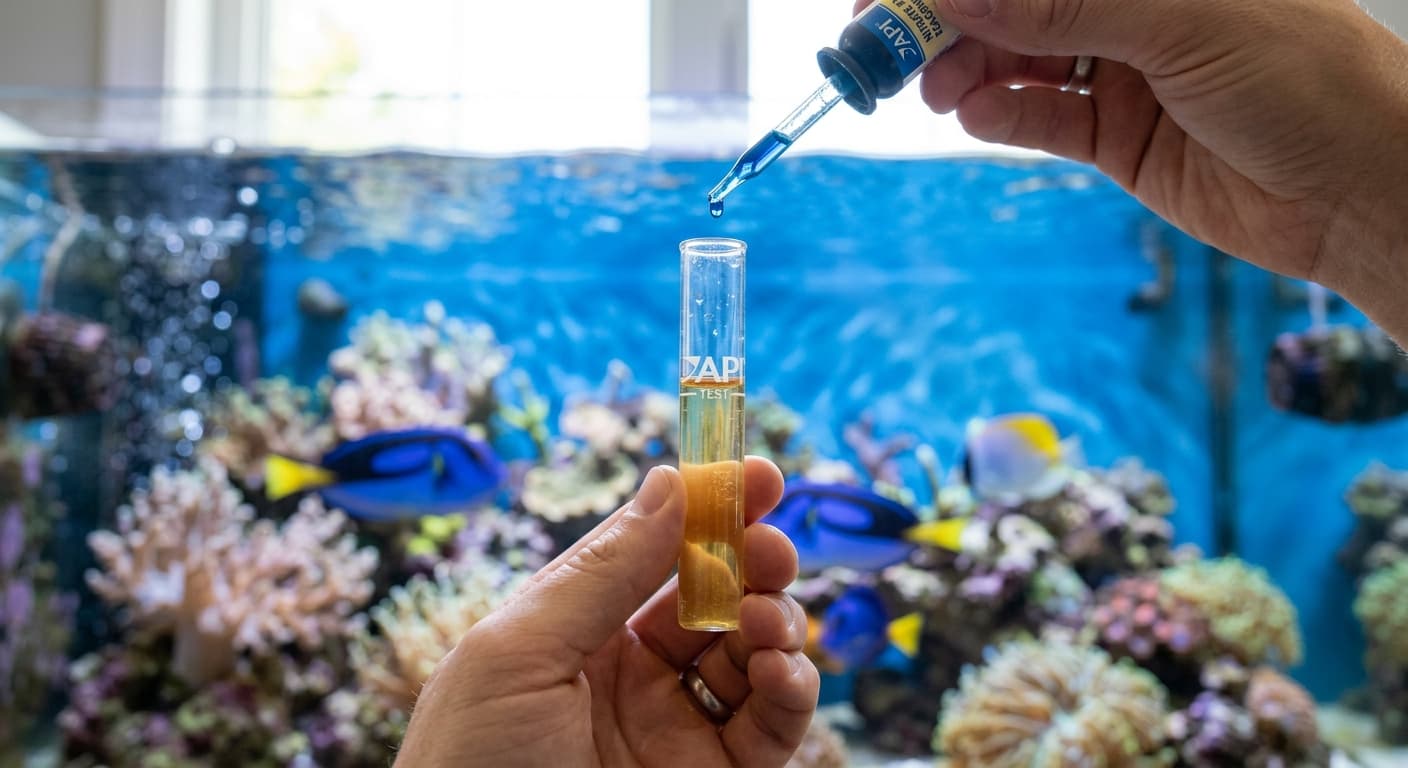
API GH and KH Test Kit
The master test kit does not include GH or KH. You need this separate kit to measure them. Fast liquid drop test, accurate enough for hobbyist use.
02
What Fish Need What Hardness
Hardness preferences fall into three rough categories.
Soft-water fish (low GH, low to moderate KH): discus, most wild-type tetras including cardinals, German blue rams, apistogrammas, chocolate gouramis, and most Southeast Asian rasboras. These fish evolved in blackwater rivers where mineral content is extremely low, with GH of 1-4 dGH and sometimes near-zero KH. In hard tap water they often survive but rarely breed and are more susceptible to disease.
Neutral to moderate hardness (GH 6-12 dGH, KH 4-8 dKH): most community fish fall here, including bettas, guppies, platies, mollies, danios, corydoras, most barbs, and the majority of cichlids not from the African rift lakes. This range suits tap water in most cities without adjustment.
Hard-water fish (high GH, high KH): African rift lake cichlids (peacocks, aulonocara, mbuna, tanganykians) need GH above 10 dGH and KH above 10 dKH with pH in the 7.8-9.0 range. Livebearers like mollies and swordtails also prefer moderately hard water, though they tolerate a wider range.
Shrimp are a special case. Neocaridina shrimp (cherry shrimp, blue dreams, red rilis) prefer GH of 6-8 dGH and KH of 2-4 dKH. Caridina shrimp (crystal reds, bees, tigers) need much softer water: GH of 4-6 dGH and KH near 0-2 dKH with specific remineralization products.
03
How to Raise GH
If your tap water is soft and you need to raise GH for hard-water species or to hit the remineralization target for neocaridina shrimp, a few methods work reliably.
Seachem Equilibrium is the standard planted tank and shrimp keeper solution. It adds calcium, magnesium, and potassium without affecting KH or pH significantly. Dose according to the target GH on the label; roughly 1 teaspoon per 10 gallons raises GH by about 3 dGH depending on starting values. Add to new water before putting it in the tank.
SaltyShrimp GH/KH+ is specifically formulated for neocaridina shrimp tanks built on RO or very soft water. It raises both GH and KH to the ratios neocaridina prefer. Widely used among shrimp keepers because it hits both parameters consistently from near-zero RO water.
Crushed coral and aragonite in the filter or substrate slowly release calcium and magnesium, raising both GH and KH over time. The release rate is pH-dependent: more dissolves when pH is lower, less when pH is stable. This makes it self-regulating for KH (see next section) but less precise for GH targeting.
Hard tap water blended with RO water is the easiest method when your goal is moderate GH. If tap water tests at 15 dGH and you want 8 dGH, a 50/50 blend lands you close. Test the blend before adding fish.
SaltyShrimp GH/KH+
Formulated specifically for neocaridina shrimp tanks on RO or very soft water. Hits both GH and KH at the right ratio in one product.
04
How to Raise KH (and Why It Matters for pH Stability)
Low KH is the hidden cause of the pH crashes that confuse a lot of fishkeepers. The pattern looks like this: tank runs at pH 7.4, then slowly drifts down to 6.8, then 6.5, fish get stressed. What happened is the KH buffer got consumed by organic acids produced from fish waste and plant respiration. Once KH hits zero, pH free-falls.
If your KH is below 3 dKH, raising it is the fix. A few approaches:
Crushed coral in a mesh bag in the filter is the most controlled method. Calcium carbonate dissolves slowly as pH drops, releasing carbonates that both stabilize pH and raise KH. Add a cup of crushed coral to your filter media and let it work over a week. Test KH at 3-day intervals. Easy to adjust by adding or removing coral. CaribSea Crushed Coral or aragonite both work well.
Baking soda raises KH directly and quickly. Sodium bicarbonate is cheap and reliable; 1 teaspoon per 10 gallons raises KH roughly 4 dKH. Dissolve it fully in a cup of tank water before adding. The downside is it also raises pH somewhat and adds sodium, which accumulates over time in tanks with frequent dosing. Good for one-time corrections, less ideal for ongoing maintenance.
Seachem Alkalinity Buffer or similar commercial KH buffers raise carbonate hardness without the sodium load of baking soda. More expensive per dose but cleaner for ongoing use.
The goal for most community tanks is KH in the 4-8 dKH range. This provides enough buffering to absorb daily CO2 fluctuation without allowing large pH swings.
CaribSea Crushed Coral (10lb)
Add a cup to your filter media and it self-regulates KH by dissolving when pH drops and stopping when pH stabilizes. Cleaner long-term than baking soda.
05
How to Lower GH and KH for Soft-Water Fish
Hard tap water creates real challenges for discus, wild-type tetras, German blue rams, and other soft-water fish. The standard solution is RO water.
Reverse osmosis filtration removes virtually all dissolved minerals, producing water with near-zero GH and KH. You then blend RO water with tap water to hit your target hardness, or use a remineralization product to add back only what you want. Discus breeders typically run 100% RO with a small amount of remineralizer to keep GH around 2-4 dGH. Community soft-water fish can often tolerate a 50/50 blend with most tap water.
Peat moss in the filter lowers both GH and KH over time through ion exchange and humic acid release. It also stains the water amber, which soft-water fish from blackwater rivers actually prefer. Neons and cardinals look better under tannin-stained water. Effects are slow and dose-dependent; use a mesh bag and test weekly to gauge how much is needed.
Rainwater collection is a free source of very soft water if you have a clean collection setup away from treated roofs. It needs testing for pH and treatment with a water conditioner for any trace contaminants before use.
Trying to use chemical softeners (like water softener salt or certain commercial products) does not actually lower GH the way fish need. Ion exchange water softeners replace calcium and magnesium with sodium, which is not helpful for soft-water fish and can be harmful to shrimp. Avoid using home water softener output for aquariums.
Table of Contents
Related Content
Popular Fish Species
Essential Gear
Best Aquarium Test Kit for Freshwater Tanks
API Freshwater Master Test Kit
Frequently Asked Questions
Sources & Further Reading
- Hard Water — Wikipedia
Chemistry of water hardness including calcium carbonate, carbonate hardness, and effects on aquatic systems.
- Hardness of Water — USGS Water Science School
USGS explanation of water hardness, measurement methods, and geographic variation in hardness levels.
- FishBase — Global Species Database
Species-specific water parameter data used to verify hardness requirements for freshwater fish cited in this guide.