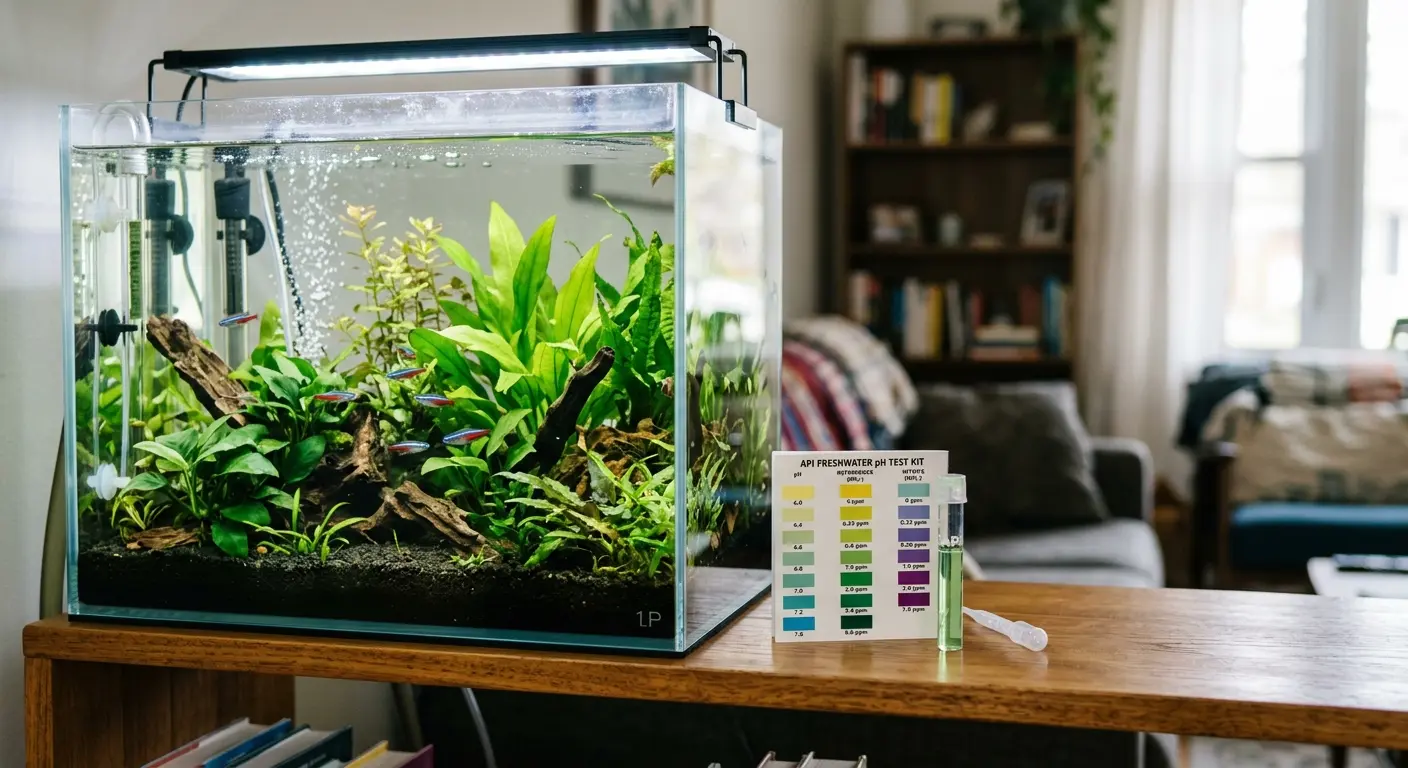
Aquarium pH: How to Test, Raise, and Lower It
pH measures how acidic or alkaline your water is on a scale from 0 to 14, with 7.0 being neutral. Most freshwater fish do best between 6.5 and 7.8. The number itself matters less than most guides suggest. What causes problems is instability. A fish that evolved in pH 6.0 water and has lived in your pH 7.4 tank for a year is adapted to pH 7.4. Moving it to pH 6.0 water stresses it more than leaving it at 7.4. Chase stability first; optimize later.
01
Understanding pH and Why It Shifts
pH in an aquarium is not static. It fluctuates throughout the day as a result of biological activity. Plants and algae consume CO2 during the day, which raises pH. At night, all living things in the tank respire and release CO2, which drops pH. In a heavily planted tank under bright light, pH can swing 0.5 to 1.0 points between morning and evening. This is normal and not harmful if the range stays within species tolerance.
Several factors push pH in one direction:
Things that lower pH over time: - Organic decay (fish waste, uneaten food, decomposing plant matter releases CO2 and acids) - Driftwood (releases tannins that acidify water) - Peat moss (acidifying, used in some substrates and as filter media) - CO2 injection for planted tanks (deliberately acidifies water) - Soft water with low buffering capacity (pH swings easily in any direction)
Things that raise pH or hold it stable: - Crushed coral and aragonite (release calcium carbonate that buffers and raises pH) - Limestone, coral rock, and Texas holey rock decorations - Hard tap water with high mineral content - Seashells and snail shells in the tank - Alkaline substrate (like CaribSea African Cichlid substrate)
Knowing which direction your tank naturally drifts is more useful than trying to force it to a target number.
API Freshwater Master Test Kit
Tests pH, ammonia, nitrite, and nitrate. Everything you need to understand what is happening in your water. Liquid tests are more accurate than strip tests for pH.
02
How to Lower pH
Lowering pH is relevant for soft-water fish like discus, cardinal tetras, German blue rams, and apistogrammas that prefer acidic conditions below 6.8. It is also relevant if your tap water runs above 8.0 and you are trying to bring it into a manageable range.
Driftwood. The most natural and sustainable method. Driftwood releases tannins that gradually acidify the water and give it the slight amber color that many soft-water fish come from in nature. The effect is slow (weeks to months) but stable, and it does not require ongoing product use. Malaysian driftwood and spider wood release more tannins than manzanita.
Peat moss. Used as filter media or substrate additive, peat releases humic acids that lower pH and soften water. The effect can be significant: peat-filtered water can drop pH by a full point over a few days. Use it in a mesh bag in your filter, start with a small amount, and test pH daily until you understand how much effect you are getting.
RO/DI water blended with tap. Reverse osmosis water has no buffering capacity and no minerals. It sits at near-neutral pH but has no resistance to change. Blending RO water with tap water dilutes the minerals in your tap water, which reduces pH if your tap water is alkaline. This is the method discus breeders and apistogramma specialists use to create the soft, slightly acidic water their fish prefer.
API pH Down. A direct acidifier (sodium biphosphate) that lowers pH quickly. The problem is stability: in water with significant buffering capacity (KH), pH Down fights against the buffer and pH rebounds after a few hours. It works better in soft water with low KH. In hard, alkaline tap water, it is a constant battle that requires repeated dosing.
API pH Down
Works for quick corrections in soft water. Less effective in hard, alkaline water where buffering fights it back up. Address KH first in those situations.
03
How to Raise pH
Raising pH is relevant for African cichlids, which come from extremely hard, alkaline lakes (pH 7.8-9.0), and for tanks where pH drifts low due to CO2 buildup or organic decay.
Crushed coral. The most reliable long-term method. Calcium carbonate dissolves slowly as pH drops, releasing minerals that raise and buffer the water. It is self-regulating: it dissolves more when pH is low and stops dissolving when pH stabilizes. Add crushed coral in a mesh bag in your filter media, or use it as a substrate layer in cichlid setups. The effect builds over days to weeks. CaribSea Aragonite and similar products work the same way.
Increase surface agitation. In CO2-rich tanks where pH drops at night, increasing surface agitation off-gasses CO2 faster. This is relevant in planted tanks where CO2 injection or natural plant respiration at night drops pH. A spray bar aimed at the surface or a surface skimmer helps off-gas CO2 and stabilize pH.
API pH Up. Raises pH quickly but has the same stability problem as pH Down in reverse. In tanks with low KH, pH Up can overshoot, and in tanks where pH naturally drifts low, the effect does not last. Use it for small corrections, not as a long-term solution.
Seachem Neutral Regulator. Buffers pH to 7.0 and maintains it there. Useful if you want a stable 7.0 without chasing a natural drift in either direction. Works best in soft water; in hard water, it competes with the existing mineral content.
API pH Up
Quick pH correction in soft water. For sustained high pH in African cichlid tanks, use crushed coral as a buffer instead.
04
Stability Over Precision
The fish keeping hobby sometimes creates anxiety about pH precision that is not reflected in how fish actually respond to water chemistry. A neon tetra in pH 7.4 water that has been stable for six months is doing fine, even though neon tetras prefer pH 6.0-7.0 in the wild. That fish has adapted. What it cannot handle is pH 7.4 Monday, 6.8 Tuesday, 7.1 Wednesday. The constant swings trigger osmotic stress and immune suppression.
When pH matters most: - Breeding. Many fish will not spawn outside specific pH ranges. German blue rams rarely breed above pH 7.0. Discus breeding requires pH 5.5-6.5 with very soft water. If breeding is not a goal, pH precision matters much less. - New fish acclimation. A fish from a store tank at pH 7.8 moving to your pH 6.5 tank needs a slow drip acclimation to adjust to the chemistry change. A sudden transfer is where pH differences cause real harm. - Shrimp. Shrimp are sensitive to pH swings as well as extremes. Cherry shrimp prefer 6.8-7.4 and do poorly outside that range.
Before making any pH adjustment, understand why your pH is where it is. If tap water runs 7.8 and your tank has been stable at 7.8 for months, your fish are adapted. Attempting to lower pH to 7.0 introduces instability for fish that are already healthy in 7.8 water. Leave it alone.
Table of Contents
Related Content
Essential Gear
Best Aquarium Test Kit for Freshwater Tanks
API Freshwater Master Test Kit
Frequently Asked Questions
Sources & Further Reading
- pH and Water — USGS Water Science School
USGS explanation of pH chemistry in natural water, including how CO2 and mineral content affect pH levels.
- Carbonate Hardness — Wikipedia
Explanation of carbonate hardness (KH) and its role as a pH buffering system in aquatic environments.
- FishBase — Global Species Database
Species pH range data used to verify tolerance ranges for freshwater fish cited in this guide.