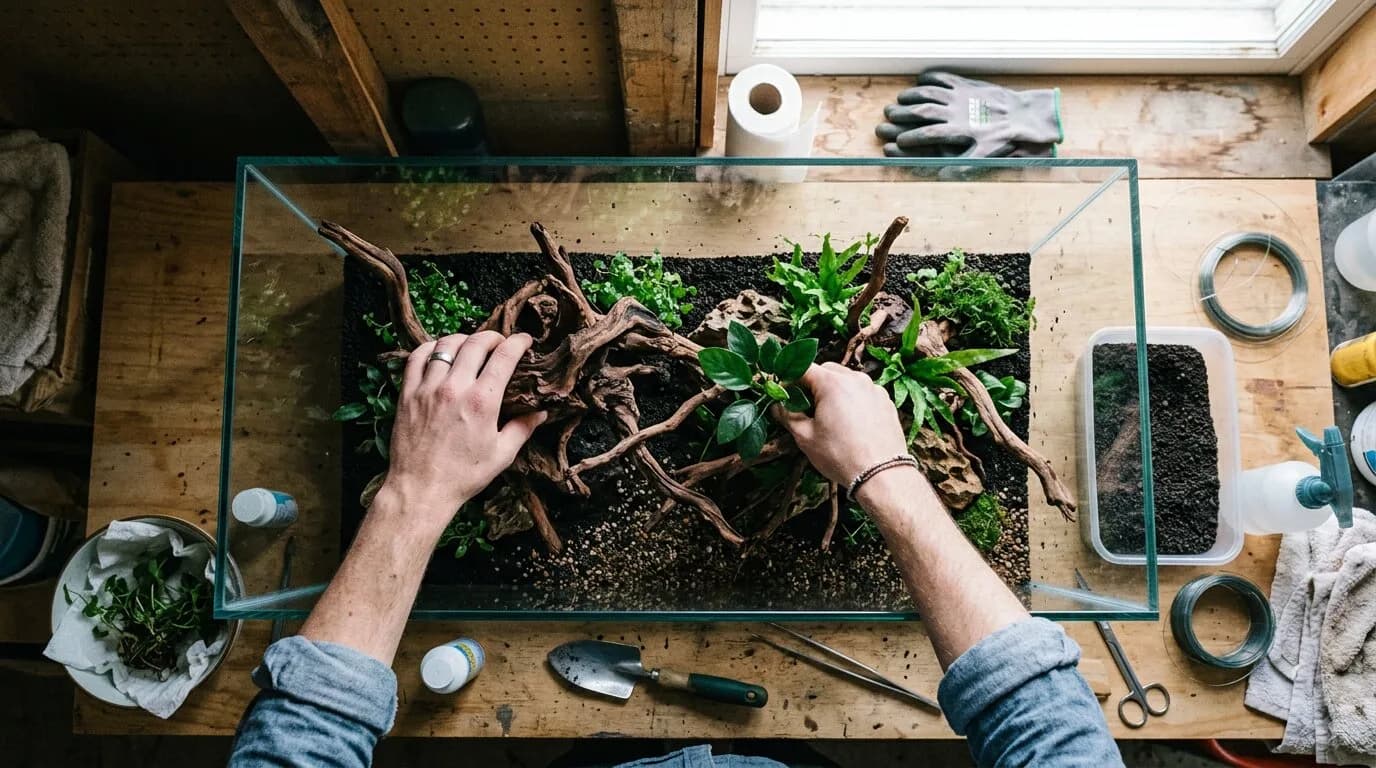
Your First Fish Tank: Complete Setup Guide for Beginners
You want fish. Great. But before you buy a single one, you need to set up their home correctly. Rushing this step is how most beginners end up with dead fish, green water, and a tank in the garage within three months. The whole process takes about an hour of hands-on work plus 4-6 weeks of patience for the tank to cycle. Here is exactly what to buy, where to put it, and how to set everything up so your fish actually thrive.
01
Choosing the Right Tank Size
Bigger tanks are easier, not harder. This surprises most beginners, but a 20 gallon tank is significantly more forgiving than a 5 gallon. More water means slower changes in temperature, pH, and ammonia levels. A 20 gallon is the best starter size for most people.
If space or budget is tight, a 10 gallon is the smallest you should go for a community tank. A 5 gallon works for a single betta or a shrimp colony, but water quality swings fast in that volume.
Avoid "starter kits" that come with everything in the box. The filter and heater included are usually the cheapest possible versions that will need replacing within 6 months. Buy the tank, filter, and heater separately. It costs about the same and you get gear that actually lasts.
For a 20 gallon standard tank, expect moderate pricing for the tank alone at major pet stores. Petco runs dollar-per-gallon sales a few times per year where tanks are excellent value.
02
Where to Put Your Tank
A 20 gallon tank weighs about 225 pounds when filled (water weighs roughly 8.3 pounds per gallon, plus the tank, substrate, and equipment). That means it needs a sturdy surface. A solid wood dresser, a purpose-built aquarium stand, or a heavy-duty shelf works. Particle board furniture is risky.
Keep the tank away from windows. Direct sunlight causes algae explosions and temperature swings. A tank next to a south-facing window will turn green within weeks.
Avoid placing it near heating vents, air conditioners, or exterior doors. Temperature stability matters more than hitting a perfect number.
Put the tank close to an electrical outlet because you will be running a filter, heater, and light. Use a drip loop on every cord so water runs down the cord and drips off the loop rather than flowing into the outlet.
Make sure you can access the top and back easily. You will be doing water changes, feeding, and filter maintenance regularly. A tank pushed flush against a wall with stuff piled on top becomes a chore to maintain.
03
Substrate: Sand, Gravel, or Bare Bottom
Gravel is the easiest for beginners. Get enough to cover the bottom 1-2 inches deep. For a 20 gallon, that is roughly 20-25 pounds. Rinse it thoroughly in a bucket before adding it to the tank. Unrinsed gravel turns your water into milk.
Sand looks more natural and is better for bottom-dwelling fish like corydoras that sift through it. Play sand from a hardware store works and is very budget-friendly for large quantities. Pool filter sand is another cheap option. Both need extensive rinsing.
If you want live plants, Seachem Flourite or Fluval Stratum are good planted tank substrates. They are moderately priced but give plant roots something to grip and contain nutrients.
Bare bottom (no substrate at all) is easiest to keep clean and works well for quarantine tanks or breeding setups, but it looks sterile and gives beneficial bacteria less surface area to colonize.
04
Equipment Setup
Install the filter first. For a 20 gallon, an AquaClear 30 or Seachem Tidal 35 hang-on-back filter is the standard recommendation. Hang it on the back, fill the media basket (sponge on the bottom, biological media on top), and do not plug it in until the tank is full of water.
Install the heater next. A 100W adjustable heater is right for a 20 gallon. Place it near the filter output so heated water circulates evenly. Suction cup it vertically or at a 45-degree angle near the waterline. Set it to 78 degrees for most tropical fish. Do not plug it in until it has been submerged for 15 minutes so the glass acclimates.
Attach your thermometer on the opposite side of the tank from the heater. This shows you the coolest point in the tank, which is what you actually want to monitor. Digital probe thermometers are the most accurate.
Install the light. For a basic community tank without live plants, any LED hood or clip-on light works. Run it on a timer for 8-10 hours per day. More than 10 hours promotes algae. If you want live plants, the Fluval Plant Nano or Nicrew ClassicLED Plus gives you enough light for low to moderate demand plants.
Hitop Adjustable Aquarium Heater
Reliable adjustable heater for 10-30 gallon tanks. Suction cups hold it securely, the dial is accurate, and it doesn't spike temperatures like cheap fixed heaters.
AquaClear 20 Power Filter
The workhorse HOB filter beginners graduate to after their first kit filter dies. Customizable media basket, strong flow rate, and it lasts for years.
05
Water Conditioning
Tap water contains chlorine and chloramine, both of which are lethal to fish and the beneficial bacteria you are trying to grow. Every drop of water that goes into your tank must be treated with a water conditioner first.
Seachem Prime is the go-to. It removes chlorine, chloramine, and temporarily detoxifies ammonia and nitrite. Use 2 drops per gallon (or 5 mL per 50 gallons). Dose it into the tank before or immediately after adding tap water.
Fill the tank slowly to avoid disturbing your substrate. Place a plate or a plastic bag on the substrate and pour water onto it. This diffuses the flow and keeps your gravel or sand in place.
Once full, plug in your filter and heater. Let the heater sit submerged for 15 minutes before plugging in. Wait 24 hours and check the temperature. Adjust the heater dial if needed. Your tank is now ready to begin cycling.
06
Cycling Your Tank
Do not add fish yet. Your tank needs to cycle first, which means growing beneficial bacteria that convert toxic ammonia into less harmful nitrate. This takes 4-6 weeks with the fishless method.
Add pure ammonia (Dr. Tim's Ammonium Chloride is the easiest source) to bring the level to 2-4 ppm. Test daily with the API Freshwater Master Test Kit. Over the next weeks, you will see ammonia drop, nitrite spike, and then nitrate appear. When ammonia and nitrite both read 0 within 24 hours of dosing, you are cycled.
See our full cycling guide for the detailed step-by-step process, troubleshooting, and how to speed it up.
Skipping this step is the number one reason beginners lose fish. It feels like you are doing nothing for a month. You are not. You are building the biological foundation that keeps your fish alive.
07
Adding Your First Fish
Once your tank is cycled, do a 50-70% water change to bring nitrate below 20 ppm. Then you can start adding fish, slowly.
Add 2-3 fish at a time, then wait at least a week before adding more. Your bacteria colony needs time to ramp up to the increased bioload. Testing ammonia daily for the first week after adding fish tells you if your colony is keeping up.
When bringing fish home, float the sealed bag in your tank for 15 minutes to equalize temperature. Then open the bag, add a half cup of tank water every 5 minutes for 20-30 minutes. This acclimates the fish to your water chemistry. Net the fish out and add them to the tank. Discard the bag water rather than dumping it in your tank.
Good starter fish for a 20 gallon include: 6-8 neon tetras, 6 bronze corydoras, a single betta (alone or with peaceful bottom dwellers), or 6 harlequin rasboras. All of these are hardy, affordable, and forgiving of beginner mistakes.
Feed sparingly for the first week. Once a day, only what they eat in 2 minutes. Uneaten food rots and spikes ammonia. You can increase to twice daily feeding once the tank is stable and you are getting consistent 0 ammonia, 0 nitrite readings.
08
Budget Breakdown: What It Costs
Here is what a solid 20 gallon beginner setup requires if you buy smart:
Aqueon 20 gallon standard tank (great value during dollar-per-gallon sales) AquaClear 30 filter (reliable and well-priced) Aqueon Pro 100W or Eheim Jager 100W heater (affordable quality option) Gravel (25 lbs, budget-friendly) Seachem Prime water conditioner (250 mL, economical and long-lasting) API Freshwater Master Test Kit (essential, moderately priced) Dr. Tim's Ammonium Chloride (inexpensive cycling aid) Basic LED light (budget to mid-range options available) Digital thermometer (very affordable)
Total: Budget-friendly to moderately priced depending on choices
Optional but recommended: Live plants (java fern, anubias, 3-5 plants, reasonably priced) Driftwood or rocks for hardscape (affordable natural decoration) Python No Spill Clean and Fill water changer (25 ft, worthwhile investment)
Yes, it costs more than cheap starter kits. But the starter kit will cost you more in the long run when you replace the filter, replace the heater, and replace the fish that died because of them. Buy it right the first time.
Aqueon 20-Gallon Starter Kit
Comes with filter, heater, and light. One box and you have everything needed to start a beginner community tank.
Table of Contents
Related Content
Popular Fish Species
Essential Gear
Best Filter for a 20 Gallon Tank
Aquaneat 3-Pack Biosponge Filter
Best Aquarium Heater for Fish Tanks
Hitop Adjustable Aquarium Heater