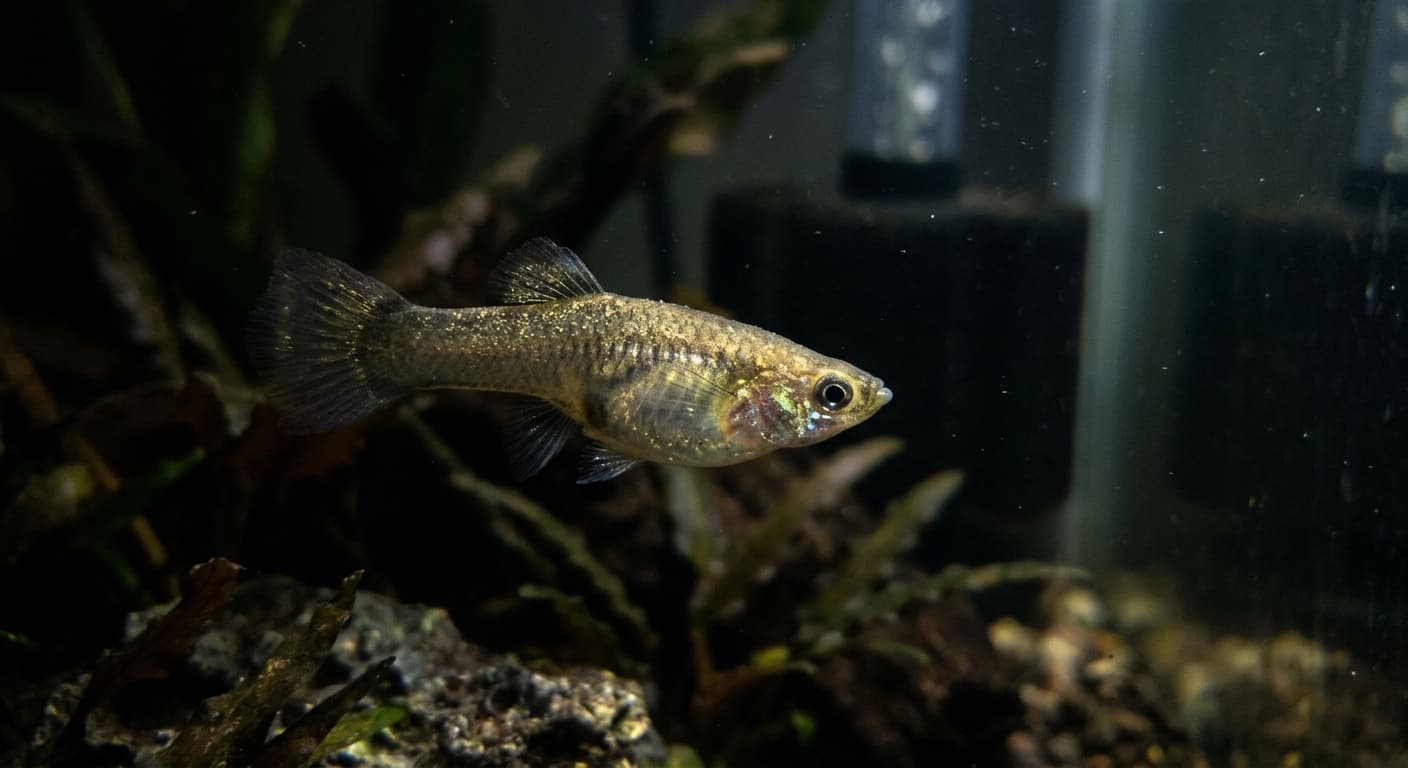
Velvet Disease in Fish: Faster Than Ich, and How to Treat It
Velvet disease looks similar to ich at first glance, but the parasite responsible (Oodinium pilularis) is different enough in biology and behavior that the treatment approach matters. Velvet is often missed until fish are already in serious distress because the early signs are subtle. Knowing what to look for and acting quickly determines whether you lose a few fish or the whole tank.
01
Is It Velvet? How to Tell
Velvet and ich both cause white or yellowish spots on fish, but the visual texture is distinctly different once you know what you are looking at.
Velvet appearance: A fine gold, rust, or yellowish dust covering the fins and body. Under a flashlight at an angle, the surface looks like the fish has been dusted with powder. The individual particles are smaller and more densely packed than ich spots, which look like grains of salt.
Ich appearance: Larger, more widely spaced white spots, each one roughly the size of a grain of coarse salt. Ich spots are more visible to the naked eye.
The flashlight test is important because velvet is frequently invisible in normal aquarium lighting. Hold a flashlight or phone flashlight close to the glass at a low angle while the rest of the room is dark. The gold or rust-colored dust becomes much more visible under directed light.
Behavioral signs: Fish scratching against surfaces (flashing), clamped fins, rapid breathing or gasping at the surface, lethargy, and loss of appetite. These symptoms appear before the dusting is visible in mild cases. If multiple fish in a tank start flashing simultaneously without obvious spots, test for velvet under low-angle light.
Velvet progresses faster than ich. In a warm tank, the parasite completes its life cycle in 1-3 days, compared to ich's 3-7 day cycle. A fish with mild symptoms can be critically affected within 48 hours.
02
What Causes Velvet and How It Spreads
Velvet is caused by the dinoflagellate parasite Oodinium pilularis (freshwater velvet) or Amyloodinium ocellatum (marine velvet). The freshwater species is semi-photosynthetic and requires light to complete part of its lifecycle.
The parasite has two phases: - Trophont phase: Attached to and feeding on the fish's skin and gills. Visible as the gold dust. This phase lasts 1-3 days. - Tomont phase: The parasite drops off, encysts, and divides into up to 250+ daughter cells called dinospores. This phase lasts 3-7 days at typical aquarium temperatures. - Dinospore phase: Free-swimming spores seeking a new host. This phase lasts 1-2 days before the spores die if no host is found.
Velvet is introduced through infected fish, live plants from contaminated water, or shared equipment. It can survive in equipment for several days. Quarantining new fish for 4 weeks catches most velvet cases before they reach the main tank. See the quarantine tank guide.
The semi-photosynthetic nature of the trophont phase is why darkening the tank is part of treatment. Reducing light slows the parasite's ability to sustain itself during the attached phase and inhibits dinospore development.
03
Treatment Protocol
Treat the whole tank, not just affected fish. Dinospores are microscopic and already in the water by the time you see symptoms.
Step 1: Dim or black out the tank immediately. Cover the tank with a towel or turn off tank lights entirely. Leave ambient low light only. The Oodinium parasite is photosynthetic and reducing light inhibits the trophont phase. This alone will not cure velvet but slows it and improves medication effectiveness.
Step 2: Raise temperature slowly to 82-84°F. Higher temperatures speed up the parasite's lifecycle, pushing it from the attached (treatment-resistant) phase to the free-swimming phase where medication can reach it. Raise by 1-2°F per hour to avoid stressing fish. Keep bettas and other heat-sensitive fish in mind. Do not push past 84°F.
Step 3: Treat with Seachem ParaGuard or copper-based medication. ParaGuard is effective against velvet and is gentler on biological filtration than copper. Dose according to label instructions. Remove activated carbon from the filter before treating. Copper-based treatments (like Cupramine) are more aggressive but require careful dosing and will kill invertebrates and plants.
Step 4: Maintain treatment for the full course. ParaGuard treatment is typically 2 weeks. Stopping early allows surviving tomonts to re-release dinospores and restart the infection. Continue even when fish appear fully recovered.
Water changes during treatment: Do a 25% water change before each re-dose. This removes dead parasites and keeps water quality stable during treatment.
Seachem ParaGuard
Effective against velvet, ich, and other external parasites. Gentler on biological filtration than copper treatments and safer for most fish species.
04
After Treatment and Prevention
After the treatment course finishes, run activated carbon in the filter for 48 hours to remove medication residue before adding any live plants or invertebrates.
Test water parameters before declaring the tank clear. Treatment medications sometimes stress biological filtration, especially copper-based products. If ammonia or nitrite appears after treatment, dose Seachem Prime and do partial water changes while the bacteria recover.
Preventing recurrence:
Quarantine all new fish. Four weeks in a separate tank lets velvet and other parasites run their course where they cannot spread to the main tank. A velvet infection that develops and is treated in a 10-gallon quarantine tank is far easier to manage than one in a 75-gallon community tank.
Avoid sharing equipment between tanks. Nets, siphon tubes, and buckets can carry dinospores. If equipment must be shared, let it air dry completely for 24 hours, or disinfect with a diluted bleach solution and rinse thoroughly.
Do not rely on fish "building immunity." Oodinium does not produce lasting immunity in fish. A fish that survives velvet can be reinfected.
Table of Contents
Related Content
Popular Fish Species
Essential Gear
Best Aquarium Test Kit for Freshwater Tanks
API Freshwater Master Test Kit
Frequently Asked Questions
Not sure what you're treating?
Match what you're seeing on the fish to the most likely cause before reaching for medication.
Open the fish symptom guide →A note on fish health advice
TankMinded shares guidance based on common hobbyist practice and published aquarium literature. We're not veterinarians. Individual cases vary, medications can interact with water chemistry in unpredictable ways, and advanced or persistent illness calls for an aquatic vet — the AAFV directory is a good place to start. Follow any treatment at your own discretion.
Sources & Further Reading
- Oodinium (Wikipedia)
Biology and lifecycle of the Oodinium dinoflagellate parasite responsible for velvet disease in freshwater and marine fish.
- Piscioodinium pillulare (FishBase)
Parasite database entry for freshwater velvet. FishBase documents host range and ecological distribution.
- FishBase Global Species Database
Reference for species-specific susceptibility and treatment parameter data cited in this guide.