How to Speed Up Tank Cycling (Without Crashing Later)
Standard fishless cycling takes 4-6 weeks. That is the honest answer. But there are legitimate shortcuts that cut this to 1-2 weeks without producing an unstable cycle that crashes a month later. This guide covers the methods that actually hold up.
01
Why Cycling Takes So Long (Quick Primer)
The nitrogen cycle works like this: ammonia from fish waste feeds Nitrosomonas bacteria, which convert it to nitrite. Then Nitrospira bacteria convert nitrite to nitrate, which is less toxic and removed with water changes. The bottleneck is growing enough of both bacterial types to handle your fish load.
Bacterial colonies double roughly every 24 hours under good conditions. That math explains the 4-6 week timeline. You are waiting on biology, not chemistry.
If you need a full walkthrough of the cycle, see how to cycle a tank. If you already understand it and just want the shortcuts, read on.
02
Method 1: Seeded Filter Media (Most Reliable)
If you know someone with an established, disease-free tank, this is the fastest method available. Pull some filter media from their running filter and drop it in yours. You are transplanting a live bacterial colony, not starting from scratch.
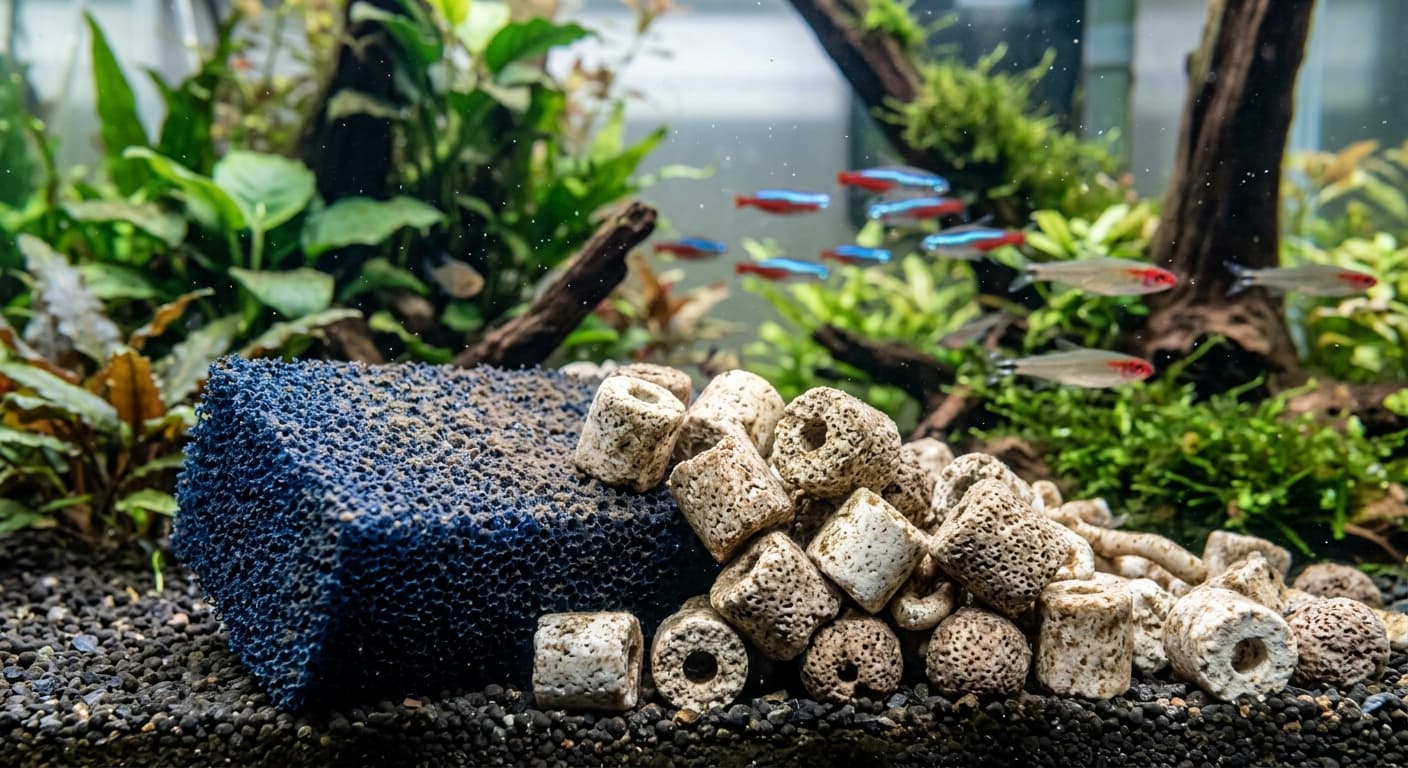
Any porous media works: sponge, ceramic rings, bio-balls. Even a handful of gravel from the donor tank helps. The bacteria live in the media, not the water. A single sponge from a healthy cycled filter can bring your cycle down to 3-7 days instead of 4-6 weeks.
How to do it: get the media wet with water from the donor tank, transfer it directly to your new filter, and do not rinse or dry it. Rinsing with tap water kills the bacteria you are trying to move. Start dosing ammonia the same day. Test every 1-2 days.
Two things to confirm before using donor media. First, make sure the donor tank is disease-free. Ich, velvet, and bacterial infections can transfer on wet equipment. Second, get the media into your filter within a few minutes of removing it. Extended air exposure will reduce colony viability.
03
Method 2: Bottled Bacteria That Works
Most bottled bacteria products do not work. The common failure modes are: wrong bacterial strains that cannot establish in a tank, cultures that died on the shelf, or live bacteria killed by chlorine in your tap water before you dechlorinate.
Fritz FritzZyme 7 is the most consistently effective freshwater option. It contains live Nitrosomonas and Nitrospira, the two strains your tank actually needs. Fritz refrigerates and ships cold specifically to keep those cultures alive. Other products use heat-resistant strains or inactive spores that perform poorly in aquarium conditions.
Tetra SafeStart also works, but with a catch: it is designed to be used when you add fish, not during a fishless cycle. If you use it with pure ammonia and no fish, results are inconsistent. Use it the way Tetra instructs, which means cycling with fish. API Quick Start has mixed reviews and the evidence for it is weak.
How to use Fritz ZyMe 7: dechlorinate your water first, always. Then add the full recommended dose based on tank volume. Add an ammonia source immediately (pure ammonia or fish food). Wait 48-72 hours before testing. The bacteria need time to establish before you will see ammonia processing.
Chlorine and chloramine in tap water kill the bacteria you just added. If you skip dechlorination, you are wasting the product.
Fritz FritzZyme 7 Live Nitrifying Bacteria
Contains actual live Nitrosomonas and Nitrospira, not dead cultures. Ships refrigerated and establishes in 24-48 hours when used with an ammonia source.
04
Method 3: Combine Both for the Fastest Results
If you have access to seeded media AND a bottle of Fritz ZyMe 7, use both. The seeded media gives you an immediate established colony; the bottled bacteria fills gaps and supplements where the donor colony is thin.
With both methods working together, a lightly stocked tank can reach a stable cycle in 3-5 days. This is about as fast as the biology allows.
Step-by-step combined approach:
- Dechlorinate your new tank water thoroughly before anything else.
- Add the donor filter media to your new filter immediately after transfer.
- Dose Fritz ZyMe 7 per the bottle instructions for your tank size.
- Add an ammonia source right away. Pure ammonia (unscented, without surfactants) at 2-4 ppm is ideal for fishless cycling.
- Maintain water temperature between 76-82F. Bacterial growth slows significantly below 72F and stops below 60F.
- Test ammonia and nitrite every 24-48 hours.
- Once you see ammonia dropping and nitrite rising, the cycle is moving. You are looking for both to hit zero.
05
How to Know When Your Cycle Is Complete
The cycle is done when ammonia reads 0 ppm, nitrite reads 0 ppm, and nitrate is rising. That third condition matters. Rising nitrate confirms that the end of the cycle is running, not just that there is no ammonia source left.
Do not add fish until you get two consecutive 0/0 readings 24 hours apart. One clean test can be a fluke. Two in a row is a pattern.
Test strips are not reliable enough for cycling. The API Freshwater Master Test Kit uses liquid reagents that read ammonia, nitrite, nitrate, and pH accurately. During cycling, accuracy matters. A strip that reads 0 when ammonia is actually 0.25 ppm will have you adding fish too early.
Specific thresholds to watch: ammonia should drop to 0 within 24 hours of dosing, nitrite should peak and then fall to 0, and nitrate should be measurable in some amount. If nitrate is still at absolute zero and ammonia is also zero, you may not have dosed enough ammonia to register the full cycle.
API Freshwater Master Test Kit
Tests ammonia, nitrite, nitrate, and pH with liquid reagents. More accurate than test strips and covers everything you need during cycling.
06
What to Do If It Stalls
A stalled cycle shows the same ammonia and nitrite readings for 5 or more days without movement. Here are the common causes and how to fix each.
Temperature too low. Below 72F, Nitrospira in particular slow down substantially. Below 60F, both bacterial types stop processing. Check your thermometer, not just your heater setting. If the tank is in a cold room or on a cold floor, the water temperature may be lower than the heater reads. Raise temp to 76-80F and wait 48 hours.
pH crash. Nitrifying bacteria need pH above 7.0 to function well. During cycling, nitrite and nitric acid production can lower pH, which then slows the bacteria responsible for clearing that same nitrite. Test pH. If it is below 7.0, add a small amount of baking soda to bring it back up, or do a partial water change with dechlorinated water.
Chlorine or chloramine in tap water. If you are doing water changes and not dechlorinating properly, you are killing your colony with each change. Use a dechlorinator that neutralizes chloramine, not just chlorine. Seachem Prime handles both and is widely available.
Not enough ammonia. The bacteria need a consistent ammonia source to grow and maintain a colony. If you are not dosing regularly, the colony shrinks. During fishless cycling, target 2-4 ppm ammonia every 24-48 hours.
If all four of those are fine and the cycle is still stuck, re-dose Fritz ZyMe 7 and wait another 48 hours before testing again.
Table of Contents
Related Content
Popular Fish Species
Essential Gear
Best Aquarium Test Kit for Freshwater Tanks
API Freshwater Master Test Kit
Frequently Asked Questions
Sources & Further Reading
- Hovanec, T.A. and DeLong, E.F. (1996): Comparative analysis of nitrifying bacteria
Foundational research identifying Nitrospira rather than Nitrobacter as the dominant nitrite-oxidizing genus in aquarium biofilters, which informs why bacterial products using Nitrospira strains outperform older formulations.
- Fritz Aquatics FritzZyme 7 Product Documentation
Manufacturer documentation on bacterial strains, storage requirements, and dosing protocols referenced in this guide.
- Aquarium Science: Nitrogen Cycle Research Summary
Comprehensive review of aquarium nitrogen cycle research, temperature and pH effects on bacterial growth rates, and analysis of commercial nitrifying bacteria products.