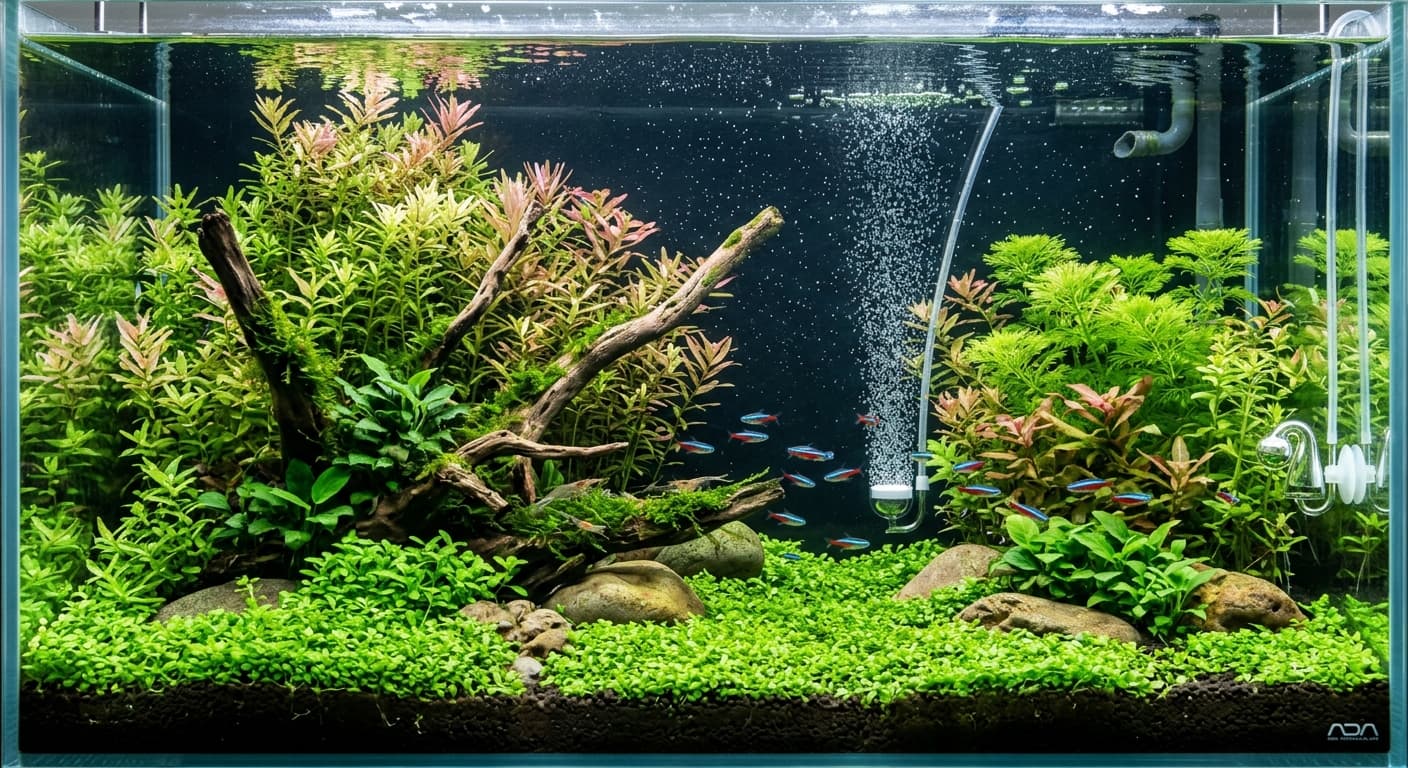
CO2 for Planted Tanks: Do You Need It and How to Add It
CO2 supplementation is where planted tanks split into two camps: low-tech tanks that run on ambient CO2 and natural nutrients, and high-tech tanks that inject CO2 to push faster growth and support demanding plants. Neither approach is wrong. A low-tech tank with the right plants can look just as good as a pressurized CO2 setup. It just looks different. This guide covers how CO2 works in planted tanks, the three main ways to supplement it, and how to decide whether your tank actually needs it.
01
Why CO2 Matters for Plant Growth
Plants photosynthesize using light, CO2, and water to produce sugars. Of the three, CO2 is usually the limiting factor in a planted aquarium.
Ambient CO2 in aquarium water comes from fish respiration, bacterial activity, and gas exchange with the atmosphere. In a fish-stocked tank, this provides roughly 3-5 ppm of dissolved CO2, enough to sustain slow-growing plants like anubias, java fern, and java moss. Demanding plants like stem plants, carpeting plants, and red plants need 15-30 ppm CO2 to grow well.
When CO2 is the limiting factor, plants grow slowly, leave room for algae to establish, and may show deficiency symptoms even in nutrient-rich water. Adding CO2 to a tank with sufficient light and nutrients can double or triple plant growth rates and dramatically reduce algae.
CO2, light, and nutrients all have to be in balance. Pumping more light into a low-CO2 tank does not make plants grow faster. It makes algae grow faster. CO2 injection is most effective when paired with appropriate lighting and a complete fertilizer routine.
02
Do You Need CO2?
Most planted tanks do not need CO2 injection to succeed. The question is what plants you want to grow and what the tank is supposed to look like.
Low-tech tanks without CO2 work well for: - Slow-growing plants (anubias, java fern, java moss, bolbitis, most cryptocorynes) - Floating plants (frogbit, duckweed, water sprite, which access atmospheric CO2 directly) - Simple planted backgrounds rather than dense scaping - Tanks where low maintenance is the goal
CO2 injection makes a significant difference for: - Carpeting plants (Monte Carlo, dwarf baby tears, glossostigma) that require dense, fast growth to fill in before algae takes over - Red and orange stem plants that show poor coloration without adequate CO2 - High-light tanks where plant growth needs to keep up with the light or algae wins - Dutch or nature aquarium styles with demanding, fast-growing plants in complex layouts
If you are keeping low-maintenance plants and are happy with steady slow growth, skip CO2. If you want a dense carpet or are struggling with algae in a high-light tank, CO2 injection will likely solve the problem.
03
Three Ways to Add CO2
1. Pressurized CO2 (best results, highest cost)
A pressurized system uses a CO2 cylinder, regulator, solenoid valve, bubble counter, and diffuser. The regulator reduces high-pressure CO2 from the tank to a controllable flow. The solenoid connects to a timer and turns the system off at night when plants do not photosynthesize. A diffuser dissolves the CO2 into fine bubbles in the water.
A drop checker (a small glass device filled with pH-sensitive solution that changes color based on dissolved CO2) provides a visual indicator of CO2 concentration without constant testing.
Pressurized CO2 is the most reliable method: stable bubble rate, consistent CO2 concentration, and easy to dial in. A basic setup (5lb cylinder, regulator, diffuser) runs $100-200 upfront. CO2 refills cost $15-30 for a 5lb tank and last 2-4 months on a 20-gallon tank.
2. DIY yeast CO2 (low cost, less stable)
A DIY setup ferments a sugar/yeast/water mixture in a bottle, with a tube running to a diffuser in the tank. CO2 produced by yeast fermentation enters the water continuously.
Cost is very low (a few dollars for bottles and airline tubing, sugar and yeast from the grocery store). The downsides: CO2 output fluctuates as yeast culture rises and falls, the mixture needs refreshing every 2-4 weeks, and the output is harder to control. DIY CO2 works well for small tanks (under 20 gallons) where the inconsistency is less impactful. It is also a good way to test whether CO2 makes a visible difference in your tank before investing in pressurized equipment.
3. Liquid carbon (CO2 substitute, limited effectiveness)
Products like Seachem Flourish Excel are often called "liquid CO2" but do not actually add dissolved CO2 to the water. They contain glutaraldehyde, which is a carbon source plants can absorb through their leaves. It provides some benefit to planted tanks, particularly for algae control, but is not equivalent to CO2 injection for growth rate or plant health.
Liquid carbon is useful as a daily supplement in low-tech tanks and as an algae control measure. It should not be dosed heavily (it is toxic to some plants and fish at overdose). It is not a substitute for CO2 injection if you want to grow demanding plants.
Seachem Flourish Excel
Liquid carbon source for low-tech planted tanks. Not equivalent to CO2 injection but provides a bioavailable carbon supplement and helps control algae at normal dosing.
04
CO2 Safety and Overdose
The main risk of CO2 injection is overdosing. CO2 replaces oxygen in fish gills at high concentrations and can kill fish before you notice a problem.
Signs of CO2 overdose: fish gasping at the surface, swimming erratically, loss of balance. If you see these symptoms, increase surface agitation immediately (point a powerhead at the surface or raise the filter outflow to create ripples). Turn off the CO2. The fish will usually recover within minutes of increased surface gas exchange.
A drop checker showing green indicates approximately 30 ppm CO2, which is the target range. Yellow means too much CO2; blue means too little.
CO2 at night: Turn CO2 off during the night using a timer connected to the solenoid. Plants do not photosynthesize at night and cannot use CO2. The CO2 builds up in the water and can overdose fish overnight if left running.
Typical safe CO2 targets: 15-30 ppm during photoperiod, 0 ppm overnight. A good rule of thumb: if fish show any unusual behavior within an hour of the CO2 turning on in the morning, reduce the bubble rate.
Table of Contents
Related Content
Popular Fish Species
Essential Gear
Best Aquarium Test Kit for Freshwater Tanks
API Freshwater Master Test Kit
Frequently Asked Questions
Sources & Further Reading
- Aquatic plant — Wikipedia
Overview of aquatic plant biology including photosynthesis, CO2 uptake mechanisms, and growth requirements.
- Carbon dioxide in fish farming — Wikipedia
CO2 toxicity thresholds in aquatic environments and effects on fish respiration.
- FishBase — Global Species Database
Reference for species-specific water parameter data, including oxygen and CO2 tolerance ranges.