How Much Does a Betta Fish Cost? A Realistic Budget Breakdown
A betta can be one of the more affordable fish to keep correctly. The word "correctly" is doing a lot of work in that sentence. A $5 fish in a $10 vase from the dollar store will cost you more in vet bills, early replacement, and frustration than a properly set up 10-gallon tank. Here is what the numbers actually look like.
01
One-Time Setup Costs
Before your betta comes home, you need a tank that will not slowly kill it. The minimum is a 5-gallon tank with a filter and heater. A 10-gallon is a better target because the extra water volume makes temperature and water quality easier to maintain.
Here is what a basic setup requires and what each item costs at current retail:
- Tank (5-gallon): $15-30. A 10-gallon runs $20-40.
- Filter: $15-35 for a small hang-on-back or sponge filter appropriate for a betta.
- Heater: $15-30. Do not skip this. Bettas need 76-80°F consistently.
- Lid and light: $10-25 if not included in a kit. A lid is not optional. Bettas jump.
- Thermometer: $5-10. A stick-on strip thermometer works. A glass submersible is more accurate.
- Water conditioner: $8-12 for a bottle of Seachem Prime. It lasts a long time at correct doses.
- Substrate (optional): $5-15 for gravel or sand. Plain gravel from any pet store works fine.
If you want to skip the component-by-component approach, the Aqueon 10 Gallon LED Starter Kit bundles the tank, filter, LED hood, and lid into one box at a price that undercuts buying each piece separately. You will still need to add a heater separately, but it covers everything else a beginner needs to get started.
Aqueon 10 Gallon LED Aquarium Starter Kit
Includes tank, filter, LED light, and lid in one box. You still need a heater, but this covers everything else a beginner needs.
02
What You Need vs. What Stores Push
Walk into any pet store and you will find an entire shelf of betta-branded products. Most of them are not worth buying.
Things stores push that you do not need:
- Betta bowls and vases: These do not have adequate volume, filtration, or heating capacity. A betta in a bowl lives a shorter, harder life.
- Mini "betta kits" under 5 gallons: Anything sold as a betta starter kit smaller than 5 gallons is not a good setup. It is a product designed around what looks cheap and cute at the register, not what the fish needs.
- Gravel vacuums sold for nano setups: A small bare-bottom or lightly planted tank does not need a dedicated gravel cleaner. A simple turkey baster handles debris in a 5-gallon.
- Betta conditioner, betta pH drops, betta "stress coat" add-ons: Most of these are redundant if you are already using a quality conditioner like Seachem Prime.
Things stores often downplay that actually matter:
- A proper heater: This is the item most commonly omitted from beginner setups, and it is the one most likely to kill your fish. Room temperature in most homes fluctuates too much. Bettas need a stable 76-80°F.
- A nitrogen cycle: A new tank with no established bacteria will spike ammonia quickly. Either use a bacterial supplement (Seachem Stability works) or plan to do more frequent water changes while the tank cycles.
- A lid: Bettas are strong jumpers. A gap in the lid or a lidless tank is a risk. Most starter kits include a lid. If yours does not, find one.
- A thermometer: You cannot eyeball water temperature. A $5 thermometer removes all guesswork.
03
The Fish Itself
Betta fish prices vary widely depending on where you buy and what variety you choose.
A standard pet store betta from PetSmart or Petco runs about $4-15. These are typically veil tail or halfmoon bettas bred for mass sale. They are not inferior fish. A healthy $6 betta in a good tank will live as long as a $60 show-quality betta in the same conditions.
Fancy varieties cost more. Halfmoon doubletail, dumbo ear (elephant ear), koi pattern, and dragonscale bettas from specialty breeders or boutique fish stores can run $20-100 or more. The prices reflect the selective breeding required, not a meaningfully different fish.
For most people starting out, a $6-15 pet store betta makes more sense than spending extra on a rare variety before you know the hobby well. A fish that dies in a poorly maintained tank is expensive regardless of what you paid for it.
Local fish store vs. big box: Fish from a dedicated aquarium store (LFS) are typically less stressed and more reliably healthy than fish from a chain pet store. Chain stores receive fish in bulk through long shipping chains. An LFS with a knowledgeable buyer selects better stock and usually maintains it more carefully. If you have one nearby, it is worth the slightly higher price.
Buying from breeders online: Reputable breeders sell bettas shipped overnight. The fish often arrive in better shape than store fish because they come from maintained breeding stock. Expect to pay $15-50 plus $15-25 for overnight shipping.
04
Recurring Monthly Costs
Once the tank is set up and running, ongoing costs are modest.
Food: A small container of quality betta pellets lasts 2-3 months for one fish. Budget $3-8 per month if you are buying a fresh container that often, though most people spend less because a container goes a long way. Freeze-dried bloodworms or brine shrimp as an occasional treat add a small amount to that.
Water conditioner: A bottle of Seachem Prime dosed correctly lasts a very long time. For a 10-gallon tank, you are using a few drops per water change. Budget $1-2 per month.
Electricity: Running a heater, small filter, and LED light on a 10-gallon tank costs roughly $2-5 per month depending on your local electricity rate and how many hours the light runs.
Water test kit: The API Freshwater Master Test Kit is a one-time purchase of roughly $25-30 that lasts 1-2 years. It is not a monthly recurring cost, but you will want one. Test strips are inaccurate and waste money in the long run.
Total ongoing for a single betta: roughly $6-15 per month.
API Freshwater Master Test Kit
Tests ammonia, nitrite, nitrate, and pH. Liquid reagent tests are more accurate than strips and this kit lasts over a year.
05
What a Cheap Setup Costs You
The math on cutting corners is worth understanding before you decide what to buy.
A betta kept in a small, unheated, uncycled bowl is significantly more likely to develop disease. Fin rot from poor water quality is the most common result. Ich shows up when temperature fluctuates. A stressed fish in marginal conditions typically lives 1-2 years. The same species in a proper 10-gallon with stable temperature and good water quality routinely lives 4-5 years.
When disease hits, treatment is not free. A round of ich treatment or medication for fin rot runs $10-20 per course. Multiple rounds over a year add up quickly. Then factor in the possibility of replacing the fish if it does not recover.
A rough comparison:
- Budget bad setup: $20 for a tiny kit, then $15-30 in treatments across the year, then likely fish replacement. You spend $50-80 and have a sick fish most of the time.
- Budget good setup: $80-120 for a proper 10-gallon setup, then $6-10 per month ongoing, and a healthy fish that lives for years. Year one total: $150-240, but the fish is actually alive and not requiring constant intervention.
The upfront cost difference is real. The long-run math favors doing it right from the start.
06
Budget Breakdown by Tier
Here is how the numbers break down across three realistic setup approaches:
Budget (minimum viable, 5-gallon) - Setup cost: $50-80 - Ongoing: $5-10 per month - Notes: Gets the job done. Requires more attentive water change schedule because smaller tanks swing faster. Still needs a heater.
Comfortable (10-gallon, quality equipment) - Setup cost: $100-150 - Ongoing: $8-12 per month - Notes: This is the sweet spot for most people. The extra water volume makes the tank more forgiving, the fish is less stressed, and the setup is stable enough to leave for a few days without crisis.
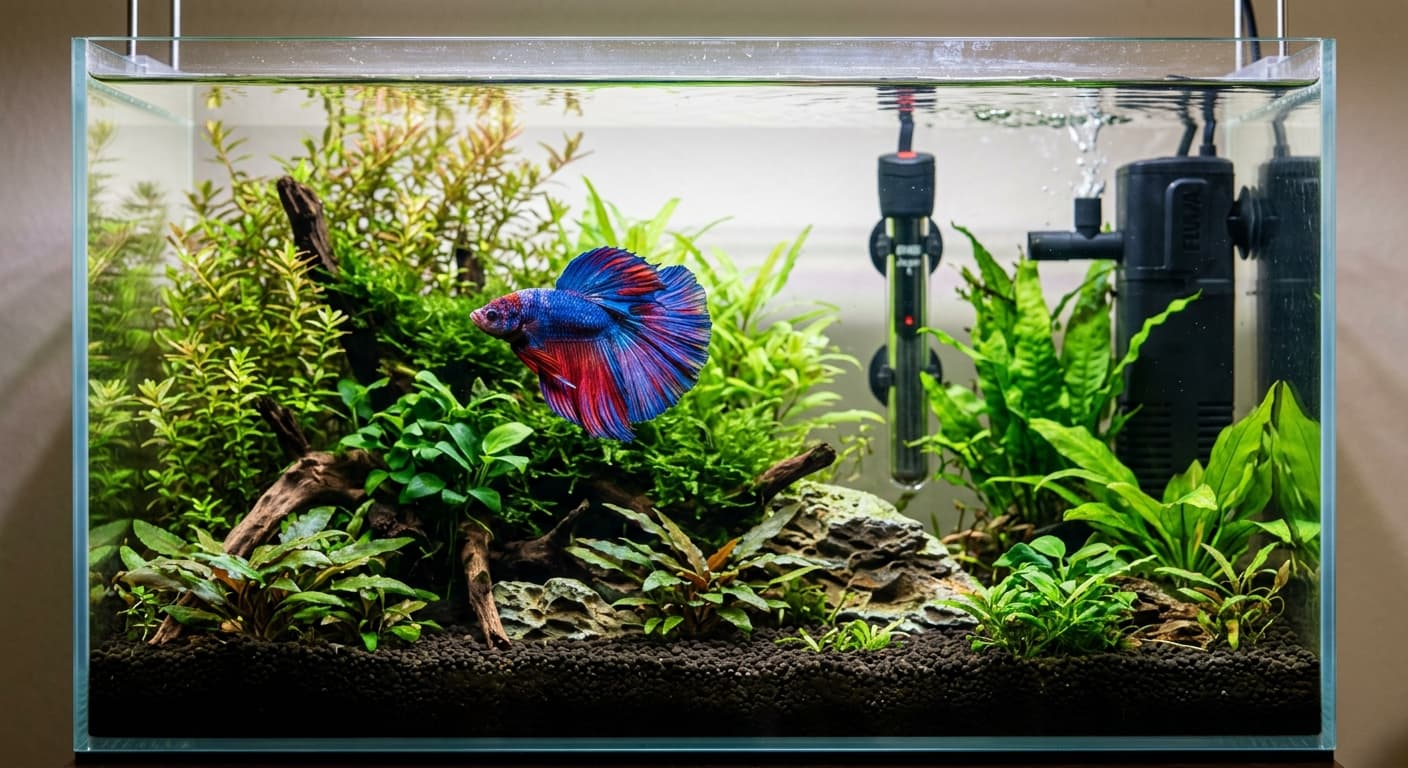
Premium (10+ gallon, planted, quality heater and filter) - Setup cost: $200-400 - Ongoing: $10-20 per month - Notes: A planted tank with a quality heater, canister or solid hang-on-back filter, and proper lighting. The fish thrives. The tank looks good. Ongoing costs are slightly higher because of CO2 supplementation or specialized plant fertilizers if you go that route, but it is still inexpensive for a hobby.
The middle tier is where most people land after their first tank. Start there if you can.
07
Where to Save vs. Where to Spend
Not everything requires full retail price, and not everything is a good place to cut costs.
Where it is fine to save:
- Substrate: Plain aquarium gravel or pool-filter sand works as well as any specialty substrate for a betta tank. No need to buy expensive planted substrate unless you are building a heavily planted setup.
- Decorations: Bettas do not care about brand names. Secondhand decorations from Facebook Marketplace, clean rocks from outdoors, or dollar store ceramic pieces work fine. Rinse well and avoid anything with paint that might leach into water.
- The tank itself: Used tanks from Facebook Marketplace or Craigslist are often free or very cheap. A 10-gallon tank in good condition with no cracks is a 10-gallon tank. Buy used, inspect for leaks, save the money for equipment.
Where spending more matters:
- The heater: Cheap heaters fail, and when they fail, they often fail stuck on or stuck off. Both outcomes can kill fish. A reliable brand like Aqueon or Eheim is worth the price difference. Replace any heater that starts reading inconsistently.
- Water conditioner: Use Seachem Prime or a similarly concentrated dechlorinator. Off-brand conditioners often require larger doses to be effective and can leave chloramine behind. A bottle of Prime costs a little more upfront and lasts far longer.
- The test kit: Test strips give inaccurate readings, especially for ammonia. A liquid test kit like the API Master Test Kit costs more upfront but gives you accurate numbers when something is wrong in the tank. Accurate information is not a place to cut corners.
Table of Contents
Related Content
Popular Fish Species
Essential Gear
Best Filter for a 20 Gallon Tank
Aquaneat 3-Pack Biosponge Filter
Best Aquarium Heater for Fish Tanks
Hitop Adjustable Aquarium Heater
Frequently Asked Questions
Sources & Further Reading
- Betta splendens care overview — Fishbase
Species data including native temperature range, habitat conditions, and biological parameters referenced in this guide.
- Aquarium nitrogen cycle basics — University of Florida IFAS Extension
Water quality and biological filtration guidance referenced in the setup and cycling sections.
- Amazon Associates program policies
Affiliate link formatting and content policies followed throughout this guide.